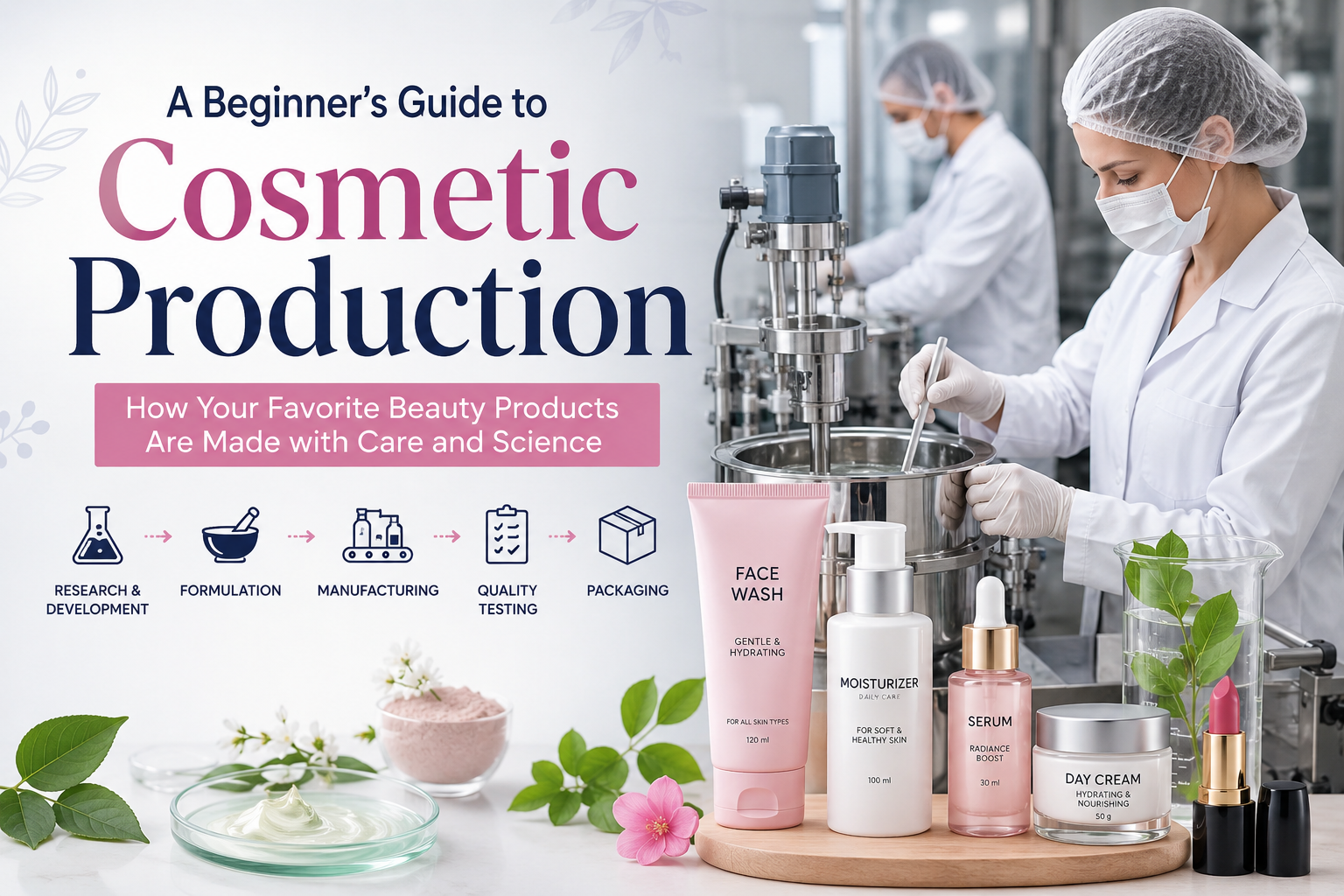
The cosmetic industry is one of the fastest-growing industries in the world. From skincare and makeup to hair care and fragrances, cosmetic products have become a part of everyday life for millions of people. Whether someone wants healthier skin, shiny hair, or simply enjoys expressing themselves through beauty products, the cosmetic industry offers solutions for every need.
However, many people only see the finished product sitting on a store shelf. Behind every moisturizer, lipstick, sunscreen, or shampoo is an entire ecosystem of research, product development, manufacturing, testing, branding, marketing, and distribution.
If you’re new to beauty products or planning to start a beauty business, this guide will help you understand how the cosmetic industry works in simple language.
What Is the Cosmetic Industry?
The cosmetic industry is a global business sector that develops, manufactures, markets, and sells products designed to improve or maintain a person’s appearance, hygiene, and overall beauty.
Unlike medicines, cosmetic products are primarily intended to clean, beautify, protect, or enhance the appearance of the skin, hair, nails, lips, and body.
Common cosmetic products include:
Face cleansers
Moisturizers
Sunscreens
Lipsticks
Foundations
Face serums
Hair oils
Shampoos
Conditioners
Perfumes
Body lotions
Nail polish
Face masks
Deodorants
Today, cosmetics are used by people of all ages and genders across every region of the world.
The beauty industry continues to expand because consumer needs and preferences are constantly evolving.
Several factors contribute to this growth:
Growing Awareness of Skincare
People now understand the importance of maintaining healthy skin rather than simply covering imperfections with makeup.
Social Media Influence
Platforms like Instagram, YouTube, and TikTok have transformed how consumers discover new beauty products.
Beauty creators regularly share:
Product reviews
Skincare routines
Makeup tutorials
Ingredient education
Before-and-after results
This has significantly increased product awareness.
Innovation
Every year, companies introduce new technologies such as:
Lightweight sunscreens
Long-lasting makeup
Vegan formulations
Waterless beauty products
Skin barrier repair formulas
AI-powered skincare recommendations
Rising Disposable Income
As incomes improve, consumers are willing to invest more in premium skincare and beauty products.
Main Categories of Cosmetic Products
The cosmetic industry includes many product categories.
1. Skincare
Skincare is currently the largest segment of the beauty industry.
Popular products include:
Face wash
Cleansers
Moisturizers
Toners
Serums
Face oils
Sunscreens
Night creams
Eye creams
Face masks
The primary goal is to maintain healthy, hydrated, and protected skin.
2. Makeup
Makeup products enhance facial features and create different looks.
Examples include:
Foundation
Concealer
Compact powder
Blush
Bronzer
Highlighter
Eyeshadow
Eyeliner
Mascara
Lipstick
Lip gloss
3. Hair Care
Hair care products help cleanse, nourish, and protect hair.
Popular products include:
Shampoo
Conditioner
Hair serum
Hair oil
Hair masks
Hair sprays
Styling creams
4. Personal Care
These products support everyday hygiene.
Examples include:
Soap
Body wash
Deodorant
Hand wash
Body lotion
Intimate hygiene products
5. Fragrance
This category includes:
Perfumes
Eau de Toilette
Body mist
Cologne
6. Nail Care
Products include:
Nail polish
Nail remover
Nail treatments
Cuticle oils
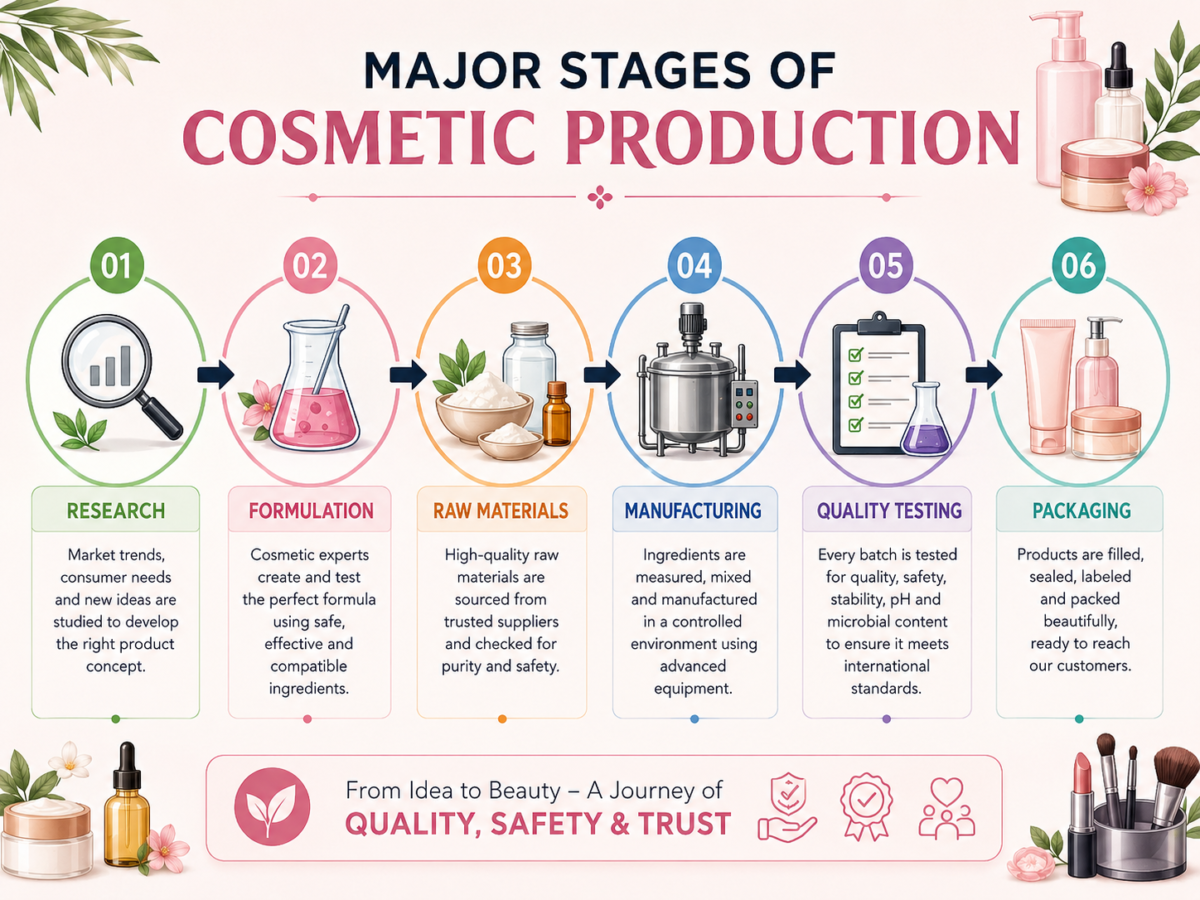
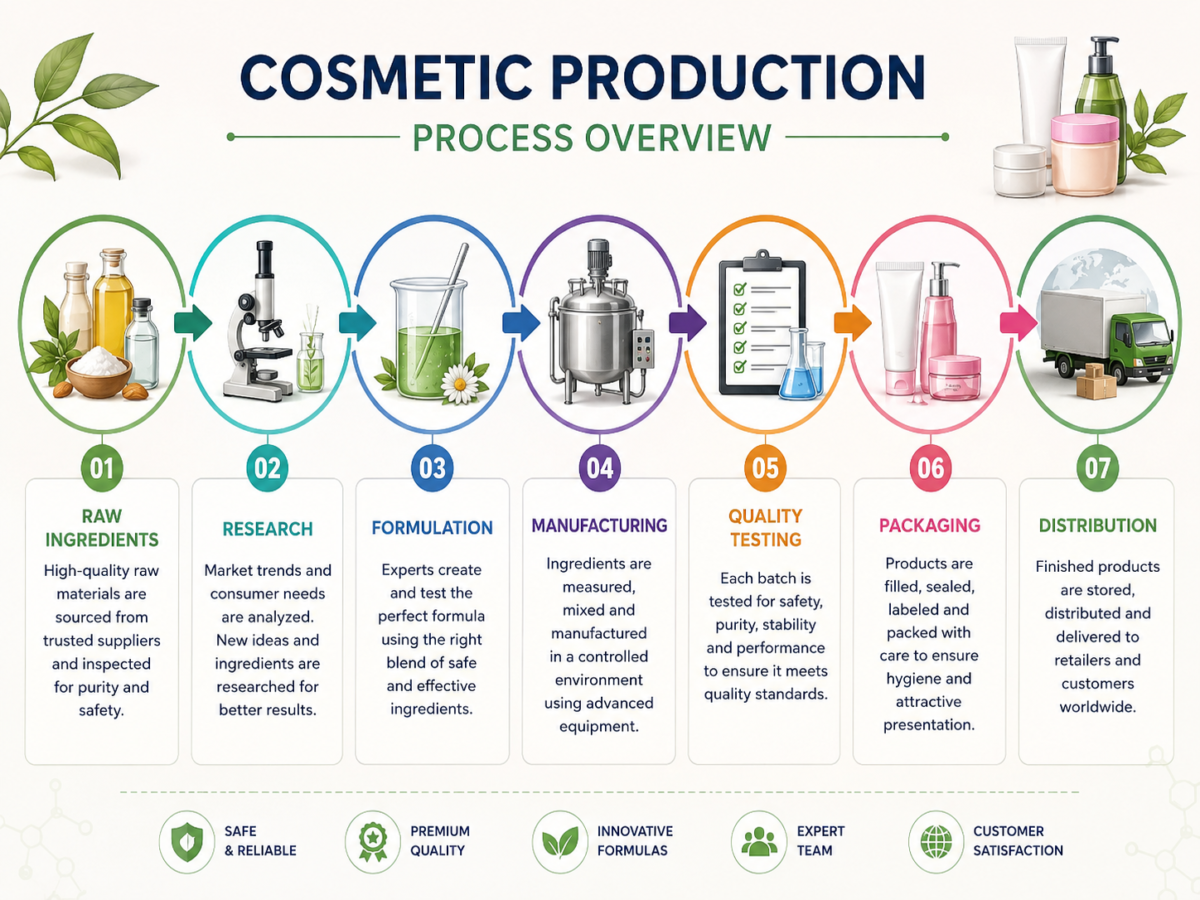
How Are Cosmetic Products Made?
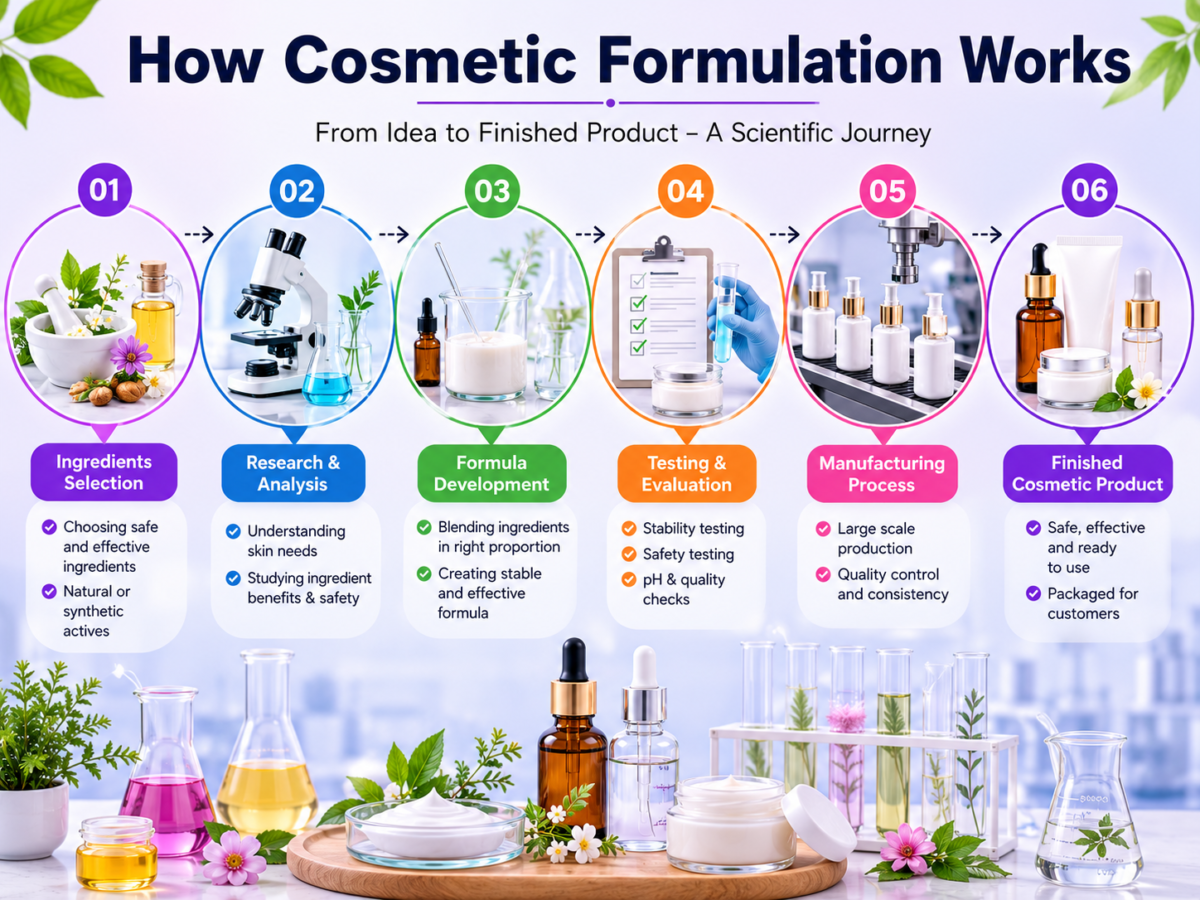
Creating a cosmetic product involves several important stages.
Step 1: Market Research
Companies first identify consumer problems.
Examples:
Dry skin
Acne
Pigmentation
Hair fall
Frizzy hair
Step 2: Product Formulation
Cosmetic chemists develop formulas by selecting safe ingredients that work well together.
This stage determines:
Texture
Stability
Performance
Shelf life
Step 3: Laboratory Testing
Products undergo multiple tests, including:
Stability testing
Compatibility testing
Microbial testing
Safety evaluation
Step 4: Packaging Design
Packaging protects the product while also attracting customers.
Popular packaging includes:
Glass bottles
Airless pumps
Tubes
Jars
Droppers
Step 5: Manufacturing
Products are manufactured under strict quality standards before being filled into containers.
Step 6: Quality Control
Every batch is checked for:
Appearance
Color
Fragrance
Texture
pH level
Performance
Step 7: Distribution
Finished products reach customers through:
Online stores
Retail shops
Pharmacies
Beauty stores
Brand websites
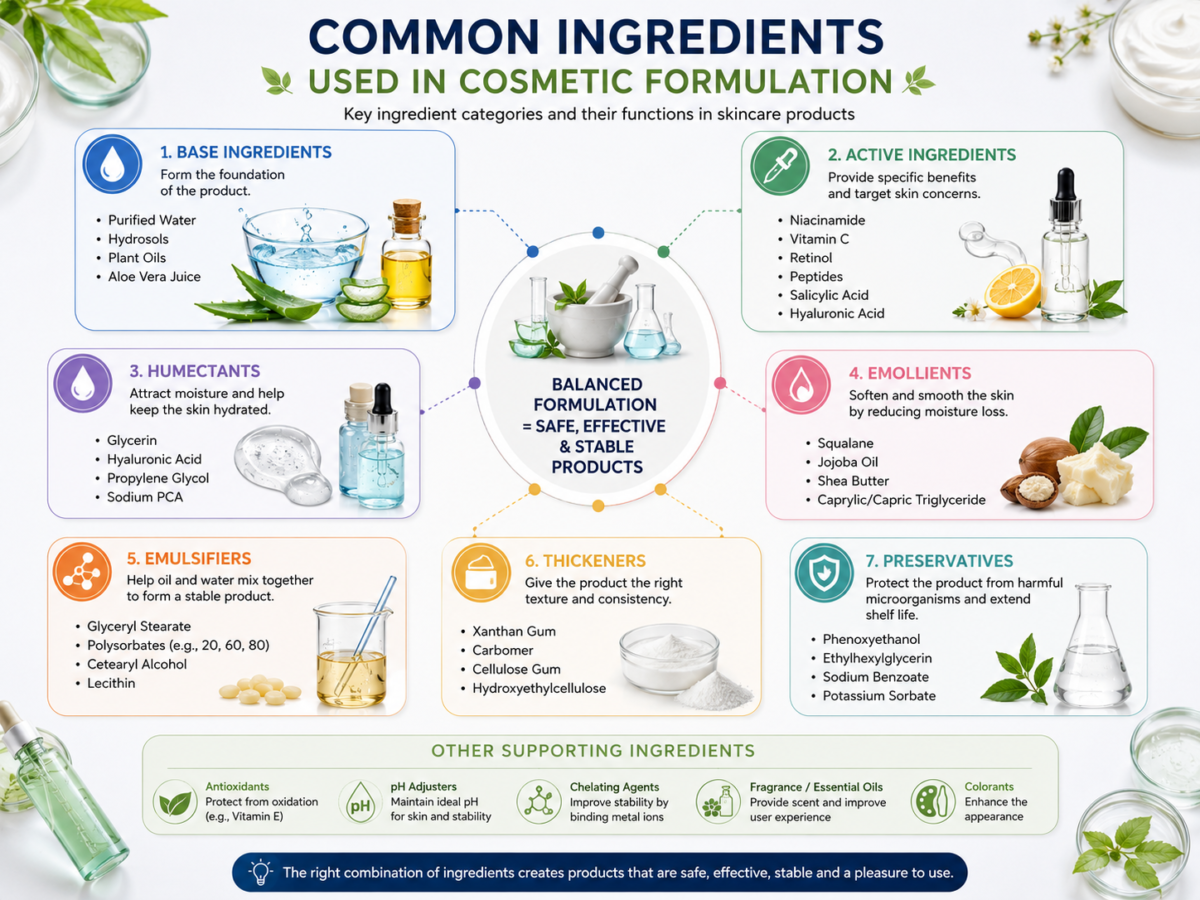
Common Ingredients Used in Cosmetics
Ingredients determine how well a product performs.
Some commonly used ingredients include:
Hyaluronic Acid
Helps retain moisture and deeply hydrates the skin.
Niacinamide
Improves uneven skin tone and strengthens the skin barrier.
Vitamin C
Brightens dull skin and supports collagen production.
Ceramides
Help repair and protect the skin barrier.
Salicylic Acid
Useful for oily and acne-prone skin.
Kojic Acid
Often used for pigmentation and dark spots.
Aloe Vera
Provides soothing and calming benefits.
Glycerin
A powerful humectant that attracts moisture to the skin.
Natural vs Synthetic Ingredients
Many consumers wonder which option is better.
Natural Ingredients
Examples:
Aloe Vera
Green Tea
Shea Butter
Coconut Oil
Advantages:
Plant-based
Popular among clean beauty enthusiasts
Limitations:
Shorter shelf life
May vary depending on harvest quality
Synthetic Ingredients
These are scientifically developed for consistency and stability.
Advantages:
Reliable quality
Better stability
Longer shelf life
Consistent performance
A cosmetic product can safely contain both natural and synthetic ingredients when formulated correctly.
How Are Cosmetics Regulated?
Every country has regulations to help ensure cosmetic products are safe for consumers.
Manufacturers must typically:
Use approved ingredients
Follow manufacturing standards
Label ingredients correctly
Ensure product safety
Avoid misleading claims
Consumers should always purchase cosmetics from reputable brands and trusted sellers.
Cosmetic Industry Trends in 2026
The beauty industry continues to evolve rapidly.
Some major trends include:
Clean Beauty
Consumers increasingly prefer products made without unnecessary ingredients.
Sustainable Packaging
Brands are reducing plastic waste by using:
Recyclable packaging
Refillable containers
Eco-friendly materials
Vegan Cosmetics
Many products are now developed without animal-derived ingredients.
Cruelty-Free Beauty
Consumers increasingly look for products that are not tested on animals where applicable.
Personalized Skincare
Technology now allows brands to recommend products based on individual skin concerns.
Skin Barrier Care
Products containing ceramides, panthenol, and soothing ingredients remain highly popular.
Career Opportunities in the Cosmetic Industry
The cosmetic industry offers exciting careers beyond makeup artistry.
Popular career options include:
Cosmetic Chemist
Product Development Specialist
Quality Control Executive
Regulatory Affairs Specialist
Packaging Designer
Marketing Executive
Beauty Consultant
Dermatology Sales Executive
Research Scientist
Brand Manager
Cosmetic Content Writer
Beauty Influencer
Product Photographer
E-commerce Manager
The industry combines science, creativity, technology, and business, making it suitable for people with diverse skills.
Challenges Facing the Cosmetic Industry
Despite its growth, the industry faces several challenges.
These include:
Counterfeit beauty products
Greenwashing claims
Ingredient misinformation
Packaging waste
Supply chain disruptions
Regulatory compliance
Rising consumer expectations
Companies that focus on transparency and quality are better positioned to earn long-term customer trust.
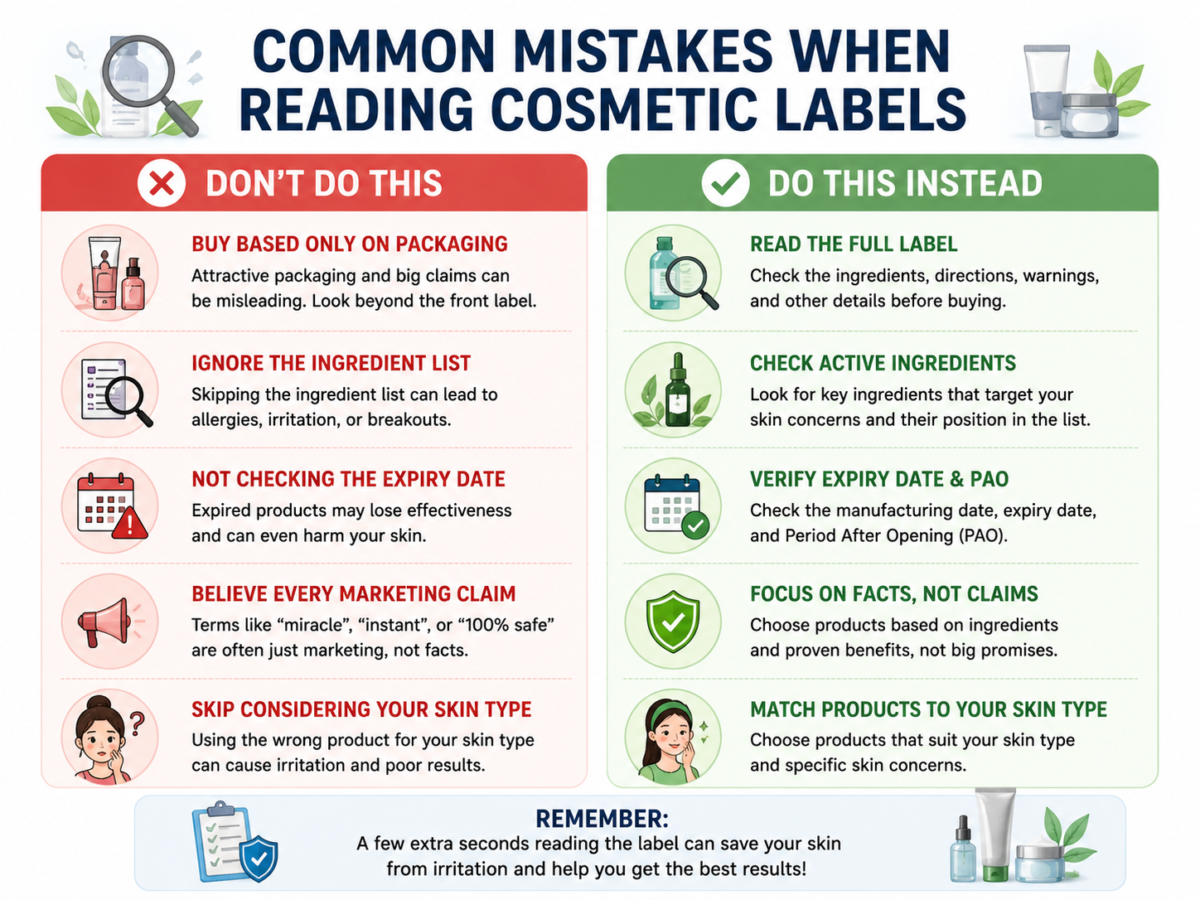
Tips for Buying Cosmetic Products
Before purchasing any cosmetic product:
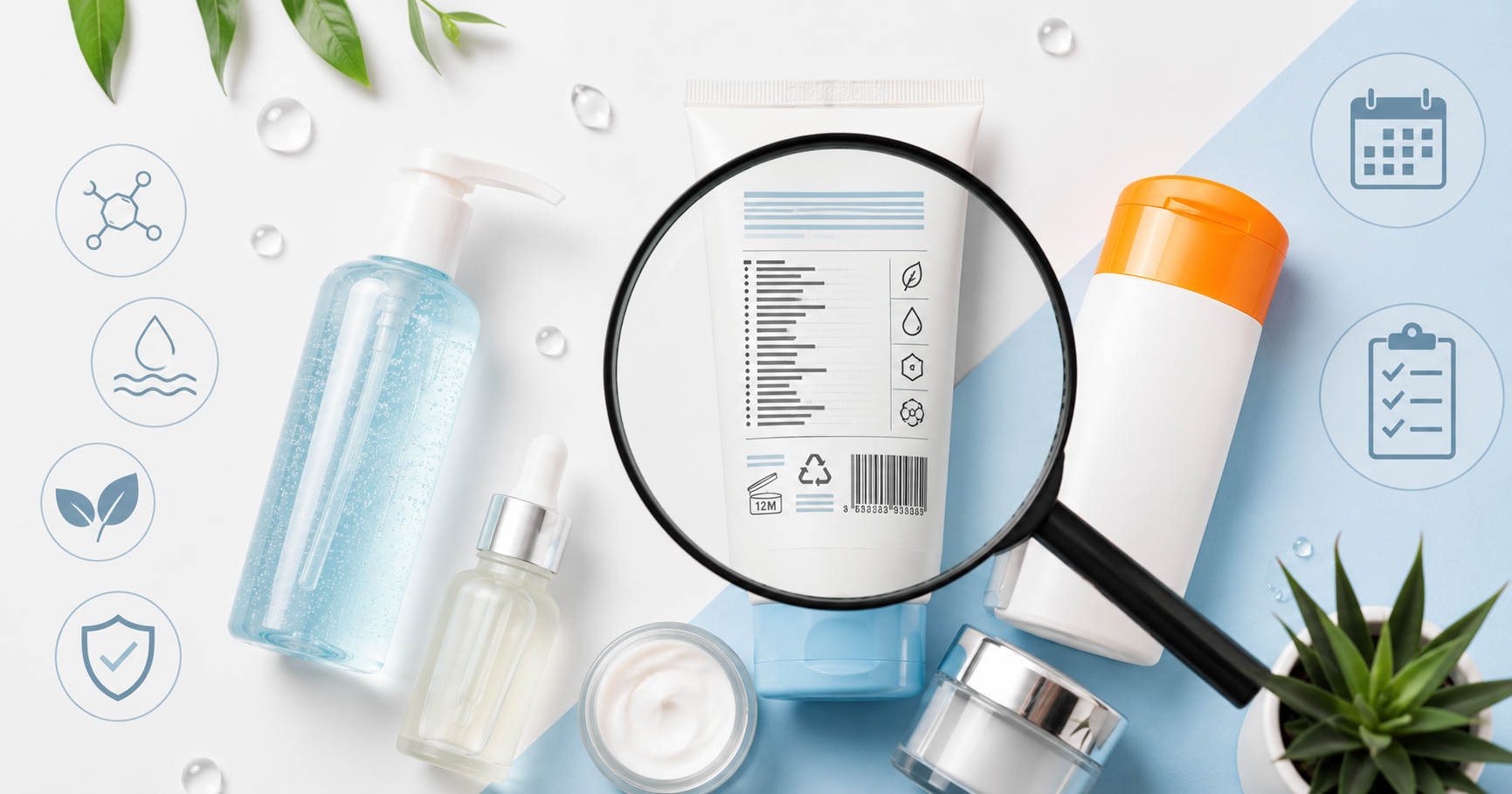
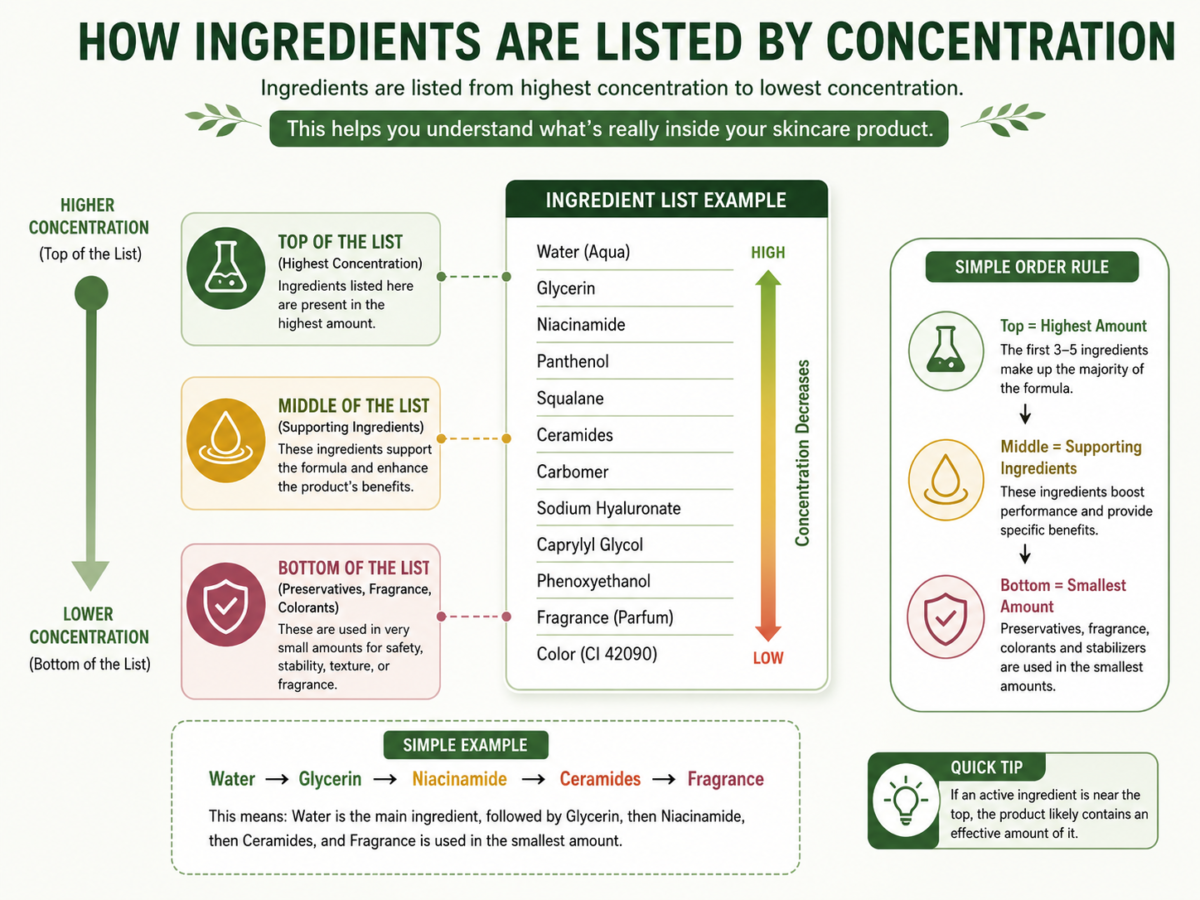
Read the ingredient list.
Check the expiry date.
Buy from trusted retailers.
Perform a patch test when trying a new product.
Choose products suitable for your skin type.
Avoid products with unrealistic claims.
Follow usage instructions carefully.
Making informed choices helps reduce the risk of irritation and improves your overall experience.
The Future of the Cosmetic Industry
The future of cosmetics is driven by innovation, sustainability, and personalization.
Emerging developments include:
AI-powered skin analysis
Smart beauty devices
Biotechnology-based ingredients
Water-saving formulations
Eco-friendly packaging
Microbiome-friendly skincare
Advanced sun protection technologies
Consumers are also becoming more educated about ingredients, encouraging brands to prioritize transparency, safety, and proven performance.
Frequently Asked Questions (FAQs)
What is the cosmetic industry?
The cosmetic industry develops, manufactures, markets, and sells products designed to cleanse, beautify, protect, and improve the appearance of the skin, hair, nails, lips, and body.
What are cosmetic products?
Cosmetic products include skincare, makeup, hair care, fragrances, personal care products, sunscreens, and nail care products.
Is skincare part of the cosmetic industry?
Yes. Skincare is one of the largest and fastest-growing segments of the cosmetic industry.
Are cosmetics and medicines the same?
No. Cosmetics are intended to clean, beautify, or enhance appearance, while medicines are intended to diagnose, treat, or prevent diseases.
What skills are needed to work in the cosmetic industry?
Professionals may need expertise in cosmetic science, chemistry, quality control, marketing, branding, design, product development, or digital marketing, depending on the role.
Final Thoughts
The cosmetic industry is much more than makeup and skincare products on store shelves. It is a dynamic field where science, creativity, technology, and consumer needs come together to create innovative beauty solutions. From ingredient research and product formulation to sustainable packaging and digital marketing, every step plays an important role in delivering safe and effective products to consumers.
As beauty trends continue to evolve, the industry is becoming more transparent, environmentally conscious, and focused on personalized experiences. Whether you’re a beauty enthusiast, an aspiring entrepreneur, or someone curious about how cosmetics are developed, understanding the fundamentals of the cosmetic industry provides valuable insight into one of the world’s most influential consumer markets.
By staying informed about ingredients, product quality, and emerging innovations, consumers can make smarter choices while appreciating the expertise behind the products they use every day.
Have you ever wondered how cosmetic companies make sure that every bottle of face serum, moisturizer, shampoo, or sunscreen is produced exactly the same way every single time? Imagine buying your favorite face cream today and getting a completely different texture or fragrance next month. Such inconsistency would reduce customer trust and could even become a safety concern.
This is where the Batch Manufacturing Record (BMR) plays an important role.
A Batch Manufacturing Record is one of the most essential documents used during cosmetic manufacturing. It acts like a detailed production diary that records every activity performed while manufacturing a specific batch of cosmetic products. Instead of relying on memory, manufacturers document every step so that the entire production process can be verified, repeated, and improved whenever necessary.
Whether a company manufactures face wash, lipstick, body lotion, shampoo, sunscreen, or hair serum, a properly maintained BMR helps ensure that every batch meets the same quality standards before reaching customers.
If you are a beginner interested in cosmetic manufacturing, quality assurance, cosmetic formulation, or regulatory documentation, understanding Batch Manufacturing Records is one of the first concepts you should learn.
In this complete guide, you’ll discover what a BMR is, why it matters, what information it contains, how it differs from other manufacturing documents, and why it is considered the backbone of cosmetic quality control.
What Is a Batch Manufacturing Record (BMR)?
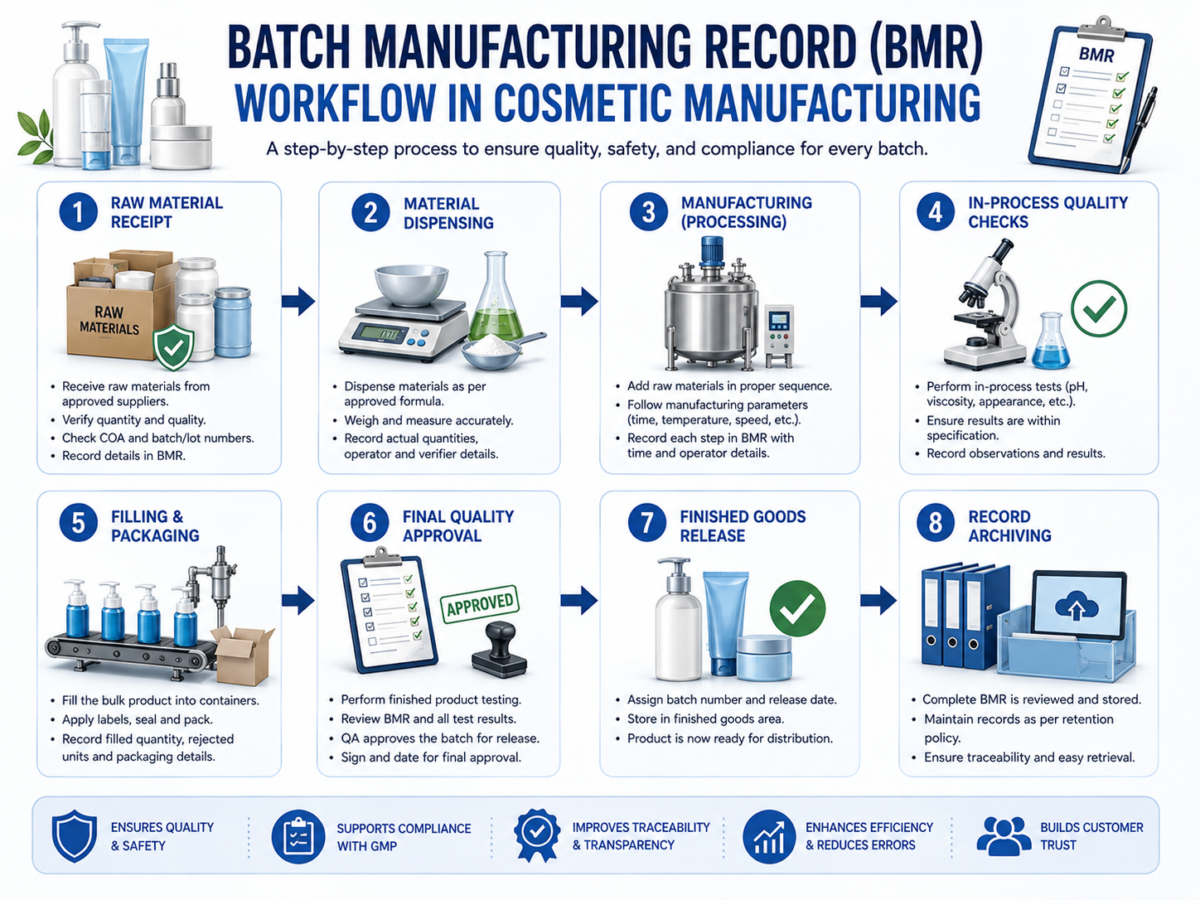
A Batch Manufacturing Record (BMR) is a written or electronic document that records every manufacturing activity carried out for one specific production batch of a cosmetic product.
Simply put, it provides complete evidence that a product was manufactured according to the approved manufacturing instructions.
Every cosmetic batch receives a unique batch number. During production, operators, supervisors, and quality personnel record important information such as:
Raw materials used
Quantity of each ingredient
Manufacturing date
Equipment used
Mixing time
Processing temperatures
Operator signatures
Quality control checks
Packaging details
Final product approval
Once production is completed, the Batch Manufacturing Record becomes a permanent record that can be referred to whenever needed.
Instead of guessing what happened during production, companies can simply review the BMR to understand every step that took place.
A Batch Manufacturing Record is a document that records the complete manufacturing history of one batch of cosmetic products from raw materials to finished goods.
Think of it as a detailed report card for every batch produced in a cosmetic factory.
Understanding BMR with a Real-Life Example
Imagine a cosmetic company manufactures 1,000 bottles of Vitamin C Face Serum.
The production team assigns the batch number:
VCS240801
During manufacturing, the Batch Manufacturing Record includes information like:
Date of manufacturing
Batch number
Formula version
Ingredient quantities
Supplier details
Mixing sequence
Processing temperature
Mixing duration
Equipment identification
Operator names
In-process quality checks
Filling machine details
Number of bottles filled
Number of rejected bottles
Final Quality Control approval
Release date
Months later, if a customer reports a quality issue, the company can review this BMR and identify exactly how that batch was manufactured.
Without this record, investigating the problem would be extremely difficult.
Why Is a Batch Manufacturing Record Important?
Many beginners think BMR is simply paperwork. In reality, it is one of the most valuable quality documents in cosmetic manufacturing.
It protects both the manufacturer and the customer by ensuring that every batch follows approved manufacturing procedures.
Some of the biggest reasons why BMR is important include:
Ensures Product Consistency
Customers expect the same product quality every time they make a purchase.
Whether they buy a face cream today or six months later, the product should have the same:
Texture
Color
Fragrance
Thickness
Performance
Stability
The Batch Manufacturing Record helps manufacturers achieve this consistency by documenting every production step.
Cosmetic products come into direct contact with the skin, hair, lips, and sometimes the eyes.
Even a small manufacturing mistake can affect product safety.
For example:
Incorrect ingredient quantity
Wrong mixing temperature
Short mixing time
Incorrect preservative level
Poor cleaning of equipment
A properly maintained BMR helps identify these issues before products reach consumers.
Supports Quality Control
Quality Control (QC) teams use the Batch Manufacturing Record throughout production.
They verify that:
Correct raw materials were used
Ingredients matched specifications
Manufacturing followed approved procedures
Testing results met acceptance limits
If anything goes wrong, QC can quickly identify the exact stage where the deviation occurred.
Helps During Audits
Regulatory authorities and certification bodies often inspect cosmetic manufacturing facilities.
One of the first documents auditors request is the Batch Manufacturing Record.
A complete and accurate BMR demonstrates that the company follows Good Manufacturing Practices (GMP) and maintains proper documentation.
Makes Product Recall Easier
Although every manufacturer aims to produce high-quality cosmetics, problems can occasionally occur.
If a specific batch needs to be recalled due to contamination, labeling errors, or packaging defects, the Batch Manufacturing Record helps identify:
Which batch is affected
When it was manufactured
Which ingredients were used
Which packaging materials were involved
Where the products were distributed
This allows companies to recall only the affected batch instead of every product in the market.
Who Uses Batch Manufacturing Records?
Many departments rely on BMRs throughout the manufacturing process.
Each department contributes important information that creates a complete production history.
Some of the main users include:
Production Department
The production team records:
Material dispensing
Manufacturing steps
Equipment usage
Processing conditions
Yield calculations
Quality Assurance (QA)
QA verifies that:
Documentation is complete
Procedures were followed correctly
Deviations are investigated
Batch records are reviewed before product release
Quality Control (QC)
QC records:
Raw material testing
In-process testing
Finished product testing
Laboratory observations
Approval or rejection decisions
Warehouse Team
The warehouse department tracks:
Raw material issue
Material returns
Packaging material usage
Inventory reconciliation
Regulatory Affairs
Regulatory professionals may use Batch Manufacturing Records to demonstrate compliance with manufacturing standards and support documentation during inspections or product reviews.
What Information Does a Batch Manufacturing Record (BMR) Contain?
A Batch Manufacturing Record is much more than a simple production sheet. It contains detailed information that documents every stage of manufacturing, from collecting raw materials to releasing the finished cosmetic product.
Although the format may vary from one company to another, most cosmetic manufacturers include the following sections in their BMR.
Product Information
The first section identifies the cosmetic product being manufactured.
It usually includes:
Product name
Product code
Batch number
Batch size
Manufacturing date
Expiry date (if assigned during production)
Formula version
Packaging type
This information ensures that the record belongs to one specific production batch and prevents confusion between different products.
For example, if a company manufactures Aloe Vera Gel, Vitamin C Serum, and Face Wash on the same day, each product will have its own separate Batch Manufacturing Record.
Every cosmetic product contains multiple ingredients, and all of them must be recorded accurately.
The BMR lists details such as:
Ingredient name
Material code
Supplier name
Lot or batch number
Required quantity
Actual quantity issued
Verification by production or quality personnel
This section ensures that only approved raw materials are used in manufacturing.
For example, if a face cream formula requires 15 kg of shea butter, the production team must record the exact quantity taken from the warehouse. Any difference between the required and actual quantity is documented and investigated if necessary.
Material Dispensing Record
Before manufacturing begins, ingredients are weighed according to the approved formula.
The dispensing section records:
Date of dispensing
Ingredient quantities
Weighing equipment used
Operator name
Checker or verifier signature
Accurate dispensing is critical because even a small mistake can affect the quality and stability of the final cosmetic product.
Imagine adding twice the required amount of fragrance to a body lotion. The product may become too strong, cause skin irritation, or fail quality testing. Proper documentation helps prevent such errors.
Equipment Details
The Batch Manufacturing Record also identifies the equipment used during production.
This section generally includes:
Mixing tank number
Homogenizer identification
Filling machine number
Storage vessel number
Cleaning status
Equipment verification
Recording equipment details helps trace production if any issue arises later.
For example, if several batches made using one mixing tank show similar quality problems, the company can inspect that equipment for maintenance or cleaning issues.
Manufacturing Instructions
This is one of the most important sections of the BMR.
It contains step-by-step instructions that operators must follow during production.
These instructions may include:
Order of ingredient addition
Mixing speed
Heating temperature
Cooling temperature
Mixing duration
Homogenization time
Holding time
Appearance checks
Operators document each completed step along with the date, time, and signature.
This confirms that the manufacturing process followed the approved procedure without skipping any important stage.
In-Process Quality Checks
Quality checks are performed while production is still in progress, not just after the product is finished.
The Batch Manufacturing Record includes observations such as:
Product appearance
Color
Odor
pH value
Viscosity
Temperature
Homogeneity
Weight verification
If any value falls outside the acceptable range, corrective action is documented immediately.
For example, if the pH of a facial cleanser is higher than expected, adjustments can be made before filling the product into bottles.
This helps reduce product wastage and improves quality.
Packaging Material Details
Once manufacturing is complete, the product is transferred to the packaging department.
The BMR records packaging information such as:
Bottle type
Tube type
Jar type
Cap details
Labels used
Cartons
Leaflets
Packaging material batch numbers
Recording packaging materials helps companies trace packaging-related issues if they occur in the future.
For instance, if a supplier provides defective pump bottles, the manufacturer can identify which production batches used those bottles.
Filling and Packing Record
The filling process is also documented carefully.
This section usually records:
Filling date
Filling machine number
Number of units filled
Number of rejected units
Number of packed units
Packaging operator details
These records help calculate production efficiency and identify any unusual losses during packaging.
Yield Calculation
Yield refers to the quantity of finished product obtained after manufacturing.
The Batch Manufacturing Record includes:
Theoretical yield
Actual yield
Percentage yield
Material loss
Production wastage
Investigation of excessive losses
For example, if the expected output is 5,000 bottles but only 4,850 bottles are produced, the production team investigates the reason for the difference.
Common causes may include:
Filling losses
Equipment residue
Spillage
Sampling during quality testing
Monitoring yield helps improve manufacturing efficiency over time.
How Is a Batch Manufacturing Record Prepared?
Creating a Batch Manufacturing Record begins long before production starts.
The document is prepared based on the approved Master Manufacturing Formula, which contains the official manufacturing process for a cosmetic product.
The general process includes the following steps:
Step 1: Prepare the Approved BMR
The Quality Assurance department prepares a standardized Batch Manufacturing Record using the approved manufacturing formula.
The document is reviewed and approved before production begins.
Step 2: Issue the BMR to Production
Before manufacturing starts, the approved Batch Manufacturing Record is issued to the production department.
Only authorized personnel are allowed to make entries in the document.
Step 3: Record Every Manufacturing Activity
As production progresses, operators record each activity immediately after completing it.
Information is never filled in later from memory.
This practice improves accuracy and maintains data integrity.
Step 4: Review by Quality Assurance
After production is completed, the Quality Assurance team reviews the entire Batch Manufacturing Record.
They verify that:
Every section is completed
Signatures are present
Calculations are correct
Deviations are documented
Quality results meet specifications
Only after successful review can the batch move toward final approval.
Common Mistakes to Avoid While Filling a BMR
Even experienced manufacturing teams can make documentation errors if they are not careful.
Some of the most common mistakes include:
Leaving blank fields in the record
Writing incorrect batch numbers
Using unapproved abbreviations
Recording information after production instead of during production
Missing operator signatures
Incorrect yield calculations
Overwriting values without proper correction
Forgetting to document deviations
Proper training and regular documentation reviews help reduce these mistakes and maintain reliable production records.
Benefits of Using a Batch Manufacturing Record in the Cosmetic Industry
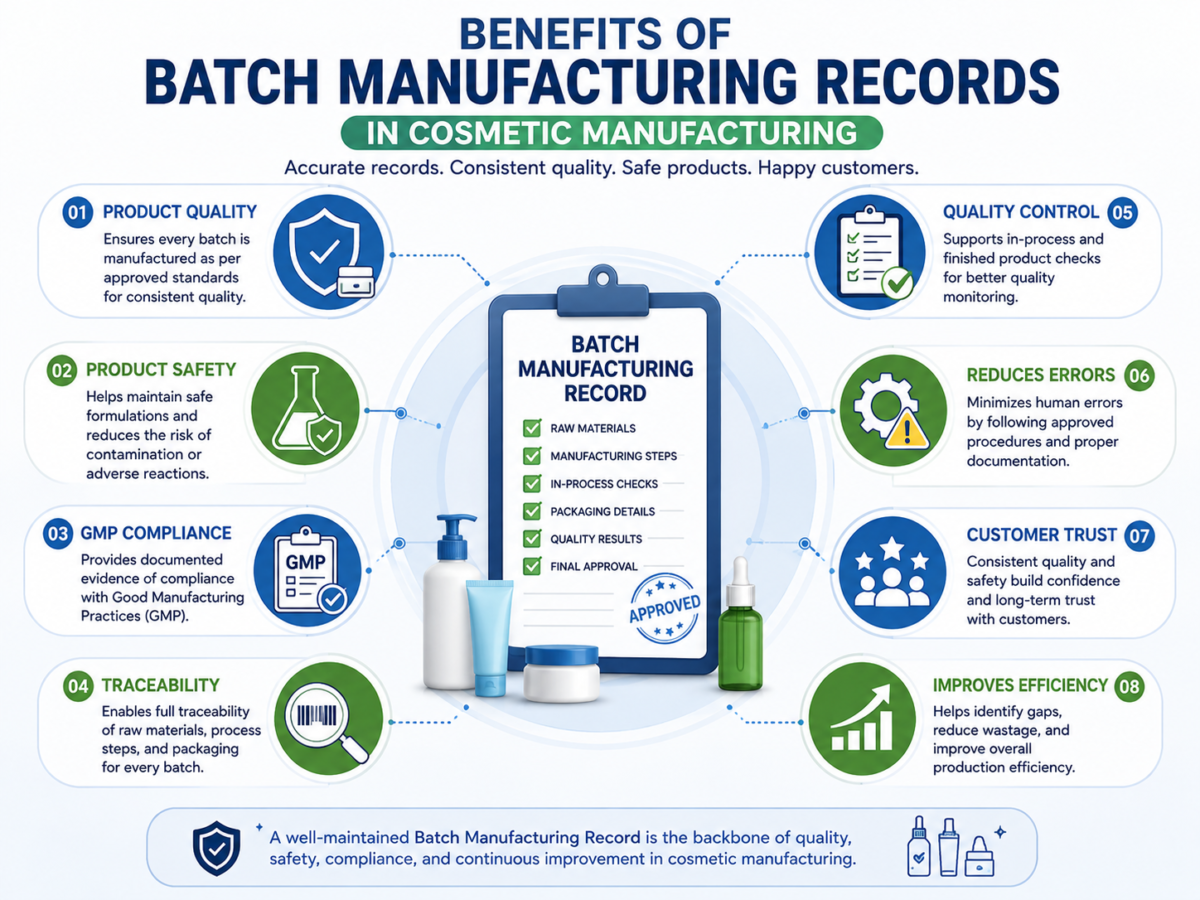
A Batch Manufacturing Record is much more than a regulatory document. It helps cosmetic manufacturers produce safe, consistent, and high-quality products while reducing production errors. Whether a company is manufacturing 500 bottles of face serum or 50,000 jars of moisturizer, a properly maintained BMR supports every stage of the production process.
Let’s explore the major benefits of using a Batch Manufacturing Record.
Maintains Consistent Product Quality
Customers expect the same quality every time they purchase a cosmetic product. A moisturizer bought today should have the same texture, fragrance, color, and performance as one purchased months later.
The Batch Manufacturing Record helps manufacturers achieve this consistency by ensuring that every batch follows the same approved process.
For example, if a shampoo is always mixed for 45 minutes at a specific speed, the BMR ensures that this procedure is followed for every batch.
Reduces Manufacturing Errors
Mistakes during cosmetic manufacturing can be expensive. Using the wrong ingredient, incorrect quantity, or improper mixing time may result in an entire batch being rejected.
Since every manufacturing step is documented and verified, the Batch Manufacturing Record helps production teams identify and prevent errors before they become major problems.
This not only saves raw materials but also reduces production costs.
Improves Traceability
Traceability means being able to track every ingredient and manufacturing activity connected to a finished cosmetic product.
A complete Batch Manufacturing Record allows manufacturers to answer important questions such as:
Which supplier provided a particular ingredient?
Which equipment was used?
Who manufactured the batch?
When was the product filled?
Which packaging materials were used?
This information becomes extremely valuable if a quality concern is reported after the product reaches the market.
Supports Customer Safety
Cosmetic products are applied directly to the skin, lips, scalp, and hair. Poor manufacturing practices can affect product safety and customer satisfaction.
The Batch Manufacturing Record helps ensure that:
Approved ingredients are used.
Manufacturing instructions are followed correctly.
Quality checks are completed.
Products meet predefined specifications before release.
As a result, customers receive products that are manufactured under controlled conditions.
Helps During Investigations
Sometimes manufacturers receive customer complaints related to leakage, unusual odor, color changes, or packaging defects.
Instead of guessing the cause, the Quality Assurance team can review the Batch Manufacturing Record to investigate:
Raw material details
Processing conditions
Equipment used
Packaging records
Quality control observations
This allows problems to be identified much faster.
Improves Manufacturing Efficiency
BMRs also help companies improve their manufacturing process over time.
By reviewing previous records, manufacturers can identify recurring issues such as:
Frequent production delays
High material losses
Equipment downtime
Filling inefficiencies
Packaging defects
Corrective actions based on these findings can improve productivity and reduce waste.
Role of Batch Manufacturing Record in Good Manufacturing Practices (GMP)
Good Manufacturing Practices (GMP) are guidelines that help manufacturers produce safe and high-quality cosmetic products.
One of the key principles of GMP is:
“If it isn’t documented, it didn’t happen.”
This is exactly why the Batch Manufacturing Record is so important.
A properly completed BMR provides documented evidence that manufacturing was carried out according to approved procedures.
It demonstrates that:
Production followed standard operating procedures (SOPs).
Approved raw materials were used.
Equipment was cleaned before use.
Quality checks were performed.
Deviations were recorded and investigated.
The finished batch met quality requirements.
Without proper documentation, it becomes difficult to prove that manufacturing was performed correctly.
Batch Manufacturing Record vs Batch Packing Record (BPR)
Beginners often confuse the Batch Manufacturing Record (BMR) with the Batch Packing Record (BPR). While both are essential manufacturing documents, they serve different purposes.
Feature
Batch Manufacturing Record (BMR)
Batch Packing Record (BPR)
Main Purpose
Records the manufacturing process
Records the packaging process
Focus
Product preparation
Filling, labeling, and packing
Covers
Ingredients, mixing, processing, quality checks
Bottles, labels, cartons, packaging materials
Prepared By
Production department
Packaging department
Used For
Manufacturing history
Packaging history
In simple words, the BMR explains how the cosmetic product was made, while the BPR explains how the finished product was packed and labeled.
Both records work together to provide complete traceability for a cosmetic batch.
Paper BMR vs Electronic BMR (eBMR)
Many cosmetic companies still use paper-based Batch Manufacturing Records. However, modern manufacturers are increasingly adopting Electronic Batch Manufacturing Records (eBMR).
Let’s compare both systems.
Paper BMR
Electronic BMR (eBMR)
Written by hand
Entered digitally
Requires physical storage
Stored securely in electronic systems
More chances of handwriting errors
Reduces manual errors
Difficult to search old records
Easy to search and retrieve
Manual calculations
Automatic calculations
Slower review process
Faster review and approval
Electronic Batch Manufacturing Records improve efficiency, reduce paperwork, and make documentation easier to manage. However, whether a company uses paper records or digital systems, the accuracy of the information remains equally important.
Best Practices for Maintaining an Accurate BMR
Maintaining a reliable Batch Manufacturing Record requires discipline and attention to detail.
Here are some best practices followed by successful cosmetic manufacturers:
Record Information Immediately
Production activities should be documented as they happen.
Writing information later from memory increases the risk of mistakes.
Write Clearly and Accurately
Whether using paper or electronic records, all entries should be clear, complete, and easy to understand.
Avoid unclear handwriting, incomplete information, or unexplained abbreviations.
Never Leave Blank Spaces
Every section of the Batch Manufacturing Record should be completed.
If a particular field does not apply, it should be marked according to the company’s documentation procedure rather than left blank.
Verify Every Entry
Important information should be reviewed by authorized personnel before moving to the next production stage.
Verification helps catch errors early.
Document Any Deviations
Sometimes manufacturing does not go exactly as planned.
For example:
A mixing step takes longer than expected.
Equipment stops unexpectedly.
A raw material is replaced with an approved alternative.
Such deviations should always be documented along with the reason and any corrective action taken.
Recording deviations demonstrates transparency and helps improve future production processes.
The Future of Batch Manufacturing Records in the Cosmetic Industry
The cosmetic industry is evolving rapidly, and manufacturing documentation is becoming more advanced every year. While many small and medium-sized companies still use paper-based Batch Manufacturing Records, larger manufacturers are shifting toward digital systems to improve speed, accuracy, and compliance.
Electronic Batch Manufacturing Records (eBMRs) are helping companies reduce paperwork, minimize human errors, and simplify record management. Production data can be entered in real time, reviewed faster by Quality Assurance teams, and stored securely for future reference.
Many modern manufacturing facilities are also integrating eBMRs with inventory management, laboratory testing, and production planning software. This allows information to flow automatically between departments, reducing duplicate work and improving overall efficiency.
As cosmetic regulations continue to evolve and consumers expect higher quality products, digital documentation is likely to become the industry standard.
Why Beginners Should Learn About BMR
If you’re planning a career in cosmetic manufacturing, formulation, quality assurance, quality control, regulatory affairs, or production management, understanding the Batch Manufacturing Record is an essential first step.
Learning how a BMR works helps you understand the complete manufacturing process rather than just the final product.
It also improves your knowledge of:
Cosmetic production workflow
Good Manufacturing Practices (GMP)
Documentation standards
Quality assurance systems
Manufacturing traceability
Product safety requirements
Regulatory compliance
Whether you work in a cosmetic factory, launch your own skincare brand, or simply want to understand how cosmetics are manufactured, knowing the purpose of a Batch Manufacturing Record will give you a strong foundation.
Common Challenges While Maintaining BMRs
Although Batch Manufacturing Records are extremely valuable, maintaining them correctly requires time and attention to detail.
Some common challenges include:
Missing or incomplete documentation
Manual calculation errors
Delays in recording production activities
Illegible handwriting in paper records
Missing signatures or approvals
Difficulty retrieving old records
Managing large volumes of paperwork
Training new employees on documentation practices
These challenges can be reduced through regular employee training, internal audits, standardized procedures, and, where appropriate, digital record-keeping systems.
Practical Tips for Cosmetic Manufacturers
Whether you are a startup or an established cosmetic manufacturer, following these practical tips can help improve Batch Manufacturing Record accuracy.
Use only the latest approved BMR format.
Verify all raw materials before dispensing.
Record every manufacturing step immediately after completion.
Double-check batch numbers and material codes.
Ensure equipment is cleaned and verified before use.
Review calculations before signing the document.
Document every deviation, even if it appears minor.
Store completed BMRs securely for future reference.
Train employees regularly on documentation practices.
Conduct periodic internal audits to identify improvement opportunities.
Following these simple practices helps build a reliable manufacturing system and supports consistent product quality.
Conclusion
A Batch Manufacturing Record (BMR) is one of the most important documents in the cosmetic industry. It provides a complete record of how a specific batch of a cosmetic product was manufactured, from raw material dispensing to final quality approval.
By documenting every production step, a BMR helps manufacturers maintain product consistency, improve safety, support quality control, comply with Good Manufacturing Practices (GMP), and investigate issues quickly if they arise.
Whether the product is a face wash, body lotion, shampoo, sunscreen, lipstick, or serum, every batch benefits from accurate and well-maintained manufacturing records.
For beginners, understanding Batch Manufacturing Records offers valuable insight into how professional cosmetic manufacturing works behind the scenes. It also highlights why documentation is just as important as formulation and production.
As the cosmetic industry continues to adopt digital technologies, Batch Manufacturing Records will remain a key part of ensuring safe, high-quality products that consumers can trust.
Frequently Asked Questions (FAQs)
1. What does BMR stand for in the cosmetic industry?
BMR stands for Batch Manufacturing Record. It is a document that records every manufacturing activity for a specific batch of cosmetic products.
2. Why is a Batch Manufacturing Record important?
A BMR helps ensure product quality, consistency, safety, traceability, and compliance with Good Manufacturing Practices (GMP). It also supports investigations and product recalls when necessary.
3. Who prepares a Batch Manufacturing Record?
The Batch Manufacturing Record is usually prepared by the Quality Assurance department using the approved manufacturing formula. During production, it is completed by production personnel and reviewed by Quality Assurance before the batch is released.
4. What information is included in a BMR?
A typical BMR contains:
Product details
Batch number
Raw material information
Dispensing records
Equipment details
Manufacturing instructions
In-process quality checks
Packaging information
Yield calculations
Operator and reviewer signatures
Final batch approval
5. What is the difference between a BMR and a BPR?
A Batch Manufacturing Record (BMR) documents the manufacturing process, while a Batch Packing Record (BPR) documents the packaging and labeling process. Together, they provide complete traceability for a cosmetic batch.
6. Can cosmetic companies use electronic Batch Manufacturing Records?
Yes. Many cosmetic manufacturers now use Electronic Batch Manufacturing Records (eBMRs) to improve accuracy, reduce paperwork, speed up approvals, and simplify document storage and retrieval.
7. How long should Batch Manufacturing Records be retained?
The retention period depends on the company’s quality management system and the regulations that apply in its operating market. Manufacturers should always follow applicable legal and regulatory requirements when deciding how long to keep BMRs.
8. Can a cosmetic batch be released without a completed BMR?
No. A batch should only be released after the Batch Manufacturing Record has been completed, reviewed, and approved by the authorized Quality Assurance personnel according to the company’s procedures.
The cosmetic products we use every day—face washes, moisturizers, lipsticks, shampoos, sunscreens, and serums—go through a carefully planned manufacturing process before they reach store shelves. Every product follows a series of important steps that ensure it is safe, effective, stable, and meets quality standards.
Many beginners think cosmetic manufacturing simply means mixing ingredients together. In reality, it is a structured process that involves research, formulation, raw material testing, manufacturing, quality control, packaging, and final inspection. Missing even one step can affect the product’s performance, shelf life, or safety.
This is why cosmetic manufacturers use a well-defined cosmetic manufacturing flow chart. It provides a clear roadmap that helps production teams follow each stage in the correct order while maintaining consistent product quality.
In this beginner-friendly guide, you will learn the complete cosmetic manufacturing flow chart, understand why every stage matters, and discover how high-quality skincare and personal care products are produced from start to finish.
What Is a Cosmetic Manufacturing Flow Chart?
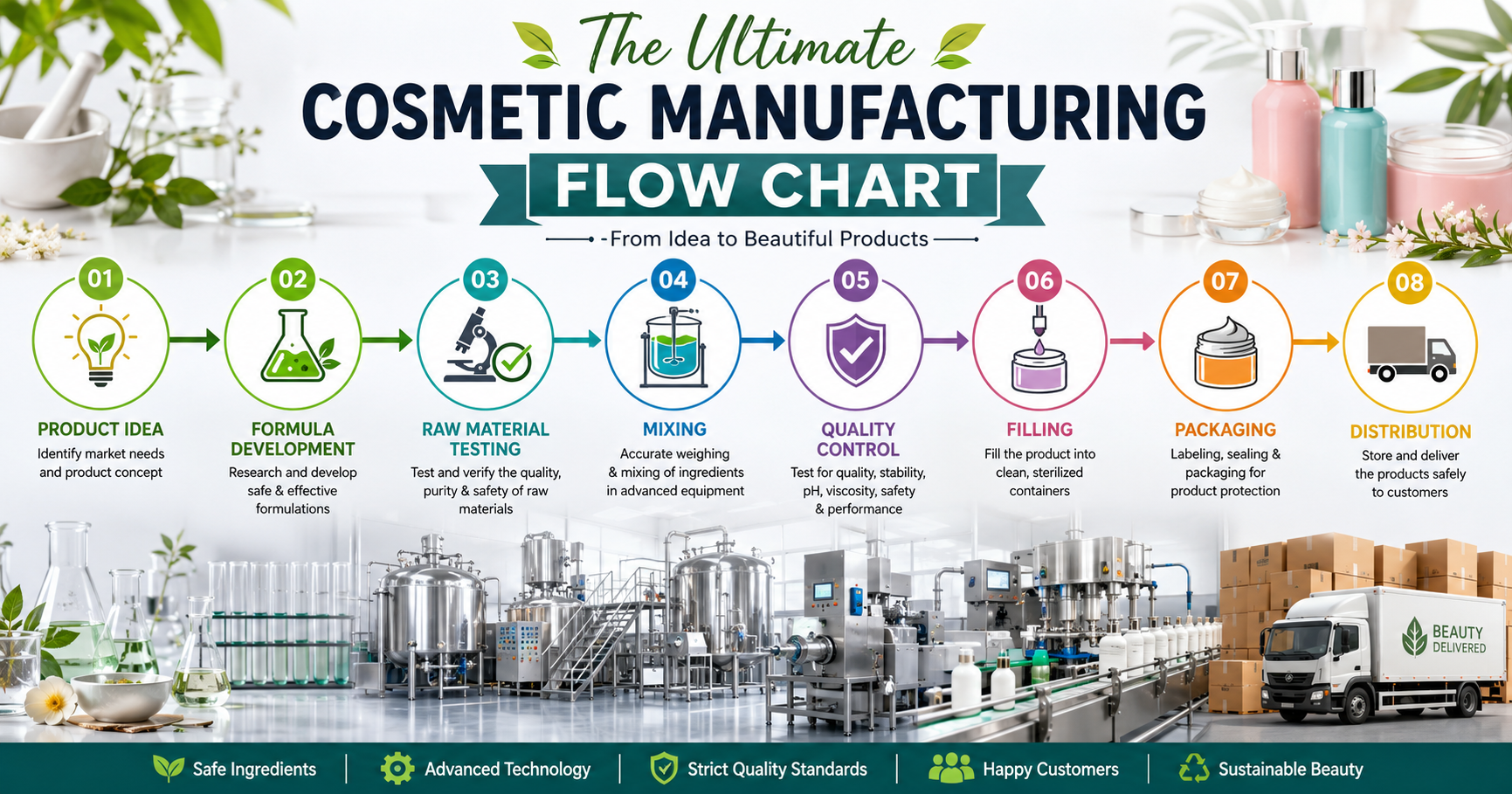
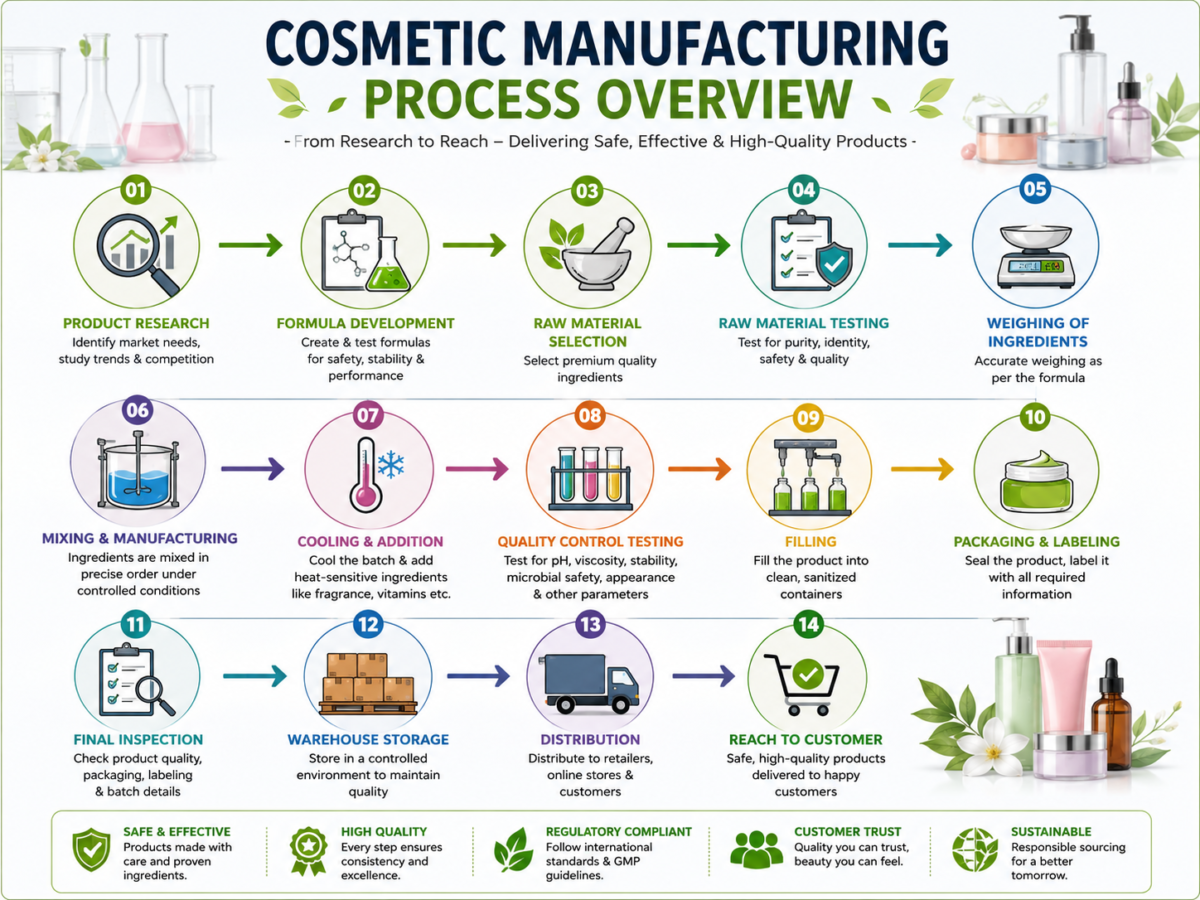
A cosmetic manufacturing flow chart is a visual representation of every step involved in producing cosmetic products. It shows how raw materials move through different stages until they become finished products ready for customers.
Instead of looking at dozens of written procedures, manufacturers can quickly understand the production sequence using a flow chart.
A typical cosmetic manufacturing flow chart includes:
A flow chart is much more than a simple diagram. It helps manufacturers organize production while reducing mistakes and maintaining product consistency.
Some major benefits include:
Better Production Planning
Every department understands its responsibilities, making production smoother and more efficient.
Improved Product Quality
Following a fixed process helps reduce variations between different production batches.
Easier Employee Training
New employees can understand the manufacturing workflow much faster using a visual guide.
Regulatory Compliance
Many cosmetic manufacturers follow Good Manufacturing Practices (GMP). A documented manufacturing process helps demonstrate compliance during inspections.
Reduced Manufacturing Errors
Clear production steps minimize the chances of incorrect ingredient additions, contamination, or packaging mistakes.
Below is a simplified cosmetic manufacturing process that most skincare and personal care products follow.
Product Idea ↓ Market Research ↓ Formula Development ↓ Raw Material Selection ↓ Supplier Approval ↓ Raw Material Testing ↓ Weighing Ingredients ↓ Batch Manufacturing ↓ Mixing & Homogenization ↓ Cooling Process ↓ Quality Control Testing ↓ Filling ↓ Packaging ↓ Final Inspection ↓ Warehouse Storage ↓ Product Distribution
Although the exact sequence may vary depending on the product type, this flow chart represents the standard manufacturing process used across much of the cosmetics industry.
Step 1: Product Idea and Market Research
Every cosmetic product begins with an idea.
A company may identify a skincare concern that consumers frequently face, such as dry skin, acne, pigmentation, dandruff, or sun protection. Before creating a product, manufacturers study market demand, customer preferences, competitor products, and current beauty trends.
For example, if consumers are looking for lightweight moisturizers that work well in humid weather, a company may decide to develop a fast-absorbing gel cream instead of a heavy lotion.
During this stage, companies ask questions such as:
Who will use the product?
What skin type is it designed for?
Which ingredients are currently popular?
What makes this product different?
What price range will customers accept?
Proper market research helps reduce the risk of launching products that fail to meet customer expectations.
Once the product idea is approved, cosmetic chemists begin creating the formulation.
This is one of the most technical stages of cosmetic manufacturing.
The goal is to develop a formula that delivers the desired performance while remaining safe, stable, and pleasant to use.
During formulation, experts carefully balance different ingredient categories such as:
Water phase
Oils
Emollients
Humectants
Emulsifiers
Preservatives
Active ingredients
Fragrance
Colorants
Thickeners
For example, a hydrating facial moisturizer may include:
Hyaluronic Acid for hydration
Glycerin to attract moisture
Ceramides to strengthen the skin barrier
Emollients for smooth texture
Preservatives to prevent microbial growth
The formulation is adjusted several times until it achieves the desired texture, stability, fragrance, appearance, and performance.
Step 3: Raw Material Selection
After the formula is finalized, manufacturers select the raw materials needed for production.
Choosing high-quality ingredients is essential because even the best formulation cannot compensate for poor-quality raw materials.
Raw materials may include:
Botanical extracts
Carrier oils
Active ingredients
Vitamins
Surfactants
Waxes
Silicones
Preservatives
Fragrances
Natural butters
Pigments
Each ingredient must meet predefined quality standards before it enters the production facility.
Manufacturers also consider:
Purity
Stability
Supplier reliability
Safety documentation
Regulatory approval
Batch consistency
Using trusted suppliers helps maintain consistent product quality over time.
Step 4: Supplier Approval
Before any ingredient is used in production, manufacturers carefully evaluate the supplier. Choosing a trusted supplier is just as important as selecting the right ingredient because the quality of raw materials directly affects the quality of the final cosmetic product.
A supplier approval process helps ensure that every ingredient meets safety, quality, and regulatory requirements.
Manufacturers usually check:
Supplier reputation and experience
Manufacturing certifications (such as GMP or ISO)
Product consistency between batches
Technical documents and specifications
Quality management system
Ability to deliver materials on time
For example, if a company purchases Vitamin E from different suppliers each month, the purity and performance may vary. Working with an approved supplier reduces this risk and helps maintain consistent product quality.
Step 5: Raw Material Testing
Even after receiving ingredients from an approved supplier, manufacturers do not use them immediately. Every batch of raw material is tested to confirm that it matches the required specifications.
This step helps prevent poor-quality or contaminated ingredients from entering the production process.
Common quality checks include:
Appearance (color and texture)
Odor
pH (where applicable)
Purity
Moisture content
Identity testing
Microbiological analysis
Heavy metal testing (for selected ingredients)
For example, Aloe Vera extract should have the expected color and meet purity standards. If laboratory results do not match the specifications, the material is rejected instead of being used in production.
Testing every batch protects both the manufacturer and the consumer.
Step 6: Weighing the Ingredients
Once the raw materials are approved, each ingredient is weighed according to the product formula.
This may seem like a simple task, but it is one of the most critical steps in cosmetic manufacturing. Even a small weighing error can change the texture, fragrance, stability, or effectiveness of the product.
To avoid mistakes, manufacturers use:
Calibrated digital weighing scales
Clean weighing containers
Clearly labeled ingredients
Standard Operating Procedures (SOPs)
Double-check systems for verification
For instance, adding too much thickener to a lotion can make it difficult to spread, while using too little preservative may reduce the product’s shelf life.
Accurate weighing ensures that every production batch performs the same way.
Step 7: Batch Manufacturing
After all ingredients have been weighed, the actual manufacturing process begins.
During batch manufacturing, ingredients are combined in a specific sequence under controlled conditions. The order of addition is important because different ingredients behave differently when mixed.
Manufacturers monitor factors such as:
Mixing speed
Temperature
Mixing time
Pressure (if required)
Batch size
For example, many cream-based products require heating the oil phase and water phase separately before combining them to form a stable emulsion.
Following the correct manufacturing procedure helps create a smooth, stable, and high-quality product.
Step 8: Mixing and Homogenization
Mixing ensures that all ingredients are evenly distributed throughout the product.
For products such as creams, lotions, serums, and sunscreens, manufacturers often use a homogenizer. This equipment breaks down tiny oil droplets into smaller particles, creating a smooth and uniform texture.
Benefits of proper homogenization include:
Smooth appearance
Better product stability
Improved spreadability
Uniform distribution of active ingredients
Reduced risk of ingredient separation
Imagine preparing homemade mayonnaise. If the ingredients are not mixed properly, the oil and water separate. Cosmetic emulsions behave in a similar way. Proper homogenization keeps the product stable throughout its shelf life.
Step 9: Cooling the Product
Many cosmetic products are manufactured at elevated temperatures. After mixing is complete, the batch is gradually cooled before adding heat-sensitive ingredients.
These ingredients may include:
Fragrance
Essential oils
Certain vitamins
Botanical extracts
Some active ingredients
Preservatives that are sensitive to heat
Cooling too quickly or too slowly can affect the final texture and stability. Manufacturers therefore follow controlled cooling procedures to maintain product quality.
For example, adding fragrance while the batch is still very hot may cause some of its aromatic compounds to evaporate, reducing the product’s scent.
Common Equipment Used in Cosmetic Manufacturing
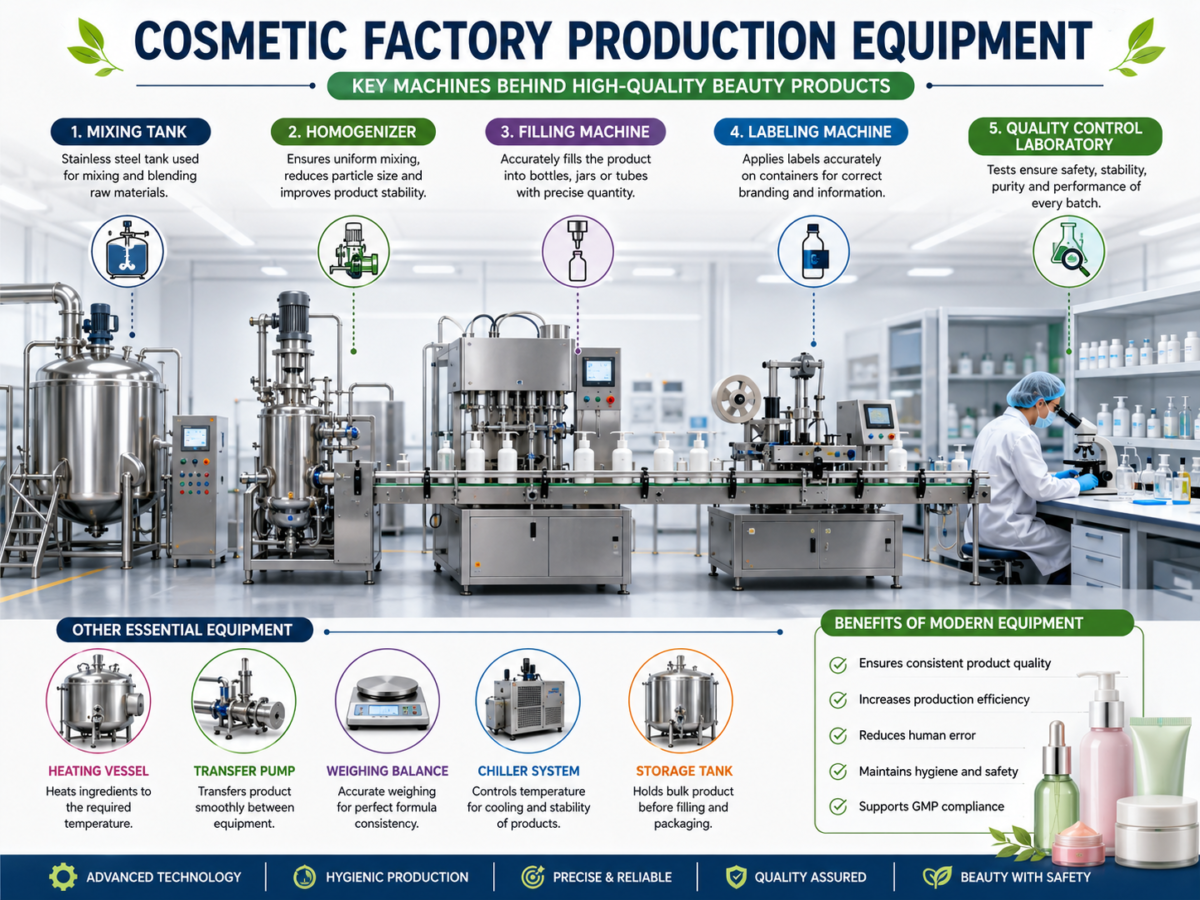
Different products require different types of equipment, but most cosmetic factories use the following machines during production:
Equipment
Purpose
Mixing Tank
Combines ingredients into a uniform mixture
Homogenizer
Creates smooth emulsions and improves stability
Heating Vessel
Heats ingredients during manufacturing
Cooling System
Brings the product to the required temperature
Digital Weighing Scale
Measures ingredients accurately
Storage Tank
Holds the finished bulk product before filling
Transfer Pump
Moves the product between processing stages
Filling Machine
Dispenses the product into bottles, tubes, or jars
Capping Machine
Seals containers securely
Labeling Machine
Applies labels accurately to the packaging
Modern factories often automate many of these processes to improve efficiency and reduce the chances of human error.
Common Mistakes to Avoid During Manufacturing
Even with a well-designed process, mistakes can occur if proper procedures are not followed. Some common manufacturing errors include:
Using unapproved raw materials
Incorrect ingredient weighing
Poor cleaning of equipment
Inadequate mixing time
Adding ingredients in the wrong order
Ignoring temperature requirements
Skipping quality checks
Improper documentation of production batches
Preventing these mistakes helps manufacturers produce safe, stable, and consistent cosmetic products.
Step 10: Quality Control (QC) Testing
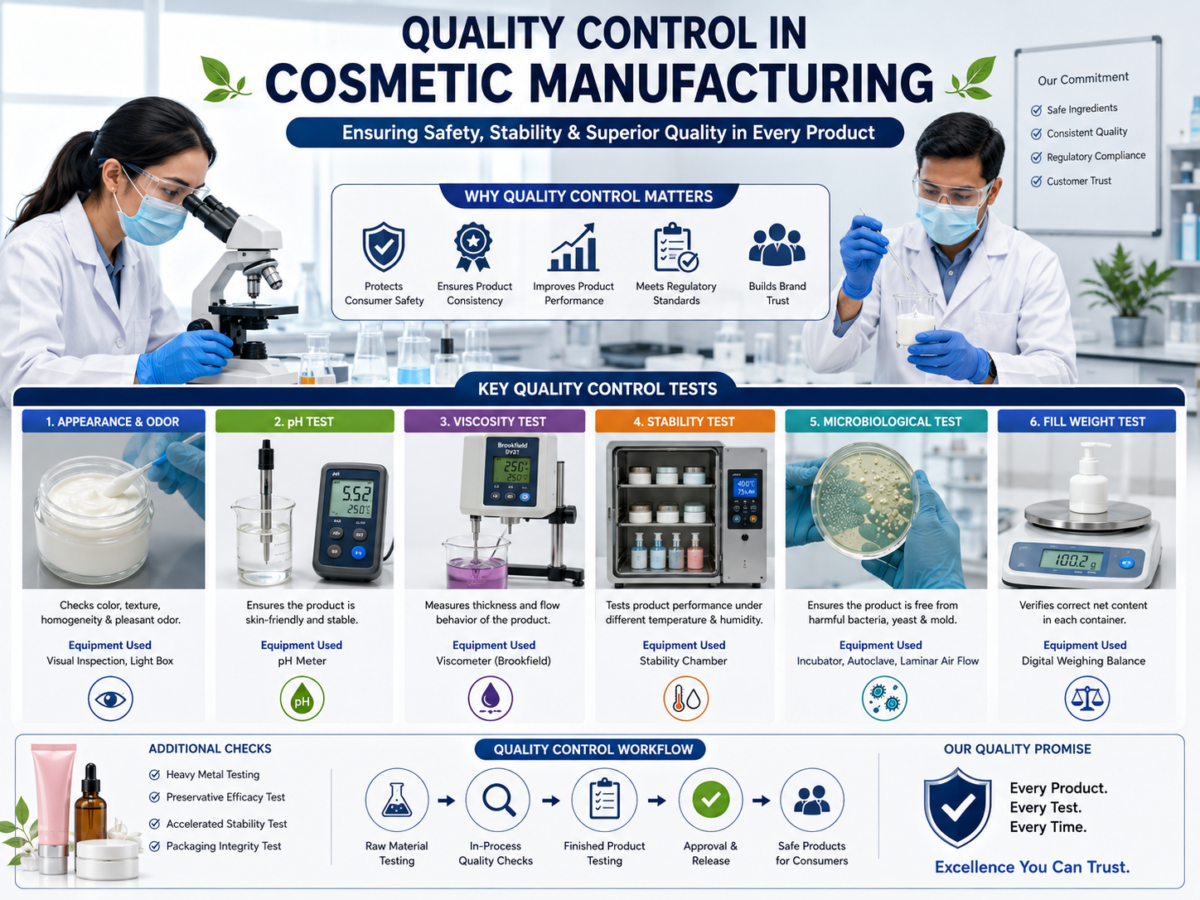
Before a cosmetic product is filled into its final container, it must pass a series of Quality Control (QC) tests. These tests help confirm that the product meets the company’s quality standards and performs as expected.
Quality control is one of the most important stages in the cosmetic manufacturing flow chart because it helps identify issues before products reach consumers.
Common QC tests include:
1. Appearance Test
Experts examine the product for:
Color consistency
Smooth texture
Uniform appearance
Absence of lumps or separation
For example, a moisturizing cream should have a smooth and creamy texture without visible oil droplets.
2. pH Testing
The pH level affects both product stability and skin compatibility.
Different products have different ideal pH ranges. For example:
Facial cleansers often have a skin-friendly pH.
Shampoos are formulated according to hair and scalp requirements.
Exfoliating products may have a lower pH depending on their active ingredients.
Maintaining the correct pH helps improve product performance and user comfort.
3. Viscosity Testing
Viscosity measures how thick or thin a product is.
This test ensures consistency between production batches.
Examples:
Lotion should flow smoothly.
Serum should remain lightweight.
Hair gel should have the intended thickness.
Face cream should neither be too runny nor too stiff.
4. Microbiological Testing
Cosmetic products must be free from harmful microorganisms.
Laboratories test for:
Bacteria
Yeast
Mold
Other microbial contamination
This is especially important for water-based products, which are more prone to microbial growth if preservation is inadequate.
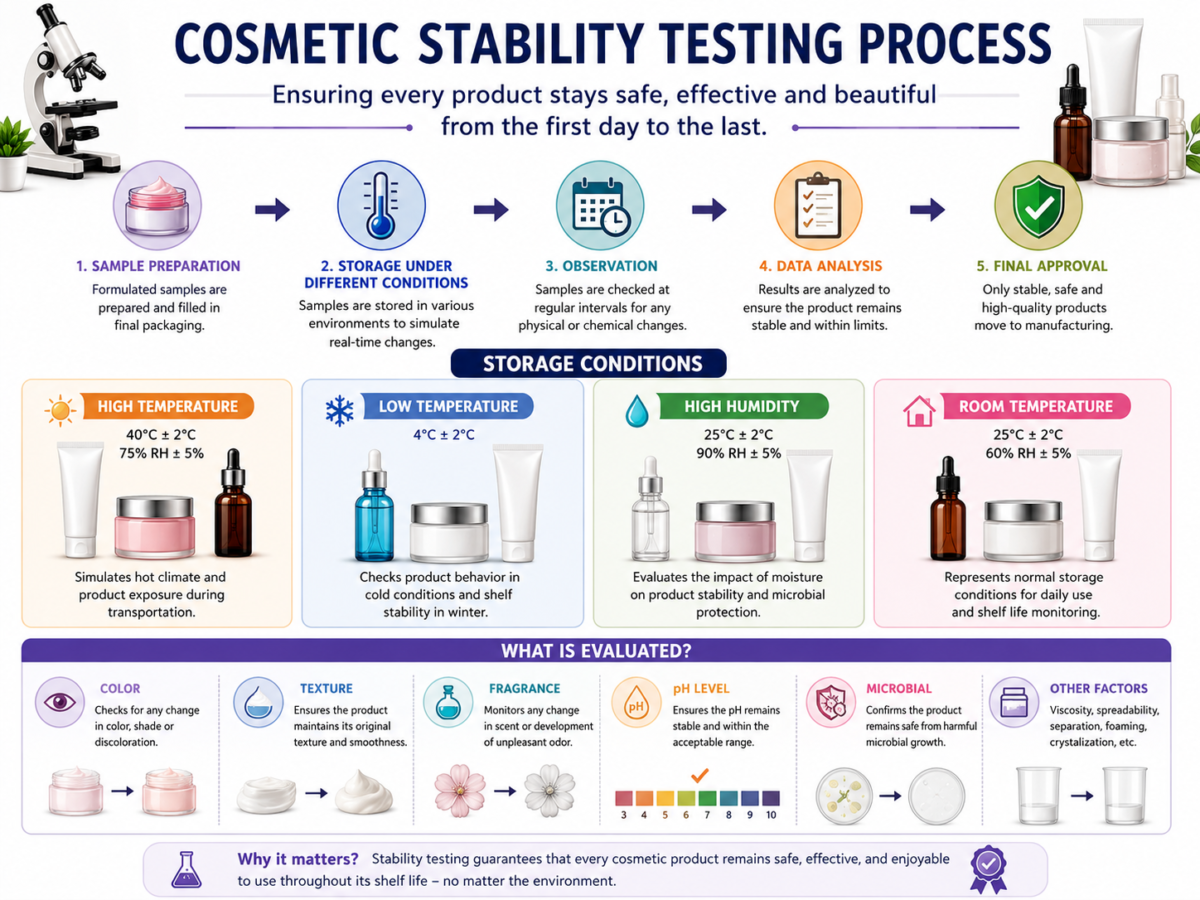
5. Stability Testing
Manufacturers evaluate how a product performs over time under different environmental conditions.
Products may be stored at:
High temperatures
Low temperatures
Humid environments
Room temperature
These tests help predict shelf life and ensure the product remains stable throughout its intended use period.
6. Fragrance Evaluation
The fragrance should remain pleasant and consistent.
Experts also check that the scent does not change during storage or interact negatively with other ingredients.
Step 11: Filling the Product
Once the product passes all quality tests, it is transferred to the filling line.
At this stage, the bulk cosmetic product is filled into its final packaging, such as:
Bottles
Tubes
Jars
Pumps
Airless containers
Sachets
Modern filling machines are designed to dispense accurate quantities while minimizing contamination.
For example, if a moisturizer is labeled as 50 ml, the filling equipment is calibrated to deliver that volume consistently across every unit.
Step 12: Packaging
Packaging is more than just making a product look attractive. It plays a crucial role in protecting the formula and enhancing the customer experience.
A good cosmetic package should:
Protect the product from contamination
Prevent leakage
Shield sensitive ingredients from light or air
Be convenient to use
Support the brand’s identity
For example:
Vitamin C serums are often packaged in opaque or amber bottles to reduce light exposure.
Airless pumps help protect formulas from repeated air contact, improving product stability.
Choosing the right packaging can help maintain product quality throughout its shelf life.
Step 13: Labeling
Every cosmetic product must include clear and accurate labeling.
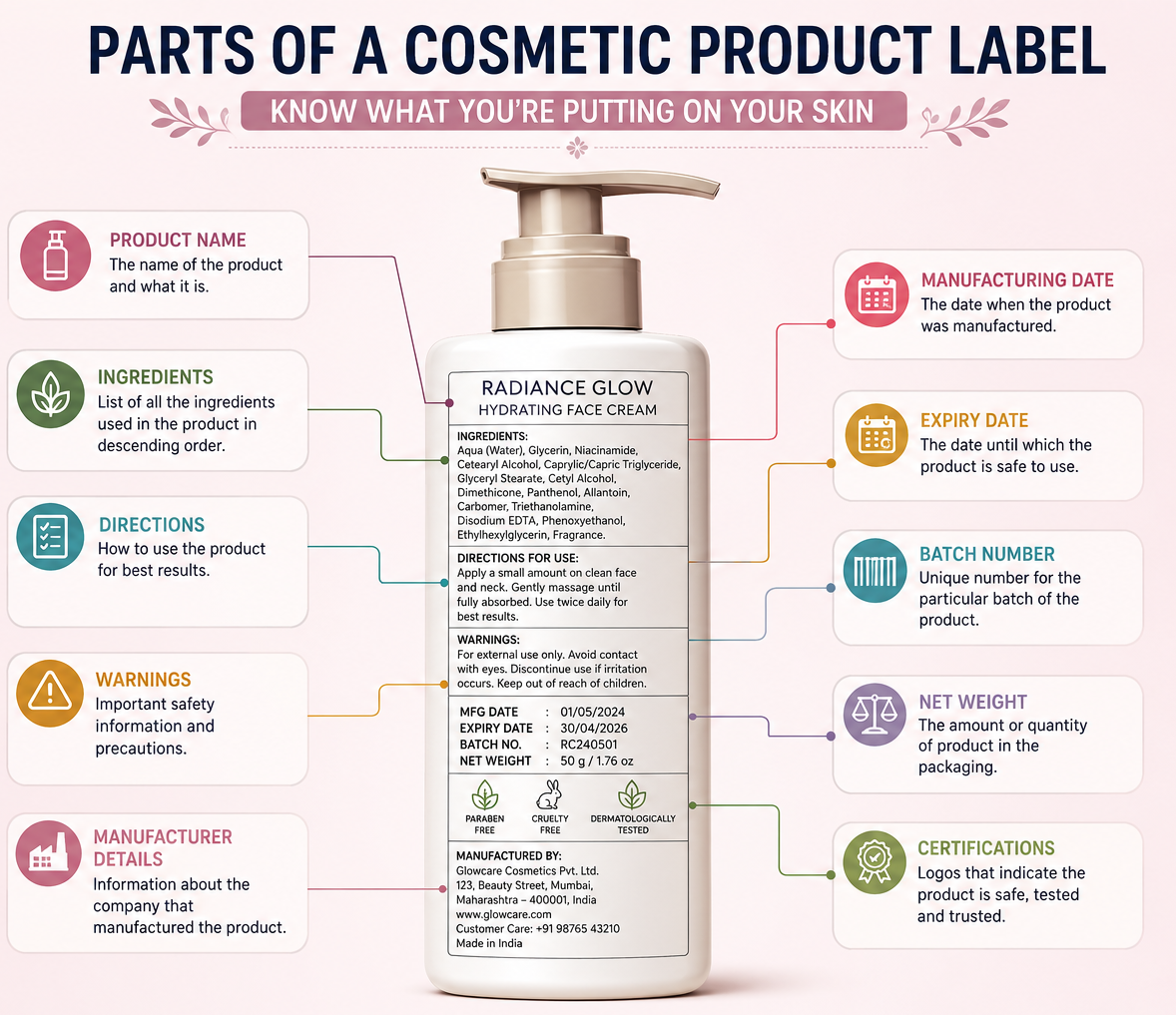
A typical cosmetic label may contain:
Product name
Brand name
Ingredient list (INCI names where applicable)
Net quantity
Manufacturing date
Batch or lot number
Expiry date or Period After Opening (if applicable)
Directions for use
Storage instructions
Manufacturer details
Safety warnings (when necessary)
Clear labeling helps consumers use products correctly and supports product traceability if any issue arises.
Step 14: Final Inspection
Before products leave the factory, they undergo one final inspection.
This stage confirms that every unit meets the required quality standards.
Inspectors check:
Proper filling level
Secure caps or pumps
Correct labels
Clear printing of batch numbers
Undamaged packaging
Clean product appearance
Any product with defects—such as scratches, leaks, missing labels, or damaged seals—is removed from the batch.
This final check helps ensure customers receive products in excellent condition.
Step 15: Warehouse Storage
After passing the final inspection, products are stored in a warehouse until they are shipped.
Proper storage conditions are essential for maintaining product quality.
Manufacturers typically monitor:
Temperature
Humidity
Cleanliness
Stock rotation
Protection from direct sunlight
Many companies follow the First In, First Out (FIFO) principle. This means products manufactured earlier are distributed before newer batches, helping reduce the risk of products remaining in storage beyond their recommended shelf life.
Step 16: Product Distribution
The final stage in the cosmetic manufacturing flow chart is distribution.
Products are transported from warehouses to:
Retail stores
Pharmacies
Supermarkets
Beauty retailers
E-commerce warehouses
Distributors
During transportation, products should be handled carefully to avoid:
Excessive heat
Physical damage
Moisture exposure
Packaging deformation
Proper logistics help ensure that consumers receive products in the same condition as when they left the factory.
Good Manufacturing Practices (GMP) in Cosmetic Manufacturing
Good Manufacturing Practices (GMP) are a set of quality guidelines that help manufacturers produce cosmetics safely and consistently.
GMP focuses on controlling every stage of production—from raw material handling to finished product storage.
Key GMP principles include:
Clean manufacturing facilities
Well-maintained equipment
Proper employee hygiene
Documented procedures
Accurate production records
Regular equipment calibration
Controlled manufacturing environments
Quality assurance at every stage
Following GMP helps reduce manufacturing errors, improve product consistency, and strengthen consumer confidence.
Real-World Example: How a Facial Moisturizer Is Manufactured
Let’s see how the cosmetic manufacturing flow chart works in a real production environment.
Imagine a company wants to launch a hydrating facial moisturizer for dry and sensitive skin.
Step 1: Product Planning
The company researches customer needs and discovers that many people want a lightweight moisturizer that hydrates without leaving a greasy feel.
Step 2: Formula Development
Cosmetic chemists create a formula using ingredients such as:
Glycerin for hydration
Hyaluronic Acid to attract moisture
Ceramides to support the skin barrier
Shea Butter for nourishment
Preservatives to maintain product safety
Several trial batches are prepared until the desired texture and stability are achieved.
Step 3: Raw Material Testing
Each ingredient is tested to verify its identity, purity, and quality before it is approved for manufacturing.
Step 4: Manufacturing
The ingredients are weighed accurately, mixed in stainless steel vessels, homogenized, and cooled under controlled conditions.
Step 5: Quality Control
The finished moisturizer undergoes tests for:
pH
Viscosity
Appearance
Microbiological safety
Stability
Only batches that meet all specifications proceed to the next stage.
Step 6: Filling and Packaging
The moisturizer is filled into airless pump bottles, labeled with product information, and packed into cartons.
Step 7: Final Inspection and Distribution
After passing the final inspection, the products are stored in the warehouse and shipped to retailers and online marketplaces.
This example shows how every stage of the manufacturing process contributes to delivering a safe, high-quality skincare product.
Common Mistakes Beginners Should Avoid
Whether you are studying cosmetic manufacturing or planning to start a skincare brand, avoiding these common mistakes can save time, money, and effort.
Choosing Ingredients Based Only on Price
Low-cost ingredients may compromise product quality, stability, or customer satisfaction. Always evaluate quality, documentation, and supplier reliability—not just cost.
Ignoring Compatibility Between Ingredients
Not all ingredients work well together. Some combinations may reduce effectiveness or affect product stability.
Skipping Quality Testing
Never assume a product is safe simply because the formula looks correct. Laboratory testing is essential to verify quality and performance.
Poor Documentation
Incomplete manufacturing records make it difficult to investigate quality issues or reproduce successful batches.
Inadequate Cleaning Procedures
Improperly cleaned equipment can lead to contamination and affect the quality of future batches.
Incorrect Storage
Heat, humidity, or direct sunlight can degrade certain cosmetic ingredients and finished products. Always follow recommended storage conditions.
Final Thoughts
Cosmetic manufacturing is much more than blending ingredients. It is a carefully controlled process that combines scientific formulation, quality assurance, regulatory compliance, and efficient production practices.
From the first product idea to the final package on a store shelf, every step in the cosmetic manufacturing flow chart plays an important role in ensuring product safety, consistency, and customer satisfaction.
For beginners, understanding this workflow provides valuable insight into how skincare and personal care products are developed and produced. Whether you’re a student, skincare enthusiast, entrepreneur, or future cosmetic manufacturer, learning these manufacturing stages will help you appreciate the science and precision behind every cosmetic product.
As the beauty industry continues to evolve, manufacturers are also embracing innovations such as automation, sustainable packaging, environmentally responsible ingredients, and advanced quality control systems. Staying informed about these practices will help you better understand the future of cosmetic manufacturing.
Frequently Asked Questions (FAQs)
1. What is a cosmetic manufacturing flow chart?
A cosmetic manufacturing flow chart is a visual guide that outlines each stage involved in producing cosmetic products, from product development and ingredient selection to quality testing, packaging, and distribution.
2. Why is a manufacturing flow chart important?
It helps manufacturers standardize production, improve efficiency, reduce errors, maintain product quality, and ensure compliance with quality standards.
3. What is the first step in cosmetic manufacturing?
The process begins with product planning and market research to identify consumer needs and define the product concept.
4. What is homogenization in cosmetic manufacturing?
Homogenization is a mixing process that creates a smooth, stable, and uniform product by evenly dispersing ingredients, especially in creams and lotions.
5. Why is quality control necessary?
Quality control helps ensure that cosmetic products meet specifications for appearance, pH, viscosity, microbiological safety, stability, and overall performance before they reach consumers.
6. What types of equipment are commonly used in cosmetic manufacturing?
Common equipment includes mixing tanks, homogenizers, heating vessels, cooling systems, weighing scales, filling machines, capping machines, labeling machines, and storage tanks.
7. What is GMP in cosmetic manufacturing?
Good Manufacturing Practices (GMP) are quality guidelines that help manufacturers produce safe, consistent, and reliable cosmetic products through controlled processes and proper documentation.
8. Can small cosmetic brands follow the same manufacturing flow?
Yes. While the scale may differ, small brands should follow the same core steps—formulation, ingredient verification, manufacturing, quality testing, packaging, and documentation—to ensure product quality and consumer safety.
Have you ever wondered how a simple moisturizer, face serum, shampoo, or sunscreen reaches the store shelf? Before any cosmetic product is launched, it goes through months—or sometimes even years—of research, testing, and improvement. This entire journey is known as the Research and Development (R&D) process.
The cosmetics industry is highly competitive, with new beauty products launching every day. However, successful products are not created by chance. Behind every effective skincare cream or hair care product is a dedicated R&D team working to develop safe, stable, and high-quality formulations that meet customer expectations and regulatory requirements.
For beginners, the term R&D may sound technical, but the concept is actually quite simple. It involves understanding customer needs, selecting suitable ingredients, creating product formulations, testing their performance, improving them based on results, and ensuring they are safe for consumers before they enter the market.
Whether it’s an anti-aging serum, a gentle baby lotion, a hydrating face wash, or a natural lip balm, every cosmetic product follows a structured development process. Companies invest heavily in R&D because product quality directly affects customer satisfaction, brand reputation, and long-term business success.
In this beginner-friendly guide, you’ll learn how cosmetic products are developed from the first idea to the final product. You’ll also understand why research and development is one of the most important departments in the cosmetic manufacturing industry.
Research and Development (R&D) is the process of creating new cosmetic products or improving existing ones through scientific research, formulation development, testing, and innovation.
The goal of cosmetic R&D is not simply to mix ingredients together. Instead, researchers carefully study how ingredients interact, how products perform on different skin types, how long they remain stable, and whether they are safe for regular use.
Think of R&D as the “brain” behind every beauty product. Marketing may help sell a product, but R&D creates the product that customers actually use.
For example:
A company wants to launch a Vitamin C serum that brightens the skin without causing irritation.
The R&D team studies different forms of Vitamin C.
They compare ingredient stability.
They test pH levels.
They improve texture.
They evaluate packaging options.
They perform stability and safety testing.
Only after successful results does the product move toward production.
Without R&D, cosmetic products would lack consistency, quality, and consumer trust.
Research and development plays a major role in ensuring that cosmetic products are both effective and safe.
Here are some of the biggest reasons why cosmetic companies invest heavily in R&D.
1. Creates Safe Products
Consumers apply skincare products directly to their skin, lips, scalp, or hair. Any unsafe ingredient combination may cause irritation or reduce product performance.
R&D helps identify safe ingredient levels and ensures products are suitable for their intended use.
Example:
A face cream designed for sensitive skin requires much gentler ingredients than a peel containing exfoliating acids. The R&D team adjusts the formula accordingly.
2. Improves Product Performance
Customers expect products to deliver visible results.
A moisturizer should hydrate the skin.
A sunscreen should provide reliable UV protection.
A shampoo should effectively cleanse without leaving hair dry.
The R&D team continuously improves formulations until they achieve the desired performance.
3. Encourages Innovation
Beauty trends change quickly.
Today’s consumers are looking for:
Lightweight moisturizers
Barrier repair creams
Ceramide-based skincare
Peptide serums
Microbiome-friendly formulations
Waterless cosmetics
Sustainable beauty products
R&D teams help companies develop innovative products that match changing consumer preferences.
4. Ensures Product Stability
Imagine buying a lotion that separates into oil and water after only two weeks.
Or a serum that changes color within a month.
These problems reduce customer confidence.
R&D teams conduct stability studies to ensure products remain effective and attractive throughout their shelf life.
5. Meets Regulatory Requirements
Different countries have different cosmetic regulations.
The R&D department develops products according to applicable safety standards, ingredient restrictions, labeling requirements, and quality guidelines before launch.
The cosmetic R&D department works toward several important goals.
Develop new products
Creating innovative skincare, haircare, and personal care products that meet market demand.
Improve existing products
Updating formulas with better ingredients, improved textures, or enhanced performance.
Enhance product safety
Reducing irritation while maintaining effectiveness.
Increase product stability
Making sure products remain consistent throughout storage and transportation.
Optimize manufacturing
Developing formulations that can be produced efficiently on a commercial scale.
Support sustainability
Using environmentally responsible ingredients, packaging, and manufacturing practices whenever possible.
Real-Life Example of Cosmetic R&D
Imagine a skincare brand notices that many customers complain about oily moisturizers during hot weather.
Instead of simply changing the label, the company begins an R&D project.
The team first studies customer feedback and identifies the main concern: people want hydration without a greasy feel.
Researchers then evaluate lightweight emollients, fast-absorbing humectants, and modern texture-enhancing ingredients. Several trial formulations are prepared in the laboratory. Some absorb quickly but don’t provide enough moisture, while others hydrate well but leave a sticky finish.
After multiple rounds of testing and refinement, the team develops a balanced formula that delivers hydration with a lightweight, non-greasy texture. Stability, compatibility, and quality tests confirm that the product performs consistently.
The result is a moisturizer that better matches consumer needs and performs well in everyday use.
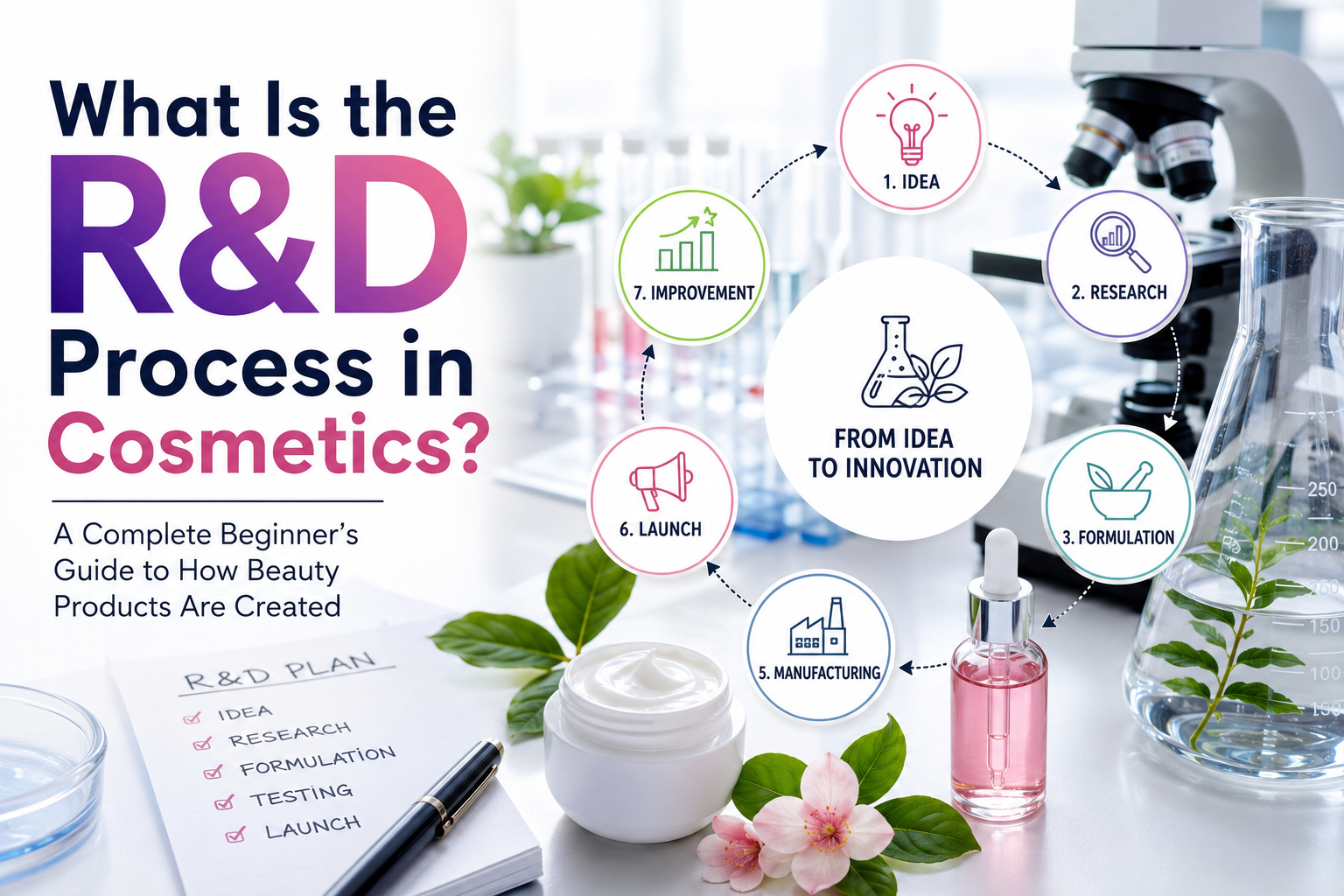
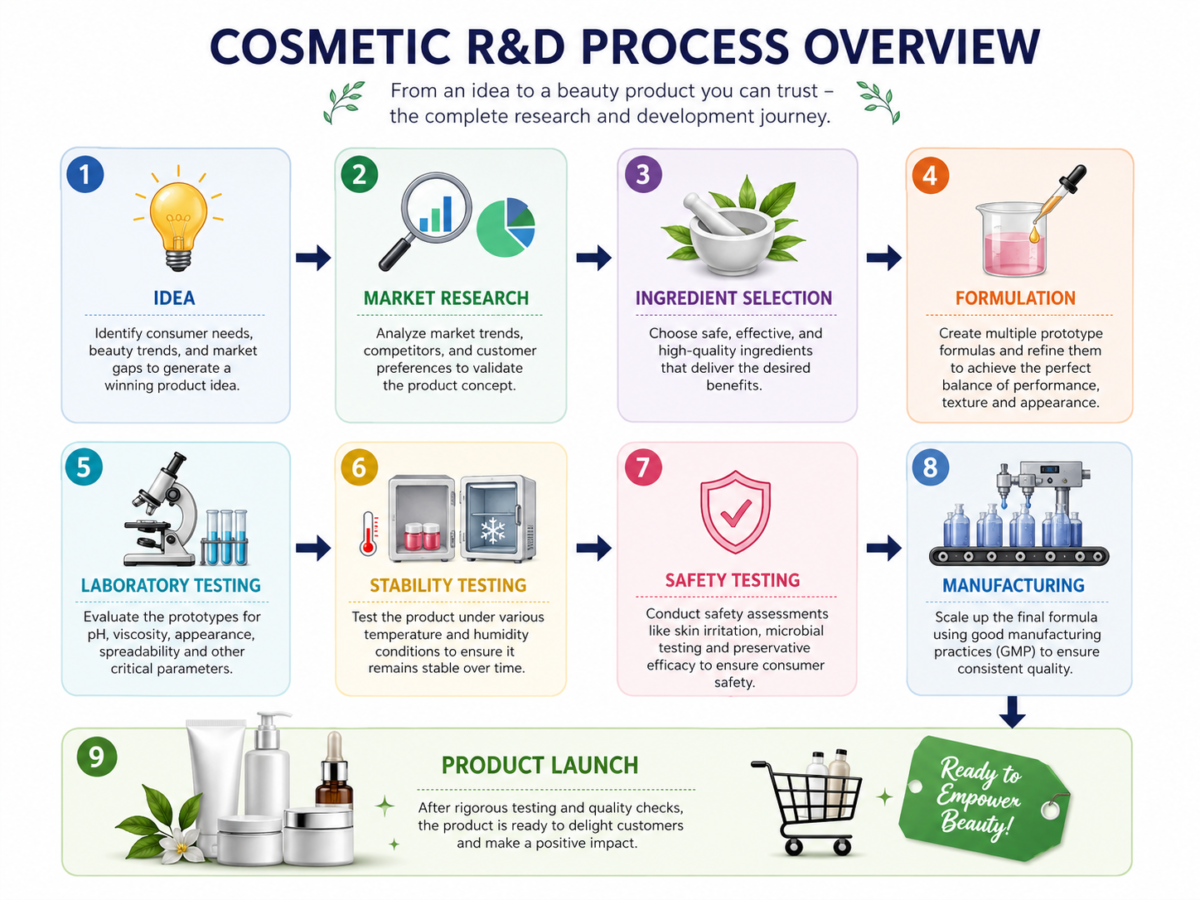
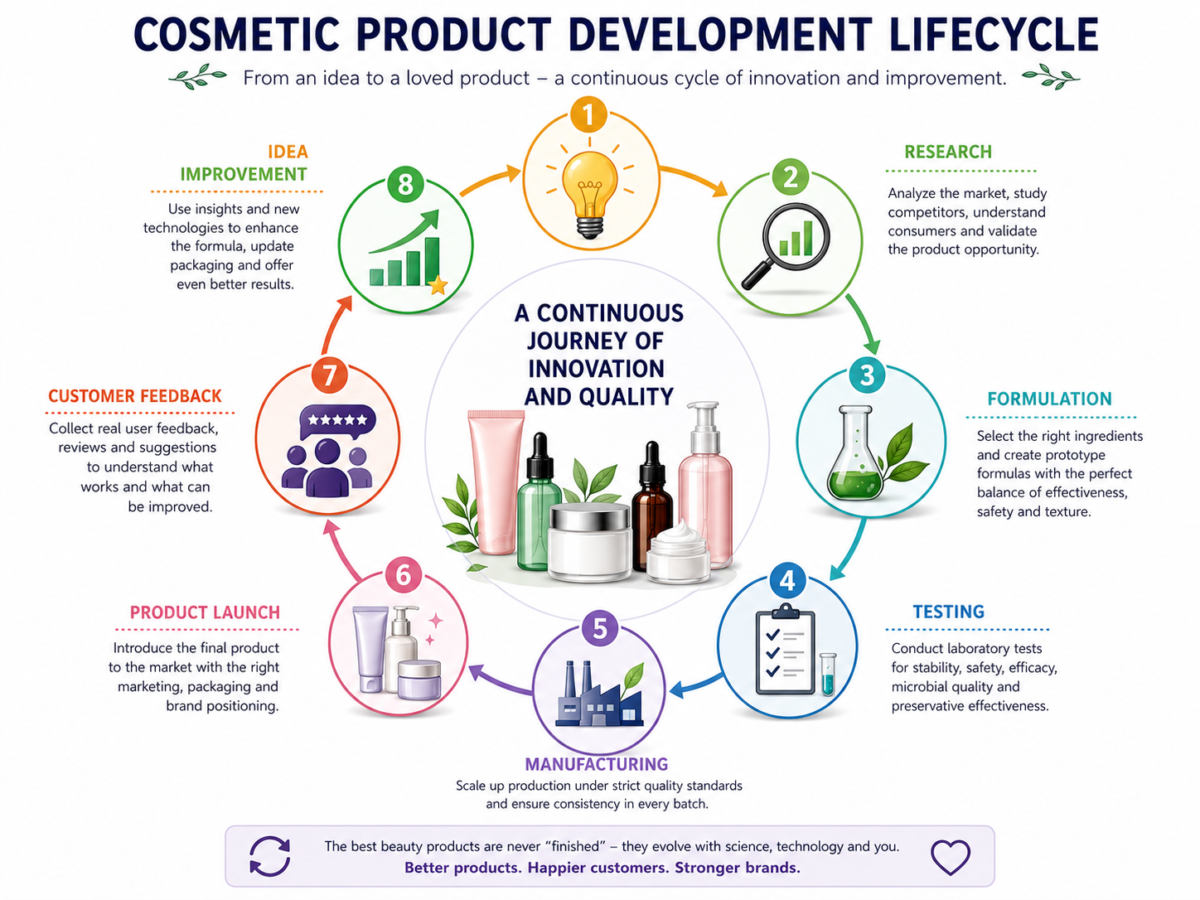
Step-by-Step R&D Process in Cosmetics
Every cosmetic product follows a structured research and development process before reaching consumers. While the exact workflow may differ from one company to another, most cosmetic manufacturers follow similar stages to ensure the product is safe, effective, stable, and suitable for the market.
Let’s explore each stage in detail.
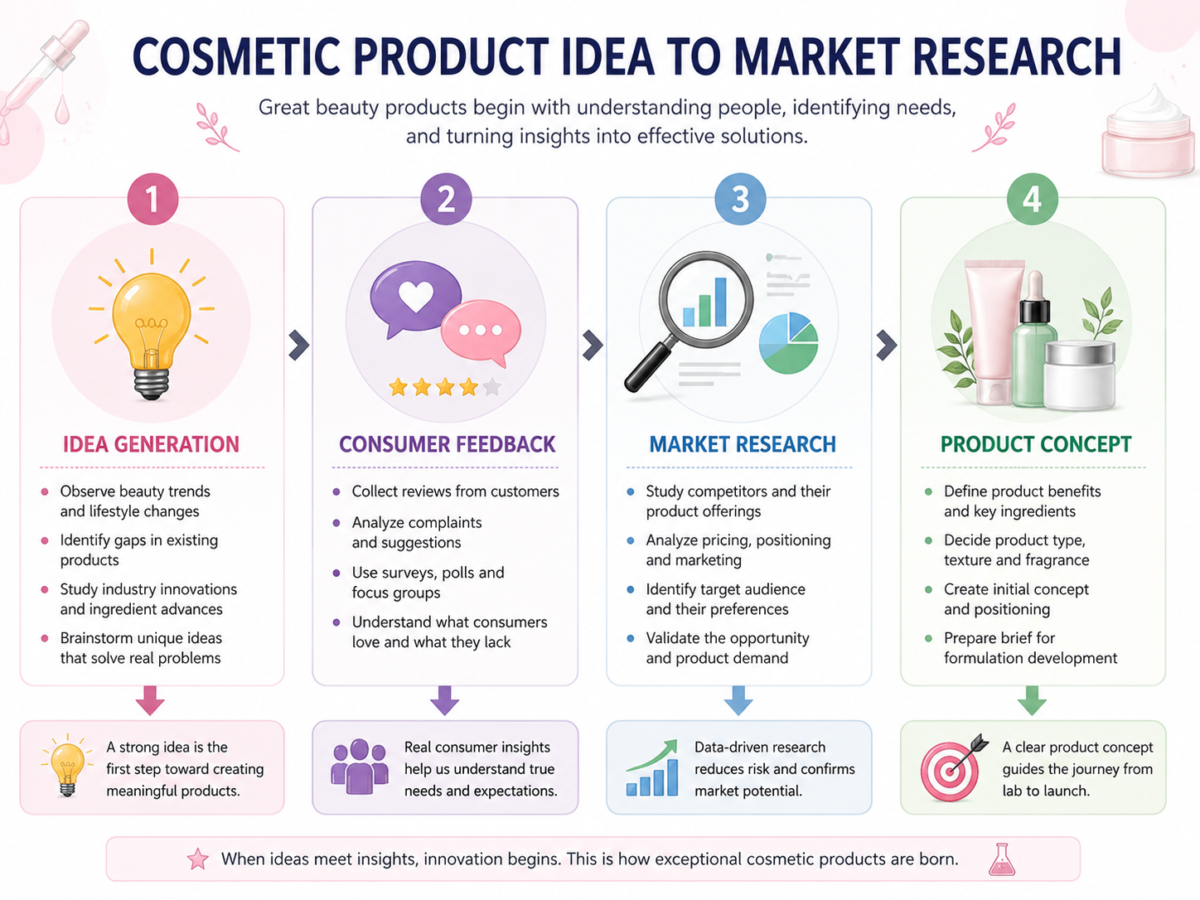
Step 1: Identifying the Product Idea
Every cosmetic product starts with an idea. This idea may come from changing beauty trends, customer feedback, scientific research, or a gap in the market.
For example, people may begin searching for fragrance-free moisturizers because they have sensitive skin. A company may notice this growing demand and decide to develop a gentle moisturizer that provides hydration without irritating ingredients.
Some product ideas are inspired by:
Consumer surveys
Social media beauty trends
Dermatologist recommendations
Competitor analysis
Advances in cosmetic science
Seasonal skincare needs
The goal is to develop a product that solves a real problem instead of simply adding another option to the market.
Practical Example
Suppose many customers complain that traditional sunscreens leave a white cast on darker skin tones. The R&D team may begin working on a lightweight sunscreen with transparent UV filters that blends more naturally into different skin tones.
Step 2: Market Research
Once the product idea is finalized, researchers study the market before creating the formula.
Market research helps answer important questions such as:
What do customers expect?
Which ingredients are currently popular?
What products already exist?
What price range will customers accept?
What problems do existing products have?
This stage helps companies avoid developing products that customers may not actually need.
For example, if consumers prefer lightweight gel moisturizers in humid climates, creating a heavy cream may not be the best choice.
Good market research reduces business risks and improves the chances of launching a successful product.
Step 3: Selecting Cosmetic Ingredients
After understanding customer needs, cosmetic scientists begin selecting ingredients.
Every ingredient has a specific purpose within the formula. Choosing the right combination is one of the most important parts of cosmetic R&D.
Some ingredients hydrate the skin, while others improve texture, preserve the product, or enhance its appearance.
Common ingredient categories include:
Active Ingredients
These provide the primary skincare benefits.
Examples include:
Niacinamide
Hyaluronic Acid
Ceramides
Vitamin C
Salicylic Acid
Panthenol
Base Ingredients
These make up the main structure of the product.
Examples include purified water, natural oils, plant butters, waxes, and emulsifiers.
Preservatives
Preservatives help protect cosmetic products from bacteria, mold, and yeast, extending their shelf life and maintaining safety.
Fragrances and Colors
Some formulations include fragrance or cosmetic colorants to improve the user experience. However, products designed for sensitive skin often use fragrance-free formulas to reduce the risk of irritation.
Practical Tip
Ingredient selection is not about adding as many ingredients as possible. A well-balanced formula with fewer compatible ingredients often performs better than a complicated formula containing dozens of unnecessary ingredients.
Step 4: Formulation Development
Once the ingredients are selected, cosmetic chemists begin creating trial formulations.
This is where science meets creativity.
Researchers prepare multiple versions of the product while adjusting ingredient percentages until they achieve the desired texture, appearance, stability, and performance.
For example, they may test different levels of:
Moisturizers
Emulsifiers
Thickening agents
Oils
Active ingredients
Preservatives
Each version is carefully documented so improvements can be made based on testing results.
Developing the right formula may require dozens of trials before the final version is approved.
Example
Imagine developing a facial cleanser.
The first formula may clean well but leave the skin feeling dry.
The second version may feel gentler but produce very little foam.
The third version may offer the ideal balance of cleansing, foam, and hydration.
This trial-and-improvement process is a normal part of cosmetic R&D and helps create products that customers enjoy using every day.
Step 5: Initial Laboratory Evaluation
After preparing trial formulations, researchers perform laboratory evaluations to identify any obvious issues before moving to advanced testing.
During this stage, they examine:
Product color
Texture
Fragrance
pH level
Thickness (viscosity)
Spreadability
Ease of application
Appearance after storage for a short period
If any problems appear, such as separation, unusual odor, or inconsistent texture, the formulation is adjusted and tested again.
This step saves time and resources by identifying potential issues early in the development process.
By the end of these first five stages, the cosmetic product has evolved from a simple idea into a carefully designed laboratory formulation. The next phase focuses on proving that the product remains stable, safe, and effective before it can be manufactured on a larger scale.
Testing and Quality Assurance in the Cosmetic R&D Process
Creating a cosmetic formula is only half the journey. Before a skincare or beauty product reaches consumers, it must pass several important tests to ensure it is safe, stable, and performs as expected. These tests help manufacturers identify potential issues early and deliver products that maintain their quality throughout their shelf life.
Step 6: Stability Testing
Stability testing checks whether a cosmetic product remains effective, safe, and visually appealing over time.
During this stage, products are stored under different environmental conditions to observe how they react. Researchers evaluate whether the formula maintains its original texture, color, fragrance, pH, and overall performance.
Common storage conditions include:
Room temperature
High temperatures
Low temperatures
High humidity
Repeated heating and cooling cycles
Scientists monitor the product for signs of instability, such as:
Separation of oil and water
Changes in color
Unpleasant odors
Thickening or thinning of the formula
Crystal formation
Packaging leakage
For example, a moisturizing cream that looks smooth when freshly prepared may begin separating after several weeks if the emulsion is not stable. Stability testing helps identify and correct such problems before the product reaches customers.
Step 7: Safety Testing
Safety is one of the most important priorities in cosmetic research and development. Even a highly effective product should not cause unnecessary irritation or discomfort when used as intended.
Safety testing helps confirm that the finished formulation is suitable for consumer use.
Depending on the product type and applicable regulations, manufacturers may evaluate:
Skin irritation potential
Eye irritation potential (for products used near the eyes)
Skin compatibility
Microbiological safety
Preservative effectiveness
For example, a facial cleanser designed for daily use should cleanse the skin without causing excessive dryness, redness, or irritation.
Many companies also conduct dermatologist-supervised evaluations to gather additional information about skin compatibility.
Step 8: Compatibility Testing
A cosmetic formula must work well not only on the skin but also with its packaging.
Compatibility testing evaluates whether the product interacts with the container, pump, cap, or tube over time.
Researchers check for issues such as:
Color changes caused by the packaging
Leaking containers
Cracked bottles or tubes
Changes in fragrance
Ingredient reactions with plastic or metal components
Imagine a vitamin C serum stored in unsuitable packaging. Exposure to light or air could reduce its stability and effectiveness. Choosing the right packaging is therefore an important part of product development.
Step 9: Preservative Effectiveness Testing
Most cosmetics contain water, which creates an environment where bacteria, mold, and yeast can grow if the product is not properly protected.
To prevent contamination, manufacturers perform preservative effectiveness testing.
During this process, the product is exposed to specific microorganisms under controlled laboratory conditions. Researchers then observe whether the preservative system can successfully control microbial growth.
A well-designed preservative system helps:
Extend product shelf life
Maintain product quality
Protect consumer safety
Prevent spoilage during normal use
This testing is especially important for products such as creams, lotions, gels, and cleansers that are frequently opened and handled by consumers.
Step 10: Pilot Batch Production
Once laboratory testing is successful, the formulation is produced on a larger scale through a pilot batch.
A pilot batch is a small manufacturing run that simulates actual factory production.
This stage helps verify that the formulation behaves the same way in manufacturing equipment as it did in the laboratory.
Researchers evaluate:
Mixing process
Heating and cooling conditions
Filling operations
Product consistency
Batch-to-batch uniformity
If any unexpected issues arise during production, adjustments can be made before full-scale manufacturing begins.
For example, a lotion that performs perfectly in a laboratory beaker may require different mixing speeds when produced in a large industrial vessel. Pilot production helps identify these practical challenges.
Step 11: Quality Control Evaluation
Before approval, every batch undergoes quality control (QC) testing to confirm that it meets the company’s predefined specifications.
Quality control teams examine several important characteristics, including:
Product appearance
Color consistency
Odor
pH
Viscosity
Weight or fill volume
Microbial limits
Packaging quality
Only products that meet all quality standards are approved for distribution.
Quality control ensures that every bottle, tube, or jar delivers a consistent experience to consumers, regardless of when or where it was manufactured.
Step 12: Regulatory Compliance and Documentation
Before a cosmetic product is launched, manufacturers must ensure it complies with the cosmetic regulations of the countries where it will be sold.
The R&D team works closely with regulatory and quality departments to prepare essential documentation, verify ingredient compliance, and confirm that product labels contain accurate information.
This process typically includes:
Verifying ingredient compliance with local regulations
Reviewing product claims
Preparing technical documentation
Confirming packaging labels
Checking manufacturing records
Ensuring safety assessments are complete
Following regulatory requirements helps protect consumers while ensuring that products can be legally marketed.
Step 13: Commercial Manufacturing and Product Launch
Once the product receives internal approval and meets all quality requirements, commercial manufacturing begins.
During production, manufacturers continue to monitor:
Raw material quality
Manufacturing conditions
Batch consistency
Packaging quality
Finished product testing
After passing final quality inspections, the product is distributed to retailers, online stores, pharmacies, supermarkets, or cosmetic outlets.
Although customers may only see the finished product on a shelf, it represents months of planning, research, testing, and collaboration across multiple departments.
Continuous Improvement After Launch
The R&D process does not end after the product is released.
Common reasons for improving an existing product include:
Better-performing ingredients become available.
Customer preferences change.
Packaging technology improves.
Sustainability goals evolve.
Updated cosmetic regulations require formula adjustments.
For example, if customers consistently request a lighter texture for a moisturizer, the R&D team may reformulate the product while maintaining its original skincare benefits.
Developing a cosmetic product is a team effort. Several professionals contribute their expertise throughout the R&D process.
Some of the key roles include:
Cosmetic Chemists
They develop and improve product formulations by selecting ingredients and optimizing product performance.
Research Scientists
They study new ingredients, technologies, and scientific findings to support innovation.
Microbiologists
They evaluate microbial safety and help ensure products remain free from harmful contamination.
Quality Control Analysts
They test raw materials, in-process samples, and finished products to ensure consistent quality.
Regulatory Affairs Specialists
They ensure products comply with cosmetic regulations and labeling requirements.
Packaging Engineers
They select packaging materials that protect the product while providing a positive consumer experience.
Each professional plays an important role in bringing safe, effective, and high-quality cosmetic products to the market.
Practical Tips for Consumers
Understanding the cosmetic R&D process can help you make smarter skincare choices.
Here are a few simple tips:
Read ingredient lists instead of relying only on marketing claims.
Choose products suitable for your skin type and concerns.
Perform a patch test before using a new skincare product.
Follow the recommended usage instructions.
Store cosmetics according to the manufacturer’s guidance.
Replace products that have expired or show changes in color, odor, or texture.
Being an informed consumer helps you get the most benefit from your skincare routine while reducing the risk of irritation or product misuse.
Frequently Asked Questions (FAQs)
1. What is R&D in the cosmetic industry?
R&D (Research and Development) is the process of researching, formulating, testing, improving, and validating cosmetic products before they are manufactured and sold to consumers.
2. Why is research and development important in cosmetics?
R&D ensures that cosmetic products are safe, effective, stable, and compliant with industry regulations. It also drives innovation and improves product quality.
3. How long does it take to develop a cosmetic product?
The development timeline depends on the product’s complexity. Many cosmetic products take several months to more than a year to complete, including formulation, testing, and quality evaluations.
4. What tests are performed during cosmetic R&D?
Common tests include stability testing, safety testing, microbiological testing, preservative effectiveness testing, compatibility testing, and quality control evaluations.
5. Can a cosmetic formula be improved after launch?
Yes. Many companies regularly update formulations based on scientific advancements, customer feedback, regulatory changes, and new ingredient technologies.
6. Does every cosmetic product go through the same R&D process?
The overall process is similar, but the specific testing requirements and development stages may vary depending on the product type, ingredients, intended use, and applicable regulations.
Conclusion
The research and development process is the foundation of every successful cosmetic product. From the first product idea to formulation development, laboratory testing, stability studies, safety evaluations, pilot manufacturing, quality control, and continuous improvement, each stage plays an important role in delivering products that consumers can trust.
Whether it is a gentle cleanser, nourishing moisturizer, brightening serum, or protective sunscreen, every well-developed cosmetic product reflects careful scientific research, technical expertise, and a commitment to quality.
For consumers, understanding the R&D process makes it easier to appreciate the effort behind everyday skincare products and encourages more informed purchasing decisions. For students and professionals interested in cosmetic science, learning about research and development provides valuable insight into one of the most innovative and rewarding areas of the beauty industry.
As cosmetic technology continues to evolve, research and development will remain at the heart of creating safer, smarter, and more effective products that meet the changing needs of consumers around the world.
Cosmetic products such as face washes, moisturizers, serums, sunscreens, shampoos, lip balms, and body lotions may look simple on the store shelf, but creating them is a detailed scientific process. Every product begins with a carefully planned cosmetic formulation that determines how well it performs, how safe it is for the skin, and how pleasant it feels during use.
A lightweight moisturizer that absorbs quickly, a vitamin C serum that remains stable for months, or a gentle cleanser that removes dirt without drying the skin are all the result of good cosmetic formulation. Behind every successful beauty product is a combination of science, research, testing, and creativity.
For beginners, the word cosmetic formulation can sound technical. However, the concept is actually quite simple. It means selecting the right ingredients and combining them in the correct amounts to create a cosmetic product that is safe, effective, stable, and enjoyable to use.
What Is Cosmetic Formulation?
Cosmetic formulation is the scientific process of designing and developing cosmetic and personal care products by combining different ingredients in specific proportions to achieve a desired purpose.
The goal is not simply to mix ingredients together. Instead, each ingredient is selected because it performs a specific function while working safely with the other ingredients in the formula.
For example, a simple facial moisturizer may contain:
Water for hydration
Humectants to attract moisture
Emollients to soften the skin
Emulsifiers to keep oil and water mixed
Preservatives to prevent microbial growth
Thickeners for the right texture
Antioxidants for product stability
Skin-beneficial active ingredients
Fragrance or fragrance-free components depending on the product
Each ingredient plays an important role. Removing or changing even one ingredient can affect the product’s texture, stability, effectiveness, or shelf life.
A cosmetic formulation is like following a recipe, but instead of baking a cake, cosmetic chemists create products that must remain safe, stable, and effective for months or even years.
Why Is Cosmetic Formulation Important?
Many people think that expensive ingredients alone create a high-quality skincare product. In reality, even premium ingredients cannot perform well without proper formulation.
A well-designed cosmetic formulation ensures that the product:
1. Delivers Effective Results
The ingredients should reach the skin properly and perform their intended function.
For example, niacinamide helps improve the skin barrier, but it must be formulated at an appropriate concentration and in a stable environment to provide visible benefits.
2. Remains Safe During Use
Every cosmetic product should be gentle enough for regular use while meeting safety standards.
Professional formulators carefully select ingredient levels to minimize irritation while maintaining product performance.
3. Stays Stable Throughout Its Shelf Life
Consumers expect products to look and perform the same from the first use until the last.
A properly formulated moisturizer should not:
Separate into oil and water
Change color unexpectedly
Develop an unpleasant smell
Lose its texture
Become contaminated with bacteria
This is why stability testing is an essential part of cosmetic formulation.
People often continue using products that feel comfortable on the skin.
A good formulation considers:
Smooth texture
Easy application
Fast absorption
Non-greasy finish
Comfortable after-feel
Suitable fragrance (or fragrance-free option)
The overall experience is just as important as the ingredients themselves.
5. Supports Product Compatibility
Many skincare users apply several products during one routine.
A good formulation helps products work well alongside cleansers, serums, moisturizers, and sunscreens without causing unnecessary pilling or irritation.
Main Goals of Cosmetic Formulation
Professional cosmetic formulators focus on several important objectives while developing products.
Safety
Every ingredient should be used within recommended limits and should comply with cosmetic regulations.
Safety is always the first priority before considering appearance or performance.
Stability
The product should remain consistent under different storage conditions.
It should maintain:
Color
Texture
Fragrance
Performance
Microbiological safety
Effectiveness
The product should perform its intended purpose.
Examples include:
Hydrating dry skin
Reducing oiliness
Supporting the skin barrier
Brightening dull skin
Improving skin texture
Cleansing impurities
Consumer Experience
People expect skincare products to feel pleasant.
A good formulation balances science with comfort by providing:
Smooth consistency
Easy spreading
Quick absorption
Elegant finish
Minimal stickiness
Manufacturing Efficiency
The formula should also be practical for large-scale production.
Manufacturers need products that can be produced consistently without quality variations.
Cosmetic Formulation vs Mixing Ingredients
One of the biggest misconceptions among beginners is believing that cosmetic formulation simply means mixing ingredients together.
This is not true.
Imagine making lemonade.
Anyone can mix water, sugar, and lemon juice.
Now imagine creating a sunscreen that remains stable in hot weather, protects the skin from UV rays, spreads evenly, stays effective for months, and passes safety testing. That requires scientific knowledge, careful calculations, specialized equipment, and extensive testing.
Professional cosmetic formulation involves understanding:
Ingredient compatibility
pH balance
Chemical stability
Preservation systems
Product texture
Skin compatibility
Manufacturing methods
Packaging interaction
Regulatory requirements
This is why experienced cosmetic chemists spend months developing a single product before it reaches the market.
Suppose a company wants to develop a lightweight moisturizer for oily skin.
Instead of adding random ingredients, the formulator carefully plans the formula.
The product may include:
Ingredient Type
Purpose
Water
Main base of the product
Glycerin
Attracts moisture to the skin
Lightweight Emollient
Softens skin without feeling greasy
Emulsifier
Combines oil and water into a smooth cream
Niacinamide
Supports the skin barrier and improves skin appearance
Preservative
Protects the product from harmful microorganisms
Thickener
Creates the desired cream texture
pH Adjuster
Maintains the ideal pH for stability and skin comfort
The formulator then performs multiple rounds of testing to ensure the moisturizer remains stable, safe, and effective before it is released to consumers.
This careful process is what makes cosmetic formulation both a science and an art
Types of Cosmetic Formulations
Not all cosmetic products are made in the same way. A face serum feels very different from a body lotion, and a shampoo behaves differently from a sunscreen. This is because each product is created using a specific type of cosmetic formulation that matches its purpose and the way it will be used.
Choosing the right formulation is one of the most important decisions during product development. Even if two products contain similar active ingredients, their performance can vary greatly depending on how they are formulated.
Below are the most common types of cosmetic formulations used in the beauty and personal care industry.
1. Cream Formulations
Creams are one of the most popular cosmetic formulations because they provide both hydration and nourishment.
They usually contain a balanced mixture of water and oils, held together by emulsifiers to create a smooth, stable texture.
Cream formulations are commonly used for:
Face moisturizers
Night creams
Anti-aging creams
Eye creams
Hand creams
Foot creams
Benefits
Deeply moisturize the skin
Help strengthen the skin barrier
Suitable for normal to dry skin
Easy to spread evenly
Example:
A winter moisturizing cream often contains shea butter, glycerin, ceramides, and plant oils to protect dry skin from moisture loss.
2. Lotion Formulations
Lotions contain more water and less oil than creams, making them lighter in texture.
They absorb quickly without leaving a heavy or greasy feeling, making them ideal for everyday use.
Lotions are commonly used for:
Body lotions
Facial moisturizers
Baby lotions
After-sun products
Benefits
Lightweight feel
Quick absorption
Comfortable in warm weather
Suitable for oily and combination skin
Example:
A lightweight daily body lotion may contain glycerin, aloe vera, and lightweight emollients to provide hydration without stickiness.
3. Gel Formulations
Gels are water-based formulations that provide hydration with little or no oil.
They are especially popular for oily and acne-prone skin because they feel refreshing and absorb quickly.
Common gel products include:
Aloe vera gels
Oil-free moisturizers
Acne treatment gels
Cooling gels
Eye gels
Benefits
Non-greasy texture
Fast absorption
Cooling effect
Ideal for humid climates
Example:
An oil-free hydrating gel with hyaluronic acid provides moisture while keeping the skin feeling fresh.
4. Serum Formulations
Serums are designed to deliver concentrated active ingredients directly to the skin.
Unlike creams, serums are usually thinner and focus on addressing specific skin concerns.
Popular serum ingredients include:
Vitamin C
Niacinamide
Hyaluronic acid
Peptides
Retinol
Tranexamic acid
Benefits
High concentration of active ingredients
Lightweight texture
Targets specific concerns
Easily layered into skincare routines
Example:
A Vitamin C serum is formulated to brighten dull skin while helping protect against environmental stress.
5. Oil-Based Formulations
Some cosmetic products rely mainly on oils instead of water.
These formulations help soften the skin and reduce moisture loss.
Examples include:
Facial oils
Beard oils
Massage oils
Cleansing oils
Hair oils
Benefits
Excellent for dry skin
Supports the skin barrier
Rich, nourishing feel
Helps lock in moisture
6. Foam Formulations
Foaming products are created using surfactants that generate lather when mixed with water.
They are commonly used for cleansing products.
Examples include:
Face washes
Body washes
Shampoos
Shaving foams
Benefits
Easy cleansing
Removes dirt and excess oil
Pleasant user experience
Simple to rinse off
7. Powder Formulations
Powders contain little or no water, which often gives them a longer shelf life.
Examples include:
Face powders
Compact powders
Loose powders
Dry shampoos
Clay masks
Benefits
Lightweight
Easy storage
Long-lasting
Convenient to carry
8. Balm Formulations
Balms are thick, semi-solid products made with waxes, oils, and butters.
Examples include:
Lip balms
Cleansing balms
Healing balms
Cuticle balms
Benefits
Forms a protective layer
Helps reduce moisture loss
Rich and nourishing
Ideal for dry areas
Main Categories of Ingredients Used in Cosmetic Formulation
Every cosmetic formula is made up of different ingredient groups. Each group has a specific purpose, and together they create a balanced, effective product.
Let’s explore the most common ingredient categories.
1. Base Ingredients
Base ingredients form the foundation of the product.
Without a suitable base, active ingredients cannot be distributed evenly.
Examples include:
Purified water
Plant oils
Mineral oils
Aloe vera juice
The base determines whether the product becomes a cream, lotion, gel, or serum.
2. Active Ingredients
Active ingredients provide the main skincare benefits.
These are the ingredients consumers often look for when purchasing skincare products.
Examples include:
Niacinamide
Vitamin C
Hyaluronic acid
Salicylic acid
Azelaic acid
Ceramides
Peptides
Panthenol
Each active ingredient is selected based on the product’s intended purpose.
For example:
A brightening serum may contain Vitamin C.
A hydrating serum may include hyaluronic acid.
A product for oily skin may use niacinamide to help improve the appearance of excess shine.
3. Emollients
Emollients soften and smooth the skin by improving its surface feel.
They also help reduce water loss from the skin.
Examples include:
Shea butter
Squalane
Jojoba oil
Caprylic/Capric Triglyceride
These ingredients contribute to the luxurious feel of creams and lotions.
4. Humectants
Humectants attract moisture and help keep the skin hydrated.
They are among the most commonly used ingredients in moisturizers and serums.
Examples include:
Glycerin
Hyaluronic acid
Propylene glycol
Sodium PCA
A well-formulated moisturizer often combines humectants with emollients for long-lasting hydration.
5. Emulsifiers
Oil and water naturally separate. Emulsifiers keep them blended into a smooth, uniform product.
Without emulsifiers, many creams and lotions would split into separate layers.
Common examples include:
Glyceryl Stearate
Cetearyl Alcohol (when used in emulsifying systems)
Polysorbates
Lecithin
These ingredients help create stable emulsions with an appealing texture.
6. Thickeners
Thickeners give products their desired consistency.
Without them, a cream might become too runny or difficult to apply.
Examples include:
Xanthan Gum
Carbomer
Cellulose Gum
Hydroxyethylcellulose
The right thickness improves both usability and consumer satisfaction.
7. Preservatives
Most cosmetics contain water, which can allow bacteria, mold, and yeast to grow if left unprotected.
Preservatives help keep products safe throughout their shelf life.
Examples include:
Phenoxyethanol
Sodium Benzoate
Potassium Sorbate
Ethylhexylglycerin
A properly preserved product remains safer to use after opening when stored as directed.
Step-by-Step Cosmetic Formulation Process
Creating a cosmetic product involves much more than combining ingredients in a mixing vessel. Professional formulators follow a structured development process to ensure every product is safe, stable, effective, and pleasant to use.
From the first idea to the finished product on store shelves, each stage plays an important role.
Let’s look at how cosmetic formulation works in real life.
Step 1: Define the Product Goal
Every cosmetic formulation begins with a clear objective.
Before selecting any ingredients, formulators ask questions such as:
What problem should this product solve?
Who will use it?
Which skin type is it designed for?
Will it be a cream, gel, lotion, or serum?
Should it feel lightweight or rich?
Will it be fragrance-free or scented?
These answers guide every decision during formulation.
Example
Imagine a company wants to create a daily moisturizer for oily skin.
The product should:
Hydrate without feeling greasy
Absorb quickly
Support the skin barrier
Layer well under sunscreen and makeup
Be suitable for everyday use
Once these goals are defined, ingredient selection becomes much easier.
Step 2: Select the Right Ingredients
This is one of the most important stages in cosmetic formulation.
Each ingredient is chosen for a specific purpose. A successful formula contains ingredients that work together rather than compete with one another.
A formulator typically selects:
A base ingredient
Moisturizing ingredients
Active ingredients
Texture enhancers
Preservatives
pH adjusters
Stabilizers
Antioxidants, if needed
Example
A beginner-friendly hydrating serum might include:
Purified water as the base
Glycerin to attract moisture
Hyaluronic acid for hydration
Panthenol to support the skin barrier
A preservative to help maintain product quality
A pH adjuster to keep the formula stable
Every ingredient is carefully measured and evaluated before production begins.
Step 3: Prepare the Formula
Once the ingredients have been selected, the formulator develops the first version of the formula.
This includes deciding:
Ingredient percentages
Mixing order
Heating temperature (if required)
Cooling process
Mixing speed
Processing time
Even small changes can affect the final product.
For example, adding an ingredient too early or at the wrong temperature may reduce its effectiveness or alter the texture.
Step 4: Create the First Prototype
The first batch is known as a prototype.
It allows the formulator to evaluate how the product performs before moving to large-scale manufacturing.
During this stage, they examine:
Texture
Color
Fragrance
Thickness
Spreadability
Absorption
Overall appearance
The first prototype is rarely perfect. Several improvements are often made before reaching the final version.
Step 5: Adjust the pH
The pH of a cosmetic product affects both product stability and skin comfort.
A formula with an unsuitable pH may:
Reduce ingredient performance
Increase the risk of irritation
Affect preservative effectiveness
Shorten shelf life
Most skincare products are formulated within a pH range that supports both skin compatibility and ingredient stability. However, the ideal pH depends on the product type and the ingredients used.
Practical Tip
Consumers should avoid changing the pH of homemade skincare products without proper testing. Even small adjustments can affect safety and performance.
Step 6: Stability Testing
A product may look perfect on the day it is made, but it also needs to remain stable over time.
Stability testing helps determine whether the formulation maintains its quality under different storage conditions.
During stability testing, formulators check whether the product:
Separates into layers
Changes color
Develops an unusual odor
Becomes too thick or too thin
Maintains its intended performance
Products are often evaluated after exposure to different temperatures, humidity levels, and storage conditions to understand how they behave over time.
Step 7: Microbiological Safety Testing
Many cosmetics contain water, making them more vulnerable to contamination by bacteria, yeast, and mold.
To help ensure product safety, manufacturers perform microbiological testing to confirm that the preservative system works as intended and that the product remains suitable for use during its expected shelf life.
This testing is especially important for products such as:
Face creams
Lotions
Serums
Cleansers
Hair conditioners
Without proper preservation, even a well-formulated product may become unsafe.
A cosmetic product should deliver the benefits promised on its label.
Performance evaluation helps determine whether the product meets its intended purpose.
Depending on the product, assessments may focus on:
Hydration
Smooth application
Cleansing ability
Shine reduction
Skin feel
Ease of rinsing
Consumer feedback also plays an important role in improving product performance before launch.
Step 9: Packaging Compatibility
Packaging is not just about appearance.
The container must protect the product throughout its shelf life.
Formulators evaluate whether the packaging:
Prevents leakage
Protects ingredients from light or air when necessary
Dispenses the correct amount of product
Maintains product quality during normal use
For example, ingredients that are sensitive to light or air are often packaged in opaque or air-reducing containers to help preserve their stability.
Step 10: Quality Control Before Production
Before a cosmetic product reaches consumers, manufacturers perform quality control checks to help ensure consistency.
These checks may include:
Appearance
Color
Odor
Texture
Viscosity
pH
Filling accuracy
Packaging quality
Only batches that meet the company’s quality standards move forward for distribution.
Common Challenges in Cosmetic Formulation
Even experienced cosmetic chemists face challenges while developing new products.
Here are some of the most common ones.
1. Ingredient Compatibility
Not all ingredients work well together.
Some combinations may reduce product stability or affect performance, so compatibility must be evaluated during development.
2. Texture Optimization
Consumers expect products to feel pleasant on the skin.
If a cream feels too heavy or a serum feels sticky, the formula may need further refinement.
3. Product Stability
A product should remain consistent throughout its intended shelf life.
Achieving long-term stability often requires repeated testing and adjustments.
4. Preservative Balance
Using too little preservative may not provide adequate protection, while excessive amounts may affect the product’s sensory feel or increase the likelihood of irritation for some users.
Finding the right balance is an important part of formulation.
5. Cost and Performance
Developing a high-quality product also involves balancing performance with manufacturing costs.
Formulators aim to create products that deliver reliable results while remaining practical to produce.
Future Trends in Cosmetic Formulation
The cosmetic industry is constantly evolving as consumer preferences, scientific research, and technology continue to advance. Modern cosmetic formulation is no longer focused only on creating effective products—it also emphasizes sustainability, transparency, and personalization.
Here are some of the major trends shaping the future of cosmetic formulation.
1. Sustainable Formulations
Consumers are increasingly looking for products that are environmentally responsible.
Many brands are now focusing on:
Biodegradable ingredients
Responsibly sourced raw materials
Water-saving formulations
Recyclable packaging
Reduced manufacturing waste
Sustainability is becoming an important consideration from product development through packaging.
2. Skin Barrier-Focused Products
Instead of using harsh ingredients, many modern formulations aim to support the skin’s natural protective barrier.
Common ingredients used for this purpose include:
Ceramides
Panthenol
Glycerin
Squalane
Oat extracts
These ingredients help improve skin comfort and hydration while supporting overall skin health.
3. Multi-Functional Products
Consumers often prefer products that offer multiple benefits in a single step.
Examples include:
Moisturizers with added hydration-supporting ingredients
Cleansers that remove impurities while helping maintain the skin barrier
Lip balms with nourishing botanical oils
Tinted moisturizers that combine hydration with light coverage
Well-designed multifunctional formulations can simplify daily skincare routines.
4. Personalized Skincare
Personalized beauty is becoming more popular as consumers recognize that every skin type has different needs.
Rather than creating one product for everyone, brands are developing formulations designed for concerns such as:
Dry skin
Oily skin
Sensitive skin
Mature skin
Acne-prone skin
Some companies also use digital skin assessments to recommend products based on individual needs.
5. Gentle and Minimalist Formulas
Many people now prefer simple skincare routines with fewer ingredients.
As a result, formulators are creating products that focus on essential ingredients while avoiding unnecessary complexity.
Minimalist formulations are often appreciated by people with sensitive skin because they reduce the number of potential irritants.
Common Beginner Mistakes to Avoid
Learning about cosmetic formulation can also help you avoid common skincare mistakes.
Buying Products Only Because of One Trending Ingredient
A product should never be judged by a single ingredient on the label.
For example, two niacinamide serums may contain the same active ingredient but perform differently because of differences in formulation, supporting ingredients, texture, and stability.
Always consider the complete formulation rather than focusing on one popular ingredient.
Using Too Many Active Ingredients at Once
Many beginners believe that using several active ingredients together will produce faster results.
In reality, using multiple products without understanding how they fit into a routine may increase the chance of irritation for some people.
A simple, consistent routine is often easier to manage and evaluate.
Ignoring Your Skin Type
Even a well-formulated product may not be suitable for everyone.
For example:
Rich creams may feel too heavy on oily skin.
Lightweight gels may not provide enough comfort for very dry skin.
Choosing products that match your skin type is just as important as choosing products with quality ingredients.
Believing Marketing Claims Without Reading Labels
Words such as “natural,” “premium,” or “advanced” do not automatically indicate product quality.
Instead, consider:
The ingredient list
Product purpose
Directions for use
Suitability for your skin type
Brand transparency
An informed purchase is usually better than one based solely on advertising.
How Understanding Cosmetic Formulation Helps Consumers
Learning the basics of cosmetic formulation offers several practical benefits.
It can help you:
Understand ingredient labels with greater confidence.
Choose products that suit your skin type and goals.
Appreciate why product texture, pH, and stability matter.
Compare products based on their overall formulation instead of marketing trends.
Build a simple, effective skincare routine with realistic expectations.
Whether you are a skincare enthusiast, a student, or someone planning to start a cosmetic business, this knowledge provides a strong foundation for making informed decisions.
Conclusion
Cosmetic formulation is the science of creating skincare and personal care products that are safe, stable, effective, and enjoyable to use. Every cleanser, serum, moisturizer, sunscreen, or shampoo is the result of careful planning, ingredient selection, testing, and quality control.
A successful cosmetic formulation is much more than a list of popular ingredients. It is about ensuring that each ingredient works well with the others, remains stable over time, and delivers the intended benefits while providing a pleasant user experience.
For consumers, understanding cosmetic formulation makes it easier to choose products based on quality rather than marketing claims. Instead of focusing only on trendy ingredients, you can evaluate the complete product, consider your skin type, and build a skincare routine that meets your individual needs.
As cosmetic science continues to evolve, formulations are becoming more innovative, sustainable, and personalized. Knowing the basics today will help you make smarter skincare decisions for years to come.
Frequently Asked Questions (FAQs)
1. What is cosmetic formulation?
Cosmetic formulation is the scientific process of selecting and combining ingredients in specific proportions to create safe, stable, and effective cosmetic and personal care products.
2. Who develops cosmetic formulations?
Cosmetic formulations are typically developed by cosmetic chemists, formulation scientists, or research and development (R&D) teams with expertise in cosmetic ingredients, product stability, and safety.
3. Why is cosmetic formulation important?
A good formulation helps ensure that a product performs as intended, remains stable throughout its shelf life, provides a pleasant user experience, and meets appropriate safety and quality standards.
4. What are the main ingredients used in cosmetic formulation?
Common ingredient categories include:
Base ingredients
Active ingredients
Humectants
Emollients
Emulsifiers
Thickeners
Preservatives
Antioxidants
pH adjusters
Each ingredient serves a specific purpose within the formula.
5. Can two products with the same active ingredient perform differently?
Yes. The overall formulation—including ingredient combinations, concentrations, pH, texture, and stability—can influence how a product performs.
6. Is cosmetic formulation only for skincare products?
No. Cosmetic formulation is used to develop a wide range of personal care products, including hair care, makeup, body care, oral care, fragrances, and personal hygiene products.
7. What is the difference between cosmetic formulation and cosmetic manufacturing?
Cosmetic formulation focuses on designing and developing the product recipe, while cosmetic manufacturing involves producing that formula on a larger scale under controlled conditions.
8. Can beginners learn cosmetic formulation?
Yes. Beginners can start by understanding ingredient functions, formulation basics, product types, and cosmetic safety. Advanced formulation requires specialized training, practical experience, and laboratory testing.
Have you ever bought an expensive skincare product but felt that it didn’t work as expected? Sometimes the problem is not the ingredients themselves—it is the pH level of the product. Many people focus only on ingredients like Vitamin C, Hyaluronic Acid, Niacinamide, or Salicylic Acid, but they often ignore one of the most important factors that determines how well these ingredients perform: pH.
Your skin naturally maintains a slightly acidic environment that protects it from harmful bacteria, pollution, and moisture loss. When skincare products have an unsuitable pH, they can disturb this natural balance, leading to dryness, irritation, breakouts, redness, and increased skin sensitivity. On the other hand, products with the right pH help your skin stay healthy, smooth, and better protected.
The good news is that understanding skincare pH is much easier than it sounds. You don’t need a science degree to choose the right products. Once you understand a few basic concepts, you’ll be able to build a skincare routine that supports your skin instead of damaging it.
In this beginner-friendly guide, you’ll learn what pH means, why it matters in skincare, how it affects different skin types, and how to choose products that keep your skin healthy and balanced.
What Does pH Mean?
The term pH stands for “Potential of Hydrogen.” It measures how acidic or alkaline a substance is. The pH scale ranges from 0 to 14.
0–6: Acidic
7: Neutral
8–14: Alkaline (Basic)
For example:
Lemon juice has a pH of around 2, making it highly acidic.
Pure water has a neutral pH of 7.
Baking soda has a pH of around 8–9, making it alkaline.
Your skin is naturally slightly acidic, which is one reason it can protect itself from harmful microbes and environmental damage.
Healthy skin usually has a pH between 4.7 and 5.5. This slightly acidic environment is often called the acid mantle.
The acid mantle is a very thin protective layer made from natural oils, sweat, and skin lipids. Although it is invisible, it plays a huge role in keeping your skin healthy.
It helps to:
Prevent harmful bacteria from growing.
Reduce moisture loss.
Keep the skin barrier strong.
Protect against environmental pollution.
Support healthy skin repair.
Think of your acid mantle like a protective shield. As long as this shield remains healthy, your skin can defend itself more effectively.
Every skincare product interacts with your skin’s natural pH. If the product is too alkaline or too acidic, it can weaken the skin barrier and reduce the effectiveness of important skincare ingredients.
Here are the biggest reasons why pH matters.
1. It Protects Your Skin Barrier
Your skin barrier is your body’s first line of defense against pollution, bacteria, UV damage, and moisture loss.
When skincare products have a balanced pH, they help preserve this protective barrier.
However, using products with an unsuitable pH may cause:
Dryness
Tightness
Redness
Increased sensitivity
Flaking
Itching
A healthy barrier also helps your moisturizer work better because your skin can retain water more effectively.
2. It Helps Active Ingredients Work Properly
Many popular skincare ingredients perform best only within a certain pH range.
For example:
Salicylic Acid works best in an acidic environment.
Glycolic Acid and Lactic Acid also require a lower pH.
Some forms of Vitamin C need an acidic pH for maximum absorption.
If the product’s pH is incorrect, these ingredients may become less effective.
Imagine trying to unlock a door with the wrong key. Even though you have the correct keychain, the door won’t open. Similarly, even excellent skincare ingredients may not deliver the expected results if the pH is unsuitable.
3. It Reduces Skin Irritation
Many people believe strong skincare products automatically give better results.
In reality, products that are too harsh often disturb the skin’s natural pH.
This may lead to:
Burning sensation
Redness
Peeling
Sensitive skin
Stinging after applying moisturizer
Balanced products are usually gentler and support healthier skin over time.
Acne-causing bacteria grow more easily when the skin barrier is damaged.
When your skin maintains its natural acidic pH, harmful bacteria have a harder time multiplying.
A balanced skincare routine can help:
Reduce breakouts
Calm inflammation
Support healing after acne
Prevent excessive oil production
This is one reason many dermatologists recommend gentle, pH-balanced cleansers for acne-prone skin.
How High and Low pH Affect Your Skin
Your skin works best when its natural pH stays between 4.7 and 5.5. When skincare products repeatedly push your skin above or below this range, your skin barrier can become stressed. This doesn’t usually happen after using a product once, but using the wrong products every day may eventually lead to skin problems.
Understanding the difference between high pH and low pH products can help you choose skincare more wisely.
What Happens If a Product Has a High pH?
A product with a high pH is more alkaline. Traditional soaps are a common example. While they may leave your skin feeling “squeaky clean,” that feeling often means your skin has lost too much of its natural oil.
Using high-pH products regularly may cause:
Dry and rough skin
Tightness after washing
Flaking
Redness
Increased sensitivity
Weakening of the skin barrier
For example, imagine washing your favorite cotton shirt with a very harsh detergent every day. Over time, the fabric becomes rough and worn out. Your skin barrier reacts in a similar way when exposed to harsh alkaline cleansers too often.
What Happens If a Product Has a Very Low pH?
Products with a low pH are more acidic. Many exfoliating products and chemical peels fall into this category because acids work best in an acidic environment.
When used correctly, these products can provide excellent benefits such as:
Removing dead skin cells
Brightening dull skin
Improving uneven texture
Reducing acne
Fading post-acne marks
However, using them too frequently or combining several acidic products in one routine may lead to:
Burning sensation
Redness
Peeling
Skin irritation
Increased sensitivity to sunlight
The key is balance. Acidic products can improve your skin, but they should be used according to your skin’s needs rather than every day.
Different skincare products are formulated with different pH levels depending on their purpose. While the exact pH varies from one brand to another, the following table gives a general idea.
Skincare Product
Typical pH Range
Main Purpose
Gentle Cleanser
5.0–6.0
Cleans skin without damaging the barrier
Facial Toner
4.5–6.0
Refreshes and prepares the skin
Moisturizer
5.0–6.5
Supports hydration and the skin barrier
Salicylic Acid Serum
3.0–4.0
Helps reduce acne and excess oil
Glycolic Acid Toner
3.0–4.0
Exfoliates dead skin cells
Vitamin C (L-Ascorbic Acid)
2.5–3.5
Brightens skin and reduces pigmentation
Sunscreen
Around 5.0–7.0
Protects against UV damage
Why pH-Balanced Cleansers Are Better
Cleansing is the first step in almost every skincare routine. Because it is used daily, the cleanser you choose has a significant impact on your skin’s overall health.
A pH-balanced cleanser removes:
Dirt
Sweat
Excess oil
Makeup residue
Sunscreen
without stripping away the skin’s natural protective oils.
After washing your face with a gentle cleanser, your skin should feel:
Fresh
Comfortable
Soft
Clean
It should not feel:
Tight
Dry
Painful
Squeaky clean
That uncomfortable tight feeling is often a sign that your cleanser is too harsh.
Yes. Regardless of your skin type, maintaining a healthy pH helps support the skin barrier. However, each skin type may notice different benefits.
Oily Skin
People with oily skin sometimes believe that stronger cleansers will remove oil more effectively. In reality, harsh cleansing can encourage the skin to produce even more oil.
A gentle pH-balanced cleanser helps remove excess sebum while keeping the skin barrier healthy.
Dry Skin
Dry skin already lacks sufficient moisture. High-pH products can make dryness even worse by increasing water loss.
Using pH-balanced skincare helps maintain hydration and improves skin comfort.
Combination Skin
Combination skin has both oily and dry areas. Gentle products with a balanced pH help cleanse oily zones without over-drying the cheeks or other dry areas.
Sensitive Skin
Sensitive skin reacts more easily to environmental changes and harsh ingredients.
A balanced pH helps reduce:
Redness
Irritation
Stinging
Skin discomfort
This is why many products designed for sensitive skin are carefully formulated to stay close to the skin’s natural pH.
Acne-Prone Skin
Healthy skin can naturally defend itself against acne-causing bacteria more effectively than damaged skin.
Using pH-balanced skincare supports the skin barrier while acne treatments target breakouts, creating a healthier environment for the skin to recover.
How to Tell If Your Skincare Is Affecting Your Skin’s pH
You don’t need special equipment to notice when your skincare routine may be disturbing your skin barrier. Your skin often gives clear signals.
Watch for signs such as:
Your face feels tight immediately after cleansing.
Moisturizer stings when applied.
Your skin becomes red more easily.
Dry patches appear even though you moisturize regularly.
Breakouts become more frequent after changing products.
Your skin feels unusually sensitive to products that never caused problems before.
If you notice several of these signs, consider simplifying your routine and choosing gentler, pH-balanced products until your skin feels comfortable again.
How pH Affects Popular Skincare Ingredients
Many skincare ingredients are effective only when they are formulated within a specific pH range. This is one reason why two products with the same ingredient may give different results. The quality of the formula, ingredient concentration, and pH all work together to determine how well a product performs.
Let’s look at some of the most popular skincare ingredients.
1. Vitamin C
Vitamin C is one of the most popular ingredients for brighter and healthier-looking skin. It helps improve uneven skin tone, supports collagen production, and protects the skin from environmental damage.
However, not every Vitamin C product works the same way.
The pure form of Vitamin C, known as L-Ascorbic Acid, performs best in a more acidic formula. If the pH is too high, the ingredient becomes less effective and may not absorb as well into the skin.
Beginner Tip
If you’re new to Vitamin C, start by using it 2–3 mornings per week before increasing the frequency. Always apply sunscreen during the day because healthy skin still needs UV protection.
2. Salicylic Acid
Salicylic Acid is a favorite ingredient for oily and acne-prone skin. It penetrates into pores, dissolves excess oil, and helps reduce blackheads and pimples.
Its performance depends greatly on maintaining an acidic pH.
Best For
Oily skin
Acne-prone skin
Blackheads
Whiteheads
Enlarged pores
Practical Tip
Avoid using multiple strong exfoliating products on the same day unless recommended by a skincare professional.
3. Glycolic Acid
Glycolic Acid belongs to the Alpha Hydroxy Acid (AHA) family. It removes dead skin cells from the surface of the skin, making the complexion look smoother and brighter.
Benefits include:
Smoother skin texture
Improved skin radiance
Reduced appearance of acne marks
Better absorption of moisturizers
Because it is an exfoliating acid, overuse may cause irritation. Beginners should use it only once or twice a week at first.
4. Lactic Acid
Lactic Acid is another AHA, but it is generally gentler than Glycolic Acid. It exfoliates while also helping the skin retain moisture, making it a good option for beginners and people with dry skin.
It can help improve:
Dullness
Rough skin
Mild pigmentation
Uneven texture
5. Niacinamide
Unlike many acids, Niacinamide is effective across a wider pH range, making it a versatile ingredient.
It helps:
Control excess oil
Reduce redness
Improve skin barrier function
Minimize the appearance of pores
Support an even skin tone
Because of its gentle nature, Niacinamide is suitable for most skin types, including sensitive skin.
Can You Mix Products with Different pH Levels?
This is one of the most common questions beginners ask.
The answer is yes, but timing and product compatibility matter.
Your skin naturally adjusts its pH after applying products, so you don’t need to worry about every product having exactly the same pH. However, combining several strong acidic products in one routine may increase the risk of irritation.
For example:
A Good Routine
Gentle Cleanser
Niacinamide Serum
Moisturizer
Sunscreen (Morning)
This routine is simple and suitable for many beginners.
A Routine That May Be Too Harsh
Glycolic Acid Toner
Salicylic Acid Serum
Vitamin C Serum
Strong Retinol
Using all of these active ingredients together in one session may overwhelm the skin, especially if you’re just starting out.
The best skincare routine is often the simplest one.
Common Myths About Skincare pH
There is a lot of confusing information online about skincare pH. Let’s clear up some common myths.
Myth 1: Lower pH Always Means Better Products
Reality: A very low pH is not automatically better.
Some ingredients require an acidic environment, but a product that is too acidic may irritate your skin if used incorrectly.
The goal is balance, not the lowest possible pH.
Myth 2: You Should Only Use Acidic Products
Reality: Not every skincare product needs to be highly acidic.
Cleansers, moisturizers, sunscreens, and serums are formulated differently depending on their purpose. A well-designed routine includes products that work together rather than products with the same pH.
Myth 3: If My Skin Tingles, the Product Is Working
Many people think a burning or stinging sensation means a product is effective.
In reality, persistent stinging may indicate irritation or a damaged skin barrier.
Healthy skincare should make your skin feel comfortable, not painful.
Myth 4: Oily Skin Doesn’t Need Gentle Products
Some people with oily skin wash their face multiple times a day using harsh cleansers.
This often backfires.
When the skin becomes too dry, it may produce even more oil to compensate.
Using a gentle pH-balanced cleanser usually helps maintain healthier oil levels over time.
Practical Tips for Maintaining Healthy Skin pH
You don’t need an expensive routine to support your skin’s natural pH. Small habits can make a big difference.
Choose a Gentle Cleanser
Avoid harsh soaps that leave your skin feeling tight. A mild cleanser is usually enough for daily use.
Don’t Overwash Your Face
For most people, cleansing twice a day is sufficient. Washing too frequently may strip away natural oils.
Moisturize Every Day
A good moisturizer helps strengthen the skin barrier and reduces moisture loss, regardless of your skin type.
Introduce Active Ingredients Slowly
When trying acids or Vitamin C for the first time, begin with a lower frequency. This allows your skin to adapt gradually.
Wear Sunscreen Daily
Even the best skincare routine cannot protect your skin from UV damage without sunscreen. Daily sun protection also helps maintain the results of your skincare products.
How to Choose pH-Friendly Skincare Products
With so many skincare products available, choosing the right ones can feel overwhelming. While most brands don’t clearly display the pH level on the packaging, you can still make smart choices by focusing on gentle, well-formulated products.
Here are a few simple tips:
Read the Product Description
Look for phrases such as:
pH-balanced
Gentle cleanser
Suitable for sensitive skin
Soap-free formula
Dermatologically tested
Although these claims don’t guarantee a perfect pH, they often indicate that the product is designed to support the skin barrier.
Avoid Overusing Harsh Cleansers
A cleanser should remove dirt, oil, sunscreen, and makeup without leaving your skin feeling dry or tight. If your face feels uncomfortable immediately after washing, it may be time to switch to a gentler formula.
Introduce New Products One at a Time
Trying several new products at once makes it difficult to identify which one is helping—or causing irritation. Add one product to your routine, use it consistently for a couple of weeks, and observe how your skin responds.
Keep Your Routine Simple
Many beginners believe they need a 10-step skincare routine. In reality, a simple routine is often more effective and easier to maintain.
A basic routine includes:
Morning
Gentle Cleanser
Moisturizer
Sunscreen
Evening
Gentle Cleanser
Treatment Serum (if needed)
Moisturizer
Once your skin adjusts well, you can gradually add other products based on your concerns.
Key Takeaways
Before you finish reading, remember these important points:
Healthy skin naturally has a slightly acidic pH of around 4.7–5.5.
This slightly acidic environment helps protect your skin barrier.
Harsh, high-pH products can lead to dryness, irritation, and increased sensitivity.
Some active ingredients, such as Salicylic Acid and L-Ascorbic Acid (Vitamin C), work best within specific pH ranges.
A simple, pH-balanced skincare routine is usually more effective than using too many products.
Consistency and patience are just as important as choosing the right ingredients.
Conclusion
The pH of your skincare products may seem like a small detail, but it plays a big role in keeping your skin healthy. A balanced pH helps maintain your skin’s natural protective barrier, supports hydration, and allows many active ingredients to perform effectively. When your skin barrier is healthy, your complexion is more likely to feel comfortable, look smoother, and become less prone to irritation.
You don’t need to memorize the pH of every product you buy. Instead, focus on choosing gentle cleansers, using active ingredients responsibly, moisturizing daily, and protecting your skin with sunscreen. These simple habits can help you build a routine that works with your skin rather than against it.
Skincare is a long-term journey, not a quick fix. Understanding pH gives you a stronger foundation for making informed decisions and achieving healthier skin over time.
Frequently Asked Questions (FAQs)
1. What is the ideal pH for healthy skin?
Healthy skin generally has a pH between 4.7 and 5.5, which helps maintain the skin barrier and protects against moisture loss and harmful microorganisms.
2. Why is a pH-balanced cleanser important?
A pH-balanced cleanser removes dirt, oil, and impurities without disrupting the skin’s natural protective barrier, reducing the risk of dryness and irritation.
3. Can the wrong pH cause acne?
An unsuitable pH doesn’t directly cause acne, but it can weaken the skin barrier and create conditions that may contribute to breakouts and inflammation.
4. How can I tell if my cleanser is too harsh?
If your skin feels tight, dry, itchy, or uncomfortable immediately after cleansing, your cleanser may be too harsh for your skin.
5. Are all soaps bad for the skin?
Not necessarily. However, many traditional soaps have a higher pH than the skin, so frequent use may lead to dryness and irritation. Gentle facial cleansers are often a better choice for daily use.
6. Does oily skin still need a pH-balanced cleanser?
Yes. Even oily skin benefits from a gentle cleanser. Harsh products can strip away natural oils, causing the skin to produce even more oil.
7. Do moisturizers have a pH level?
Yes. Most moisturizers are formulated to be compatible with the skin’s natural pH while helping maintain hydration and support the skin barrier.
8. Can I use Vitamin C and Salicylic Acid together?
Yes, but it depends on your skin type and tolerance. Beginners may find it easier to use them at different times of the day or on alternate days to minimize irritation.
9. Is pH the only factor that determines whether a skincare product is good?
No. Ingredient quality, formulation, concentration, packaging, and your skin type are also important. pH is one important part of an effective skincare product, but it is not the only factor.
10. How long does it take for the skin barrier to recover?
Recovery time varies depending on the level of damage and your skincare routine. Mild irritation may improve within a few days, while a more compromised skin barrier can take several weeks with gentle care and consistent moisturizing.
Have you ever wondered how your favorite face wash, sunscreen, moisturizer, or lipstick is made before it reaches the store? Every cosmetic product goes through a carefully planned manufacturing process known as cosmetic production. It is much more than simply mixing ingredients together. Every product must be researched, tested, manufactured, packed, and checked for quality before customers can safely use it.
Whether it is a gentle cleanser for sensitive skin or a bright lipstick for special occasions, cosmetic production ensures that every product meets safety standards, performs well, and provides a good user experience.
Understanding cosmetic production is helpful for skincare beginners, beauty enthusiasts, students, and anyone planning to start a cosmetic business. It also helps consumers appreciate why quality products are often worth the investment.
In this beginner-friendly guide, you will learn the meaning of cosmetic production, the departments involved, the production stages, examples, and the responsibilities of the people working behind every skincare and beauty product.
Cosmetic Production Definition
Cosmetic production is the complete process of manufacturing beauty and personal care products by using approved cosmetic ingredients under controlled conditions. The process includes planning, research, formulation, ingredient testing, manufacturing, quality inspection, packaging, labeling, and final distribution.
The goal of cosmetic production is not only to create attractive products but also to make sure they are:
Safe for human use
Effective for their intended purpose
Stable during storage
Free from contamination
Consistent in quality from batch to batch
In simple words, cosmetic production is the journey that transforms raw ingredients into finished skincare, haircare, makeup, and personal care products.
Cosmetic products come into direct contact with our skin, lips, scalp, or eyes. Poor manufacturing practices can cause irritation, allergies, infections, or product failure. That is why cosmetic production follows strict quality procedures.
Some major reasons why cosmetic production is important include:
1. Ensures Product Safety
Every ingredient is carefully measured and tested before production begins. Manufacturers follow hygiene standards to reduce contamination risks.
2. Maintains Product Quality
Customers expect the same texture, fragrance, color, and performance every time they purchase a product. Cosmetic production helps maintain this consistency.
3. Protects Consumer Health
Products are tested for stability, microbial safety, and compatibility before being sold.
4. Builds Brand Trust
When customers receive high-quality products consistently, they become loyal to the brand.
5. Supports Innovation
Modern cosmetic production allows companies to introduce better ingredients, eco-friendly packaging, and improved skincare technologies.
Examples of Cosmetic Products Made Through Cosmetic Production
Almost every beauty and personal care product goes through cosmetic production.
Some common examples include:
Face wash
Moisturizer
Sunscreen
Face serum
Toner
Lip balm
Lipstick
Foundation
Compact powder
Shampoo
Conditioner
Hair oil
Hair serum
Body lotion
Body wash
Hand cream
Deodorant
Perfume
Face mask
Scrubs
Although these products look very different, they all follow a systematic production process before reaching consumers.
Imagine a company wants to launch a new Vitamin C face serum.
The production journey may look like this:
The research team selects a stable form of Vitamin C.
The formulation expert develops the recipe.
Raw materials are purchased from approved suppliers.
Ingredients are mixed using industrial equipment.
The product is tested for safety and stability.
Quality inspectors approve the batch.
The serum is filled into bottles.
Labels are applied.
Products are packed into cartons.
The finished goods are shipped to distributors and retailers.
This entire journey is called cosmetic production.
Major Stages of Cosmetic Production (Step-by-Step Guide)
Cosmetic production follows a systematic process to ensure every product is safe, effective, and consistent. Whether a company manufactures a moisturizer, shampoo, sunscreen, or lipstick, the basic production stages are almost the same.
Let’s understand each stage in simple English.
1. Product Research and Market Analysis
Every cosmetic product starts with an idea.
Before manufacturing begins, companies study the market to understand what customers need. They research current beauty trends, consumer concerns, and popular ingredients.
For example:
People want fragrance-free skincare for sensitive skin.
Demand for mineral sunscreen is increasing.
More customers prefer vegan and cruelty-free cosmetics.
Lightweight moisturizers are becoming popular in hot climates.
The research team also studies competitor products to understand what improvements can be made.
Main Responsibilities
Identify customer needs
Study market trends
Analyze competitors
Decide the product category
Estimate product demand
Example: A skincare company notices that many people struggle with oily skin during summer. They decide to develop a lightweight gel moisturizer specially designed for oily skin.
2. Cosmetic Formulation and Product Development
Once the product idea is approved, cosmetic chemists begin creating the formula.
This is one of the most important stages because the product’s quality depends on its formulation.
The chemist carefully selects:
Active ingredients
Base ingredients
Emulsifiers
Preservatives
Fragrance (if needed)
Colorants (if required)
Stabilizers
Moisturizing agents
Different samples are prepared until the desired texture, fragrance, appearance, and performance are achieved.
Main Responsibilities
Develop the product formula
Choose safe ingredients
Ensure ingredient compatibility
Improve product texture
Achieve desired performance
Example: A Vitamin C serum may require several trial formulations before the chemist finds the perfect combination that remains stable for months.
3. Raw Material Procurement
After the formula is finalized, the purchasing department orders raw materials from approved suppliers.
Only high-quality ingredients should be used because poor-quality materials can reduce product effectiveness or cause safety issues.
Common raw materials include:
Plant extracts
Oils
Butters
Vitamins
Humectants
Emollients
Preservatives
Essential oils
Packaging materials
Every raw material is inspected before entering production.
Main Responsibilities
Purchase approved ingredients
Verify supplier quality
Check certificates
Store ingredients correctly
Maintain inventory
Example: If a supplier delivers aloe vera extract with incorrect specifications, it will be rejected before production begins.
4. Manufacturing and Mixing
This is where the cosmetic product is actually made.
Ingredients are measured accurately and mixed in large stainless steel manufacturing tanks.
Depending on the product type, different equipment may be used.
Examples include:
Mixing tanks
Heating vessels
Cooling systems
Homogenizers
Filling machines
Temperature, mixing speed, and production time are carefully controlled.
Main Responsibilities
Measure ingredients accurately
Follow manufacturing procedures
Monitor temperature
Maintain hygiene
Record batch information
Example: A moisturizer requires oil and water phases to be heated separately before being combined into a smooth cream.
5. Quality Control Testing
No cosmetic product should be sold without quality testing.
The quality control (QC) team checks whether the product meets company standards.
Common tests include:
Appearance
Color consistency
Fragrance
pH level
Viscosity
Stability
Microbial testing
Packaging inspection
Only approved batches move to the next stage.
Main Responsibilities
Test product safety
Verify product consistency
Approve or reject batches
Document inspection results
Example: If a face wash has the wrong pH level, it may irritate the skin. The QC team identifies this issue before the product reaches customers.
Departments Involved in Cosmetic Production
A cosmetic product is not made by one person or one machine. It is the result of teamwork between different departments. Each department has its own responsibilities, and together they ensure that every product is safe, effective, and ready for customers.
Let’s look at the main departments involved in cosmetic production.
The Research and Development (R&D) department is where new cosmetic products are created. This team studies market trends, explores new ingredients, and develops innovative formulations that meet customer needs.
R&D experts also improve existing products by making them more effective, gentler on the skin, or better suited to different skin types.
Main Responsibilities
Develop new cosmetic formulas
Improve existing products
Test ingredient compatibility
Study new skincare technologies
Conduct product trials
Example: If customers want a sunscreen that feels lighter on oily skin, the R&D team works on creating a non-greasy formula without reducing sun protection.
2. Purchasing and Procurement Department
The purchasing department ensures that all raw materials and packaging materials are available before production begins.
This department works closely with approved suppliers to source high-quality ingredients at the right price.
Main Responsibilities
Purchase raw materials
Select reliable suppliers
Verify ingredient quality certificates
Manage inventory
Ensure timely deliveries
A delay in raw material supply can slow down the entire production process, making this department very important.
3. Production Department
The production department is responsible for manufacturing cosmetic products according to approved formulas and standard operating procedures.
Operators carefully measure ingredients, monitor machines, and maintain cleanliness throughout the manufacturing process.
Main Responsibilities
Mix ingredients accurately
Operate manufacturing equipment
Follow production instructions
Maintain hygiene
Record batch information
Example: While producing a facial cleanser, the production team carefully controls the mixing speed and temperature to achieve the correct texture.
4. Quality Control (QC) Department
The Quality Control department checks products at different stages of manufacturing to make sure they meet quality standards.
This team inspects raw materials, monitors production, and tests finished products before they are released.
Main Responsibilities
Test raw materials
Check product appearance
Measure pH and viscosity
Conduct microbial testing
Approve or reject batches
Without quality control, unsafe or defective products could reach customers.
5. Quality Assurance (QA) Department
Many beginners confuse Quality Assurance with Quality Control, but their roles are different.
Quality Control (QC) checks the product.
Quality Assurance (QA) checks the entire production process.
QA ensures that every department follows approved procedures and maintains proper documentation.
Main Responsibilities
Monitor manufacturing processes
Conduct internal audits
Verify documentation
Ensure compliance with quality standards
Improve production systems
6. Packaging Department
Once the product passes quality inspection, it moves to the packaging department.
Packaging is not just about making products look attractive. It also protects the product from contamination, sunlight, moisture, and damage during transportation.
Main Responsibilities
Fill products into containers
Seal bottles and tubes
Apply labels
Print batch numbers
Pack products into cartons
Good packaging also helps customers understand how to use the product safely.
7. Warehouse and Inventory Department
After packaging, finished products are stored in warehouses until they are shipped.
Proper storage conditions help maintain product quality and shelf life.
Main Responsibilities
Store finished goods safely
Monitor stock levels
Manage inventory
Prepare shipments
Maintain storage conditions
8. Sales and Marketing Department
Even the best cosmetic product cannot succeed if people do not know about it.
The sales and marketing department promotes products through advertising, social media, websites, retail stores, and educational campaigns.
Main Responsibilities
Launch new products
Promote brand awareness
Conduct marketing campaigns
Gather customer feedback
Increase product sales
Customer feedback collected by this department often helps the R&D team improve future products.
How These Departments Work Together
Think of cosmetic production like preparing a healthy meal.
R&D creates the recipe.
Purchasing buys fresh ingredients.
Production cooks the meal.
Quality Control checks the taste and safety.
Packaging prepares it for customers.
Warehouse stores it properly.
Sales introduces it to the market.
If one department does not perform its job properly, the final product may not meet customer expectations.
Responsibilities in Cosmetic Production
Cosmetic production is not just about making beauty products. Every team member has a responsibility to ensure that products are safe, effective, and meet customer expectations. Below are the key responsibilities involved in the cosmetic production process.
1. Ensuring Product Safety
Safety is the top priority. Manufacturers must use approved cosmetic ingredients and follow strict hygiene practices. Every batch should be tested before it reaches the market.
2. Maintaining Consistent Quality
Customers expect the same texture, fragrance, color, and performance every time they buy a product. Maintaining consistency is one of the biggest responsibilities in cosmetic production.
3. Following Standard Operating Procedures (SOPs)
Every manufacturing step must follow written procedures. This helps reduce errors and ensures every batch is produced correctly.
4. Keeping Accurate Records
Production details, batch numbers, ingredient quantities, and quality test results should be properly documented. Good record-keeping helps trace products if any issue arises later.
5. Maintaining Clean Manufacturing Facilities
Machines, equipment, and production areas should be cleaned regularly to prevent contamination and protect product quality.
6. Improving Products Continuously
Consumer needs and skincare trends change over time. Cosmetic companies should regularly improve formulations, packaging, and production methods to offer better products.
Common Challenges in Cosmetic Production
Although cosmetic manufacturing is highly organized, companies still face several challenges.
Raw Material Availability
Natural ingredients may become difficult to source due to seasonal changes or supply chain disruptions.
Maintaining Product Stability
Some active ingredients are sensitive to heat, light, or air. Manufacturers must ensure products remain stable throughout their shelf life.
Quality Consistency
Producing thousands of identical products requires strict monitoring and quality checks.
Packaging Compatibility
A good formula can still fail if the packaging reacts with the ingredients or does not protect the product properly.
Meeting Customer Expectations
Consumers today expect products that are effective, affordable, environmentally friendly, and suitable for different skin types.
Practical Tips for Choosing Quality Cosmetic Products
Understanding cosmetic production can help you make smarter skincare choices. Here are a few practical tips:
Buy products from trusted and reputable brands.
Read the ingredient list before purchasing.
Choose products suitable for your skin type.
Check the manufacturing and expiry dates.
Avoid products with damaged or broken packaging.
Always perform a patch test before trying a new skincare product.
Store cosmetics in a cool, dry place away from direct sunlight.
Follow the usage instructions provided on the label.
Remember, even a well-made product may not suit everyone. Your skin type, lifestyle, and personal sensitivities all play a role in how a product performs.
Conclusion
Cosmetic production is a carefully managed process that transforms raw ingredients into safe, effective, and high-quality beauty products. From product research and formulation to manufacturing, quality control, packaging, and distribution, every stage plays an important role in delivering products that consumers can trust.
Behind every moisturizer, sunscreen, shampoo, or lipstick is a team of professionals working together to ensure safety, consistency, and performance. Understanding this process not only helps you appreciate the effort involved in creating cosmetics but also enables you to make better purchasing decisions.
Whether you are a skincare beginner, a beauty enthusiast, or someone planning to enter the cosmetic industry, learning about cosmetic production provides a strong foundation for understanding how modern beauty products are developed and manufactured.
Frequently Asked Questions (FAQs)
1. What is cosmetic production?
Cosmetic production is the complete process of manufacturing beauty and personal care products, including research, formulation, production, quality testing, packaging, and distribution.
2. Why is cosmetic production important?
It ensures cosmetic products are safe, effective, hygienic, and consistent in quality before reaching consumers.
3. What are the main stages of cosmetic production?
The main stages include product research, formulation, raw material procurement, manufacturing, quality control, packaging, and distribution.
4. Which department develops new cosmetic products?
The Research and Development (R&D) department is responsible for creating and improving cosmetic formulations.
5. What is the role of Quality Control in cosmetic production?
Quality Control tests raw materials and finished products to ensure they meet safety and quality standards.
6. What is the difference between Quality Assurance and Quality Control?
Quality Assurance focuses on improving the manufacturing process, while Quality Control tests the products themselves.
7. What products are made through cosmetic production?
Face washes, moisturizers, sunscreens, serums, shampoos, conditioners, lipsticks, perfumes, body lotions, and many other beauty products.
8. Why are raw materials important in cosmetic production?
High-quality raw materials help produce safe, effective, and reliable cosmetic products with consistent performance.
9. How can consumers identify quality cosmetic products?
Look for trusted brands, proper labeling, manufacturing and expiry dates, ingredient lists, and undamaged packaging.
10. Can cosmetic production affect product performance?
Yes. Even with excellent ingredients, poor manufacturing practices can reduce a product’s effectiveness, stability, and safety.
Have you ever picked up a skincare product because the packaging looked attractive, only to find that it didn’t work for your skin?
You’re not alone.
Many people spend money on creams, serums, face washes, and sunscreens without reading the product label. Instead, they trust advertisements, social media influencers, or eye-catching packaging. Unfortunately, beautiful packaging doesn’t always mean the product is suitable for your skin.
The label on a cosmetic product is one of the most valuable sources of information. It tells you what ingredients are inside, who the product is designed for, how to use it correctly, when it expires, and whether it meets safety standards.
Learning to read cosmetic labels doesn’t require a chemistry degree. Once you understand a few basic terms and symbols, shopping for skincare becomes much easier and safer.
In this guide, you’ll learn how to read cosmetic product labels step by step, understand ingredient lists, identify misleading marketing claims, and make smarter skincare choices with confidence.
Why Reading Cosmetic Labels Is Important
Reading a cosmetic label helps you make informed decisions instead of buying products based only on attractive advertisements.
A label can tell you:
Whether the product suits your skin type
Which active ingredients it contains
How much of an ingredient is likely present
Whether it contains potential allergens
How to use it safely
Storage instructions
Expiry information
Manufacturer details
Safety warnings
For example, imagine buying a moisturizer labeled as “hydrating.” If you read the ingredient list carefully, you might discover that it contains alcohol high on the list, which may not be ideal for very dry or sensitive skin.
Similarly, a sunscreen may advertise “SPF 50,” but the label also reveals whether it offers broad-spectrum UVA and UVB protection—something that’s just as important as the SPF number.
Reading labels helps you avoid costly mistakes and choose products that actually benefit your skin.
What Information Is Found on a Cosmetic Product Label?
Most cosmetic products include several important sections on their packaging. Understanding each section makes product selection much easier.
Step 1: Read the Product Name Carefully
The first thing people notice is usually the product name.
However, product names often focus on marketing rather than functionality.
For example:
Brightening Face Cream
Glow Booster Serum
Instant Fairness Cream
Miracle Repair Gel
These names sound impressive but don’t explain what the product actually contains.
Instead, look for descriptive terms like:
Niacinamide Serum
Vitamin C Serum
Salicylic Acid Face Wash
Ceramide Moisturizer
Zinc Oxide Sunscreen
These names tell you the main active ingredient and make it easier to understand the product’s purpose.
Practical Tip: Always check whether the product name matches the ingredient list. A product claiming to be a “Vitamin C Serum” should list a Vitamin C ingredient near the top of the ingredient list.
Step 2: Understand What the Product Is Designed to Do
Most cosmetic labels clearly mention the product category or intended use.
Examples include:
Cleanser
Moisturizer
Sunscreen
Toner
Serum
Face Mask
Lip Balm
Shampoo
Conditioner
The label may also mention specific skin concerns, such as:
Acne-prone skin
Dry skin
Oily skin
Sensitive skin
Combination skin
Pigmentation
Anti-aging
Dull skin
This helps narrow down whether the product is suitable for your skincare routine.
For instance, someone with oily skin may prefer a lightweight gel moisturizer, while someone with dry skin might need a richer cream.
Step 3: Learn How Ingredient Lists Work
The ingredient list is the most important part of any cosmetic label.
Ingredients are generally listed in descending order of concentration. This means the ingredient present in the highest amount appears first, while those in smaller amounts appear later.
Active ingredients are the components responsible for delivering the product’s main benefits.
Common skincare actives include:
Ingredient
Main Benefit
Niacinamide
Controls oil, improves skin barrier
Vitamin C
Brightens skin and reduces dullness
Hyaluronic Acid
Deep hydration
Salicylic Acid
Treats acne and unclogs pores
Glycolic Acid
Gentle exfoliation
Lactic Acid
Smoothens skin texture
Ceramides
Strengthen skin barrier
Retinol
Reduces signs of aging
Zinc Oxide
Mineral sun protection
Titanium Dioxide
UV protection
nowing these ingredients helps you choose products based on your skin concerns rather than marketing claims.
For example:
Acne → Salicylic Acid
Dry skin → Ceramides + Hyaluronic Acid
Pigmentation → Vitamin C + Niacinamide
Fine lines → Retinol
Sensitive skin → Panthenol + Ceramides
Step 5: Understand Cosmetic Claims on the Front Label
The front of a cosmetic package often contains attractive claims designed to catch your attention. While many of these claims are useful, some are simply marketing terms and don’t always guarantee better performance.
Here are some of the most common cosmetic claims and what they generally mean.
Dermatologically Tested
This means the product has been tested on human skin under the supervision of dermatologists.
However, it does not guarantee that the product is suitable for everyone or that it is allergy-free.
Tip: Even if a product is dermatologically tested, always perform a patch test if you have sensitive skin.
Hypoallergenic
A hypoallergenic product is formulated to reduce the chances of causing allergic reactions.
Keep in mind that “hypoallergenic” does not mean “allergy-proof.” Every person’s skin reacts differently.
Non-Comedogenic
This is one of the most useful claims for people with oily or acne-prone skin.
Non-comedogenic means the product is formulated to avoid clogging pores.
Examples include:
Oil-free moisturizers
Gel sunscreens
Lightweight foundations
Fragrance-Free
Many people confuse Fragrance-Free with Unscented, but they are not the same.
Fragrance-Free
No fragrance has been added.
Unscented
The product may contain fragrance ingredients that mask the smell of other ingredients.
If you have sensitive skin, fragrance-free products are usually the safer choice.
Alcohol-Free
Not every alcohol is harmful.
There are two main types:
Drying Alcohols
Alcohol Denat.
Ethanol
Isopropyl Alcohol
These may dry out sensitive skin.
Fatty Alcohols
Cetyl Alcohol
Cetearyl Alcohol
Stearyl Alcohol
These actually help moisturize and soften the skin.
Always read the full ingredient list rather than avoiding every ingredient with the word “alcohol.”
Many cosmetic packages include small symbols that provide important information.
Open Jar Symbol (PAO)
One of the most common symbols is an open jar with a number.
Examples:
6M
12M
24M
This stands for Period After Opening (PAO).
It tells you how long the product remains safe after opening.
For example:
6M = Use within 6 months after opening.
12M = Use within 12 months.
24M = Use within 24 months.
If your moisturizer has a 12M symbol and you opened it in January, you should aim to finish it before the following January.
Recycling Symbol
This symbol indicates that the packaging is recyclable.
Some brands also mention:
Recycled plastic
Refillable packaging
Eco-friendly materials
These labels can help you make more sustainable choices.
Cruelty-Free Symbol
A bunny logo usually indicates that the product or its ingredients were not tested on animals.
However, it’s still helpful to check whether the claim is supported by a recognized certification.
Vegan Symbol
A vegan cosmetic product does not contain animal-derived ingredients.
Examples of ingredients not used in vegan products include:
Beeswax
Lanolin
Carmine
Collagen from animal sources
Step 9: Manufacturing Date vs Expiry Date
Many shoppers only check the expiry date, but the manufacturing date is equally important.
Manufacturing Date
This tells you when the product was made.
Example:
Manufactured: March 2026
Expiry Date
This indicates the last recommended date for using an unopened product.
Example:
Expires: March 2029
Always avoid buying products that are close to their expiry date, especially if you don’t plan to use them immediately.
Step 10: What Is a Batch Number?
Every cosmetic product has a unique batch or lot number.
Manufacturers use this number to:
Track production
Identify quality issues
Recall defective batches if necessary
If a company announces a product recall, the batch number helps consumers determine whether their product is affected.
Step 11: How to Spot Misleading Cosmetic Labels
Not every claim printed on a cosmetic package tells the full story. Some labels use attractive words that sound scientific or impressive but don’t always provide meaningful information.
Learning to identify these marketing terms can help you make smarter purchasing decisions.
Here are a few examples.
“Natural”
Many people assume that a product labeled Natural is automatically safer or better.
However, in many countries, there is no single universal definition of the word “natural” for cosmetics.
Organic”
Organic products usually contain ingredients grown without certain synthetic pesticides or fertilizers.
However, not every product labeled “organic” is made entirely from organic ingredients.
“Chemical-Free”
This is one of the most misleading cosmetic claims.
Everything—including water—is a chemical.
So, no cosmetic product is truly “chemical-free.”
“Clinically Proven”
This phrase sounds convincing, but it doesn’t always explain:
How many people were tested
How long the study lasted
Step 12: How to Read Sunscreen Labels Correctly
Sunscreen is one of the most important skincare products, and understanding its label helps ensure you’re getting effective protection.
SPF Number
SPF stands for Sun Protection Factor.
Common options include:
SPF 30
SPF 50
SPF 50+
Higher SPF provides greater protection against UVB rays, but no sunscreen blocks 100% of UV rays.
For everyday use, SPF 30 or higher is generally recommended.
Step 13: Understanding Cosmetic Certifications
Some cosmetic products carry certifications from recognized organizations.
These certifications can provide additional confidence about certain product standards.
Examples include:
Cruelty-Free Certification
Vegan Certification
Organic Certification
Dermatologist Tested
ISO Manufacturing Standards
Good Manufacturing Practice (GMP)
Step 14: Check the Manufacturer Information
A trustworthy cosmetic product should clearly mention:
Manufacturer’s name
Company address
Customer care details
Website
Country of origin
This information makes it easier to contact the company if you have questions or concerns.
Avoid products with unclear or missing manufacturer information.
Step 15: Read the Directions Before Using Any Product
Many skincare problems happen simply because products are used incorrectly.
Always read the usage instructions.
For example:
Vitamin C Serum
Directions may say:
Apply in the morning.
Follow with sunscreen.
Step 16: Always Read the Warnings
The warning section is often overlooked, but it’s one of the most important parts of the label.
Common warnings include:
For external use only
Avoid contact with eyes
Keep out of reach of children
Discontinue use if irritation occurs
Store in a cool, dry place
Step 17: Patch Testing Is Essential
Even if a product has excellent reviews and high-quality ingredients, your skin may react differently.
A simple patch test can help identify irritation before applying the product to your entire face.
How to Patch Test
Apply a small amount behind the ear or on the inner forearm.
Leave it for 24–48 hours.
Watch for redness, itching, swelling, or burning.
If no reaction occurs, begin using the product as directed.
Common Mistakes People Make While Reading Cosmetic Labels
Even after checking the label, many shoppers still make mistakes that can lead to buying the wrong product. Avoiding these common errors will help you choose skincare products more confidently.
1. Buying Based Only on the Front Label
Words like “Glow,” “Natural,” “Instant Brightening,” or “Premium Formula” may catch your attention, but they don’t tell the complete story.
Always turn the product around and read the ingredient list, directions, and warnings before purchasing.
2. Ignoring the Ingredient List
Many people buy a product because it contains one popular ingredient, such as Vitamin C or Niacinamide, without checking what else is inside.
The ingredient list helps you understand whether the product also contains fragrance, drying alcohols, or other ingredients that may not suit your skin.
3. Not Checking the Expiry Date
Using expired cosmetics may reduce effectiveness and increase the risk of irritation or contamination.
Always check:
Manufacturing Date
Expiry Date
Period After Opening (PAO)
4. Believing Every Marketing Claim
Claims like:
Chemical-Free
Miracle Formula
Instant Results
100% Safe
should always be viewed with caution.
Instead, focus on ingredients, directions, and product quality.
5. Choosing Products Without Considering Your Skin Type
A moisturizer that works well for dry skin may feel heavy on oily skin.
Similarly, a strong acne treatment may irritate sensitive skin.
Always match the product to your individual skin needs rather than following trends.
Conclusion
Reading the labeling of cosmetic products is one of the easiest ways to become a smarter skincare shopper. A few extra minutes spent checking the ingredient list, expiry date, usage instructions, and safety information can help you avoid unsuitable products and choose ones that truly match your skin’s needs.
Remember that attractive packaging and bold marketing claims don’t always reflect product quality. The real value lies in understanding what’s inside the bottle, how to use it correctly, and whether it suits your skin type.
As you become familiar with common ingredients, cosmetic symbols, and label terminology, reading product labels will become second nature. This knowledge allows you to invest in skincare more confidently, avoid unnecessary irritation, and build a routine based on facts rather than advertising.
The next time you shop for a cleanser, serum, moisturizer, or sunscreen, take a moment to read the label carefully. Your skin will thank you for making informed choices.
Frequently Asked Questions (FAQs)
1. Why is it important to read cosmetic product labels?
Reading cosmetic labels helps you understand the ingredients, directions, warnings, expiry dates, and product claims so you can choose products that suit your skin type and concerns.
2. What does the ingredient order on a cosmetic label mean?
Ingredients are generally listed from the highest concentration to the lowest concentration. The first few ingredients make up most of the product’s formula.
3. What does “non-comedogenic” mean?
Non-comedogenic means the product is formulated to reduce the likelihood of clogging pores, making it a popular choice for oily and acne-prone skin.
4. Is “fragrance-free” the same as “unscented”?
No. Fragrance-free products do not contain added fragrance, while unscented products may include fragrance ingredients to neutralize odors.
5. What is the PAO symbol on cosmetic packaging?
The Period After Opening (PAO) symbol shows how long a product is recommended to be used after it has been opened, such as 6M, 12M, or 24M.
6. What should I check before buying a skincare product?
Check the ingredient list, skin type suitability, expiry date, directions, warnings, manufacturer details, and active ingredients before purchasing.
7. Can I use cosmetics after their expiry date?
It’s generally not recommended. Expired products may lose effectiveness and could increase the risk of skin irritation or contamination.
8. Are products labeled “natural” always better?
Not necessarily. The word “natural” doesn’t always guarantee better quality or suitability. Always read the ingredient list instead of relying only on front-label claims.
9. How can I know if a cosmetic product is genuine?
Purchase from trusted retailers, inspect the packaging for quality, verify the batch number if available, and make sure the manufacturer information is complete.
10. Should I patch test every new skincare product?
Yes. A patch test helps identify possible irritation or allergic reactions before applying the product to your entire face.
Healthy and manageable hair requires more than just regular washing, especially after treatments like straightening, smoothening, rebonding, or keratin therapy. While these treatments can transform the appearance of your hair, they also make it more vulnerable to dryness, frizz, and damage if proper care is not maintained.
This is where the Streax Professional Canvoline range comes in. Developed for post-treatment hair care, the Canvoline Shampoo and Hair Mask are designed to help maintain smoothness, improve manageability, and provide nourishment to hair that has undergone chemical processing.
Understanding the Needs of Chemically Treated Hair
Chemical treatments alter the structure of the hair to achieve a desired look. While the results can be impressive, treated hair often loses moisture and becomes more prone to breakage and frizz over time.
Using regular hair care products may not always provide the level of nourishment and protection that treated hair requires. Products specifically formulated for post-treatment care can help maintain the health and appearance of the hair while extending the life of salon treatments.
About Streax Professional Canvoline Range
The Streax Professional Canvoline range has been created to support the needs of chemically treated hair. It focuses on cleansing, conditioning, and restoring moisture without weighing the hair down.
Among the most popular products in the range are the Canvoline Shampoo and Canvoline Hair Mask, which work together to keep hair soft, smooth, and manageable.
Streax Professional Canvoline Shampoo Review
The shampoo is designed to cleanse the scalp and hair gently while helping maintain the smooth texture achieved through salon treatments.
Unlike harsh cleansers that can leave hair feeling dry, this shampoo aims to remove dirt and buildup while preserving the hair’s natural moisture balance.
Read More:10 Amazing Ayurvedic Skin Care Products for Naturally
Key Ingredients
The formula includes ingredients that support hair nourishment and protection.
Kera-Charge Technology helps strengthen the hair structure and improve overall hair texture.
Baobab Oil is known for its moisturizing properties and helps reduce dryness while adding softness and shine.
Ceramide Mimic Molecules support the hair’s protective layer and help reduce moisture loss.
Benefits of Streax Professional Canvoline Shampoo
Regular use of the shampoo may offer several benefits:
Gently cleanses the scalp and hair
Helps control frizz and flyaways
Maintains smoothness after chemical treatments
Improves hair manageability
Adds softness and natural shine
Helps reduce dryness caused by styling and treatments
The shampoo creates a pleasant cleansing experience without making the hair feel stripped or rough after washing.
While shampoo cleanses the hair, deep conditioning is equally important for maintaining its health. The Canvoline Hair Mask is formulated to provide intensive nourishment and hydration to chemically treated hair.
Hair masks generally work deeper than regular conditioners and are designed to repair and strengthen the hair over time.
Benefits of the Hair Mask
The Canvoline Hair Mask offers several advantages for damaged and treated hair.
It helps restore moisture to dry strands, making the hair feel softer and smoother. The mask also assists in reducing frizz and improving overall hair texture.
With regular use, many users notice that their hair becomes easier to manage and style. The hair appears healthier, smoother, and more polished.
Why a Hair Mask Matters
Chemically treated hair often lacks the natural oils and moisture needed to stay healthy. A hair mask helps replenish this lost hydration and provides extra care that a regular conditioner may not deliver.
Including a hair mask in your weekly hair care routine can make a noticeable difference in the appearance and feel of your hair.
How to Use Streax Professional Canvoline Shampoo and Hair Mask
For best results, both products should be used together.
Start by thoroughly wetting your hair and applying the shampoo. Massage it gently into the scalp and hair before rinsing with water.
After shampooing, remove excess water and apply the hair mask from the mid-lengths to the ends of the hair. Leave it on for five to ten minutes before rinsing thoroughly.
Using the hair mask once or twice a week is generally sufficient for maintaining softness and nourishment.
Who Should Use the Canvoline Range?
The Streax Professional Canvoline range is particularly suitable for:
Chemically straightened hair
Rebonded hair
Smoothened hair
Keratin-treated hair
Dry and frizzy hair
Hair damaged by frequent heat styling
People with untreated hair can also use these products if they are looking for additional smoothness and hydration.
Pros and Cons
Pros
The products are specifically formulated for chemically treated hair and help maintain smoothness and softness. They are easy to incorporate into a regular hair care routine and provide salon-inspired care at home.
Cons
Results can vary depending on individual hair type and condition. Those dealing with scalp concerns such as severe dandruff may require specialized treatments in addition to regular hair care products.
Final Thoughts
Maintaining chemically treated hair requires consistent care and the right products. The Streax Professional Canvoline Shampoo and Hair Mask are designed to address the common concerns associated with treated hair, including dryness, frizz, and loss of smoothness.
The shampoo provides gentle cleansing while the hair mask delivers deep nourishment and hydration. Together, they help support healthier-looking, softer, and more manageable hair.
For individuals who have invested in salon treatments and want to maintain those results for longer, the Streax Professional Canvoline range can be a practical addition to their hair care routine.
Frequently Asked Questions (FAQs)
1. Is Streax Professional Canvoline Shampoo suitable for chemically treated hair?
Yes. Streax Professional Canvoline Shampoo is specially formulated for chemically treated hair, including straightened, rebonded, smoothened, and keratin-treated hair. It gently cleanses while helping maintain softness, smoothness, and shine.
2. Can I use Streax Professional Canvoline Shampoo every day?
Yes, if your hair needs frequent washing, you can use it regularly. However, for most people, washing 2–3 times a week is enough to keep chemically treated hair clean without causing dryness.
3. How often should I use the Streax Professional Canvoline Hair Mask?
For best results, use the Canvoline Hair Mask once or twice a week after shampooing. It provides deep hydration, reduces frizz, and helps maintain smooth, healthy-looking hair.
4. Does Streax Professional Canvoline help control frizz?
Yes. The shampoo and hair mask are designed to moisturize the hair, reduce frizz and flyaways, and improve overall manageability, especially for dry and chemically treated hair.
5. Can I use Streax Professional Canvoline products on untreated hair?
Yes. Although the range is developed for chemically treated hair, people with dry, frizzy, or damaged hair can also use these products to improve softness, hydration, and shine.
6. Does Streax Professional Canvoline Shampoo contain ingredients that strengthen hair?
Yes. The formula includes Kera-Charge Technology, Baobab Oil, and Ceramide Mimic Molecules, which help nourish the hair, improve moisture retention, and strengthen the hair structure.
7. Can Streax Professional Canvoline repair damaged hair?
The products help nourish, hydrate, and improve the appearance of damaged hair. While they cannot reverse severe hair damage permanently, regular use can make hair feel smoother, softer, and healthier.
8. Should I use a conditioner along with the Canvoline Hair Mask?
The Canvoline Hair Mask provides deep conditioning, so an additional conditioner is usually not necessary on the days you use the mask. On other wash days, you can use a lightweight conditioner if needed.
9. Is Streax Professional Canvoline suitable for color-treated hair?
Yes. The Canvoline range is generally suitable for color-treated and chemically processed hair, as it is formulated to provide gentle cleansing and hydration while helping maintain hair smoothness.
10. How long does it take to see results with Streax Professional Canvoline?
Many users notice softer and smoother hair after the first few uses. For the best results in reducing frizz and improving hair manageability, use the shampoo and hair mask consistently for 4–6 weeks as part of your
Hairfall has become one of the most common concerns among people of all age. Factors such as stress, pollution, unhealthy eating habits, hormonal imbalances, and excessive use of chemical-based hair products can weaken hair roots and lead to significant hair loss. As a result, consumers are increasingly turning toward natural and safe hair care solutions that not only reduce hair fall but also promote healthy hair growth.
Among the many products available in the market, Mamaearth Onion Hair Oil with Onion Oil & Redensyl has emerged as a popular choice for individuals seeking stronger, healthier, and shinier hair. Powered by the goodness of natural ingredients and backed by modern hair care science, this hair oil is designed to nourish the scalp, strengthen hair follicles, and encourage hair regrowth.
In this article, we will explore the features, benefits, ingredients, and usage of Mamaearth Onion Hair Oil and understand why it has become a trusted product for hair care enthusiasts.
What is Mamaearth Onion Hair Oil?
Mamaearth Onion Hair Oil is a natural hair care formulation specially developed to reduce hair fall and support healthy hair growth. The product combines the traditional benefits of onion oil with the scientifically advanced ingredient Redensyl, creating a powerful solution for weakened and thinning hair.
The oil has a lightweight and non-sticky texture, making it comfortable for regular use. Unlike many conventional hair oils, it does not leave a greasy residue and is suitable for all hair types. It is also safe for chemically treated and colored hair.
What makes this product stand out is Mamaearth’s commitment to a toxin-free formula. The oil is free from harmful ingredients such as silicones, parabens, mineral oil, and artificial dyes, ensuring a safer and healthier hair care experience.
Before understanding how this oil works, it is important to know the common causes of hair fall.
1. Stress and Lifestyle Factors
Modern lifestyles often involve high stress levels, inadequate sleep, and poor dietary habits. These factors can weaken hair roots and disrupt the natural hair growth cycle.
2. Nutritional Deficiencies
A lack of essential vitamins, minerals, and proteins can result in brittle and weak hair that breaks easily.
3. Pollution and Environmental Damage
Dust, dirt, UV rays, and pollution can damage the scalp and hair follicles, leading to excessive hair shedding.
4. Excessive Use of Chemicals
Frequent coloring, straightening, heat styling, and chemical treatments can strip hair of its natural strength and moisture.
5. Hormonal Changes
Hormonal fluctuations caused by age, pregnancy, or medical conditions can contribute to hair thinning and hair loss.
Mamaearth Onion Hair Oil is formulated to address many of these concerns by nourishing the scalp and strengthening hair from the roots.
One of the primary benefits of this hair oil is its ability to reduce hair fall. The combination of Onion Oil and Redensyl works to strengthen hair follicles and improve scalp health, helping minimize hair breakage and shedding.
2. Promotes Hair Growth
Regular use of the oil supports healthier and stronger hair growth. The active ingredients stimulate the scalp and help create a favorable environment for new hair development.3. Strengthens Hair from the Roots
Weak roots are one of the leading causes of hair fall. This oil nourishes the scalp and roots with essential nutrients, making hair stronger and more resilient.
4. Improves Hair Shine and Texture
The blend of nourishing oils deeply conditions the hair, making it softer, smoother, and naturally shinier.
5. Supports a Healthy Scalp
A healthy scalp is essential for healthy hair. The ingredients help maintain scalp nourishment, reduce dryness, and improve overall scalp condition.
6. Suitable for All Hair Types
Whether you have straight, curly, wavy, dry, oily, or chemically treated hair, this oil can be incorporated into your regular hair care routine.
Powerful Ingredients and Their Benefits
Onion Oil
Onion Oil is the star ingredient of this formulation. Rich in sulfur, antioxidants, and essential nutrients, onion oil helps improve blood circulation to the scalp and nourishes hair follicles.
Benefits:
Supports healthy hair growth
Strengthens hair roots
Reduces hair fall
Improves scalp health
Enhances hair thickness
Redensyl
Redensyl is considered one of the most innovative ingredients in modern hair care. It is often referred to as a breakthrough ingredient for hair growth support.
Benefits:
Stimulates hair follicles
Encourages new hair growth
Improves hair density
Enhances hair thickness
Supports stronger and healthier hair
By combining Redensyl with Onion Oil, Mamaearth has created a formula designed to target hair fall at its root cause.
Almond Oil
Almond Oil is rich in Vitamin E, magnesium, phospholipids, and healthy fatty acids.
Benefits:
Nourishes the scalp
Reduces hair breakage
Improves hair texture
Strengthens damaged hair
Adds softness and shine
Castor Oil
Castor Oil is widely known for its nourishing and moisturizing properties.
Benefits:
Deeply conditions the scalp
Supports healthy hair growth
Improves blood circulation
Locks in moisture
Strengthens hair strands
Its thick nutrient profile makes it an important component in hair strengthening formulations.
Bhringraj Oil
Bhringraj has been used in Ayurvedic hair care for centuries.
Benefits:
Promotes healthy hair growth
Helps reduce hair fall
Improves scalp circulation
Conditions hair naturally
Supports stronger roots
Bhringraj is often considered one of the most effective herbs for maintaining healthy hair.
Amla Oil
Amla, also known as Indian Gooseberry, is packed with antioxidants and Vitamin C.
Benefits:
Strengthens hair follicles
Supports scalp health
Helps prevent premature greying
Improves hair texture
Promotes overall hair wellness
Amla is a traditional ingredient that continues to be highly valued in modern hair care products.
How to Use Mamaearth Onion Hair Oil
Using the oil correctly can maximize its benefits.
Step 1: Apply the Oil
Take a sufficient amount of oil and apply it directly to your scalp using your fingertips.
Step 2: Massage Gently
Massage the scalp in circular motions for 5–10 minutes. This helps improve blood circulation and ensures better absorption of the nutrients.
Step 3: Leave It On
Allow the oil to remain on your scalp for a few hours or overnight for deeper nourishment.
Step 4: Wash Thoroughly
Use a mild shampoo to wash off the oil and cleanse the scalp.
Step 5: Repeat Regularly
For best results, use the oil 2–3 times a week as part of your regular hair care routine.
Who Can Use This Hair Oil?
Mamaearth Onion Hair Oil is suitable for:
Men and women experiencing hair fall
Individuals with weak or thinning hair
People looking to improve hair growth
Users with colored or chemically treated hair
Those seeking a natural and toxin-free hair care solution
Its gentle formula makes it suitable for regular use without causing excessive dryness or damage.
What Makes Mamaearth Onion Hair Oil Different?
Toxin-Free Formula
The product is free from:
Silicones
Parabens
Mineral Oil
Artificial Dyes
This makes it a safer alternative compared to many conventional hair oils available in the market.
Natural Ingredients
The formula contains carefully selected natural oils and botanical extracts that work together to nourish hair and scalp.
Lightweight and Non-Sticky
Unlike traditional oils that feel heavy and greasy, this oil has a lightweight texture that is comfortable to use.
Suitable for Modern Hair Care Needs
Whether your hair is exposed to pollution, heat styling, or chemical treatments, the oil is designed to support healthier hair maintenance.
Tips for Better Hair Growth
While using Mamaearth Onion Hair Oil, consider the following practices:
Eat a protein-rich diet.
Stay hydrated.
Manage stress through exercise or meditation.
Avoid excessive heat styling.
Use gentle hair care products.
Get adequate sleep.
Maintain a healthy scalp hygiene routine.
Hair growth results are often enhanced when good hair care habits are combined with effective products.
Final Verdict
Mamaearth Onion Hair Oil with Onion Oil & Redensyl is a thoughtfully formulated hair care product that combines the benefits of traditional natural ingredients with modern scientific innovation. Its blend of Onion Oil, Redensyl, Almond Oil, Castor Oil, Bhringraj Oil, and Amla Oil helps nourish the scalp, strengthen hair roots, reduce hair fall, and support healthy hair growth.
The toxin-free formulation, lightweight texture, and suitability for all hair types make it an attractive choice for individuals seeking a natural approach to hair care. While consistent use is important for visible results, the product offers a comprehensive solution for people looking to improve the overall health, strength, and appearance of their hair.
If you are searching for a natural hair oil that supports stronger, healthier, and shinier hair while addressing hair fall concerns, Mamaearth Onion Hair Oil can be a valuable addition to your hair care routine.
Frequently Asked Questions (FAQs)
1. Does Mamaearth Onion Hair Oil really help reduce hair fall?
Yes, Mamaearth Onion Hair Oil is formulated with Onion Oil and Redensyl, which help strengthen hair roots, nourish the scalp, and reduce hair breakage. Regular use, along with a healthy hair care routine, may help reduce hair fall over time.
2. Can Mamaearth Onion Hair Oil promote new hair growth?
The oil contains Redensyl, an ingredient known for supporting healthy hair follicles. While results vary from person to person, consistent use may encourage healthier and stronger hair growth.
3. How often should I use Mamaearth Onion Hair Oil?
For best results, apply the oil 2–3 times a week. Massage it gently into your scalp, leave it on for a few hours or overnight, and wash it off with a mild shampoo.
4. Is Mamaearth Onion Hair Oil suitable for all hair types?
Yes. The oil is suitable for straight, wavy, curly, oily, dry, and normal hair. It is also safe for chemically treated and color-treated hair.
5. Can men and women both use Mamaearth Onion Hair Oil?
Yes, Mamaearth Onion Hair Oil is designed for both men and women who want to reduce hair fall, strengthen their hair, and improve overall scalp health.
6. Is Mamaearth Onion Hair Oil free from harmful chemicals?
Yes. The formula is free from silicones, parabens, mineral oil, sulfates, and artificial dyes, making it a safer option for regular hair care.
7. How long does it take to see results?
Hair growth varies from person to person. Most users notice improvements in hair texture and reduced hair fall after using the oil consistently for 8–12 weeks, along with a balanced diet and healthy lifestyle.
8. Can I leave Mamaearth Onion Hair Oil overnight?
Yes. Leaving the oil on overnight allows the nourishing ingredients to penetrate deeply into the scalp and hair roots. If you prefer, you can also leave it on for 2–3 hours before washing.
9. Does Mamaearth Onion Hair Oil have a strong onion smell?
No. Although it contains Onion Oil, the product is blended with other natural ingredients to provide a mild and pleasant fragrance that is not overpowering.
10. Is Mamaearth Onion Hair Oil worth buying?
If you’re looking for a lightweight, toxin-free hair oil that helps nourish the scalp, strengthen hair roots, and support healthy hair growth, Mamaearth Onion Hair Oil is a good option. However, results depend on consistent use and the underlying cause of your hair fall.