
Introduction
The cosmetic manufacturing industry operates in a highly regulated environment where product quality, safety, consistency, and traceability are essential. Consumers expect every cosmetic product, whether it is a face cream, shampoo, serum, lotion, perfume, or lipstick, to perform consistently while meeting established quality standards. To achieve this objective, manufacturers implement standardized production processes supported by comprehensive documentation.
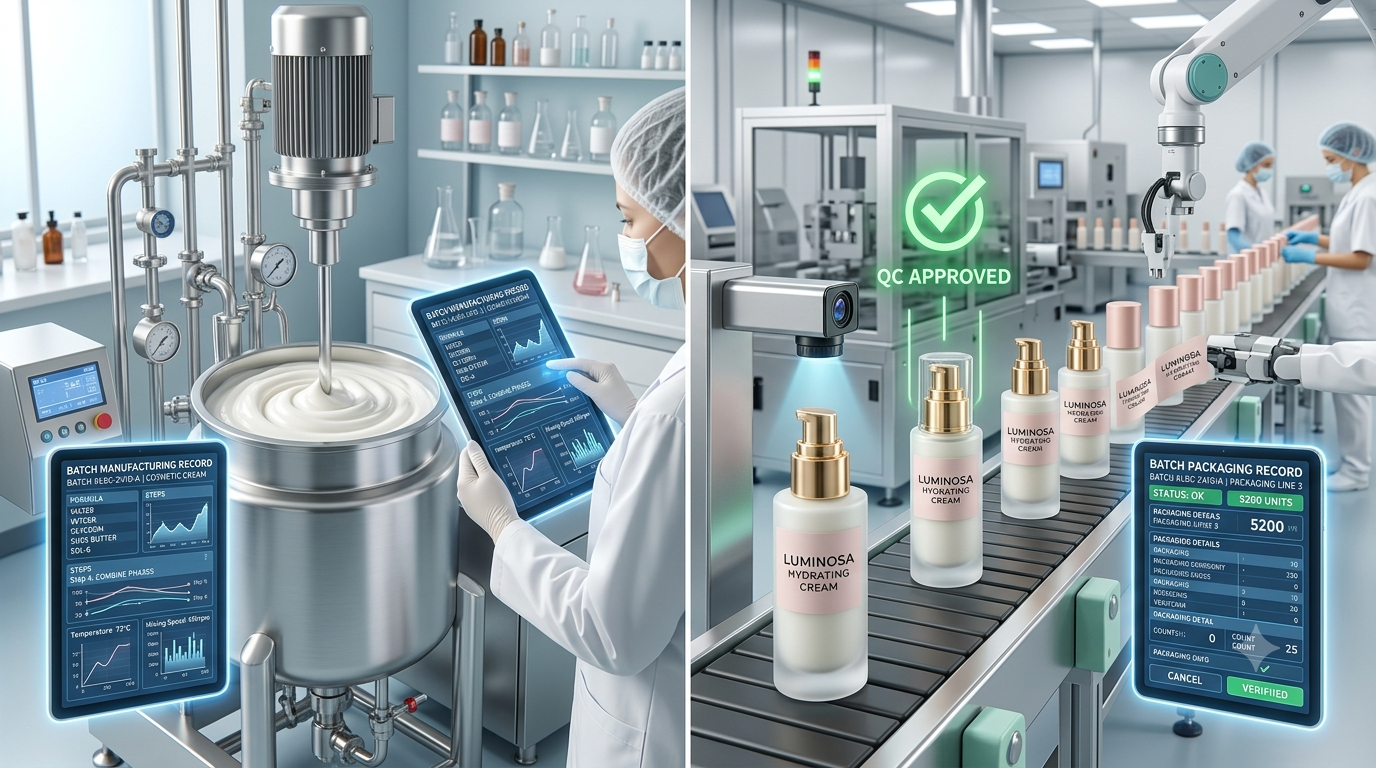
Among the most important manufacturing documents is the Batch Manufacturing Record (BMR). This document provides complete evidence that each production batch has been manufactured according to the approved formulation, manufacturing instructions, quality requirements, and applicable Good Manufacturing Practices (GMP).
A Batch Manufacturing Record serves as both a production document and a quality assurance record. It captures every significant manufacturing activity performed during the production cycle, ensuring complete traceability from raw material dispensing to the release of the finished product.
This article provides a detailed overview of Batch Manufacturing Records in the cosmetic industry, including their purpose, components, manufacturing workflow, benefits, regulatory significance, and best practices.
What is a Batch Manufacturing Record (BMR)?
A Batch Manufacturing Record (BMR) is an official manufacturing document that records all activities associated with the production of a specific batch of cosmetic products. It documents every stage of manufacturing, including raw material verification, equipment preparation, processing operations, in-process inspections, packaging activities, quality verification, and final product approval.
Each manufacturing batch is assigned a unique batch number, and a separate Batch Manufacturing Record is generated for that batch. The document provides complete production history and enables manufacturers to demonstrate that the product has been manufactured according to approved procedures and quality standards.
The Batch Manufacturing Record forms an integral part of the Quality Management System (QMS) and serves as documentary evidence during internal audits, customer audits, certification assessments, and regulatory inspections.
Purpose of a Batch Manufacturing Record
The primary purpose of a Batch Manufacturing Record is to ensure that every cosmetic product is manufactured consistently while maintaining complete documentation throughout the production process.
The objectives of maintaining a BMR include:
- Recording every manufacturing activity performed during production.
- Verifying compliance with approved manufacturing procedures.
- Ensuring complete traceability of raw materials and packaging materials.
- Supporting quality assurance and quality control activities.
- Facilitating deviation investigations and corrective actions.
- Providing documentary evidence during audits and inspections.
- Supporting product recall activities when required.
- Maintaining consistency between different manufacturing batches.
A properly maintained BMR establishes confidence that manufacturing operations have been executed in accordance with predefined specifications.
Importance of BMR in Cosmetic Manufacturing
Documentation is considered one of the fundamental principles of Good Manufacturing Practices. Product quality cannot be verified solely through finished product testing; it must be established throughout the manufacturing process.
A Batch Manufacturing Record supports this objective by documenting every critical manufacturing parameter.
Its importance includes:
Product Consistency
Every production batch follows identical manufacturing instructions, resulting in consistent product quality and performance.
Manufacturing Traceability
Complete documentation enables manufacturers to trace every raw material, packaging component, processing step, and operator involved in production.
Quality Assurance
The Quality Assurance department reviews Batch Manufacturing Records before batch release to verify compliance with approved manufacturing procedures.
Regulatory Compliance
Maintaining accurate manufacturing records demonstrates compliance with applicable cosmetic GMP requirements and internationally recognized quality standards.
Investigation Support
In the event of customer complaints, product defects, or process deviations, the Batch Manufacturing Record provides essential information for root cause analysis and corrective act.
How Does a Batch Manufacturing Record Work?
The Batch Manufacturing Record follows the manufacturing process from production planning through final batch release.
1. Batch Authorization
Production begins only after the manufacturing schedule has been approved and a unique batch number has been assigned.
The BMR identifies:
- Product name
- Product code
- Batch number
- Batch size
- Manufacturing date
- Planned yield
This information establishes the identity of the production batch throughout the manufacturing process.
2. Raw Material Dispensing
All raw materials are verified before use.
The following information is documented:
- Material name
- Material code
- Supplier
- Batch number
- Quantity issued
- Quantity consumed
- Expiry date
- Material approval status
Only approved materials released by Quality Control are permitted for manufacturing operations.
3. Equipment Preparation
Production equipment must be cleaned, inspected, and verified before manufacturing begins.
The BMR records:
- Equipment identification number
- Cleaning status
- Calibration status
- Line clearance verification
- Equipment release approval
This process minimizes the risk of contamination and product mix-ups.
4. Manufacturing Operations
Manufacturing activities are documented in chronological order.
Typical operations include:
- Ingredient weighing
- Water phase preparation
- Oil phase preparation
- Heating
- Mixing
- Homogenization
- Cooling
- Addition of fragrances
- Addition of preservatives
- Bulk transfer
Each operation includes processing parameters such as temperature, mixing speed, processing duration, equipment identification, operator signature, and supervisory verification.
This documentation ensures manufacturing consistency across all production batches.
What is Batch Packaging Record (BPR) in the Cosmetic Industry?
Introduction
Packaging is a critical stage in cosmetic manufacturing that directly influences product quality, consumer safety, brand identity, and regulatory compliance. Regardless of the quality of the formulation, improper packaging can compromise product integrity, reduce shelf life, and increase the risk of contamination or product mix-ups. To ensure that every cosmetic product is packaged according to approved specifications, manufacturers maintain comprehensive packaging documentation known as the Batch Packaging Record (BPR).
A Batch Packaging Record (BPR) is an official controlled document that records every activity performed during the packaging of a specific production batch. It provides documented evidence that packaging operations have been completed in accordance with approved packaging instructions, product specifications, Good Manufacturing Practices (GMP), and internal quality management procedures.
The BPR contains detailed information relating to packaging materials, packaging equipment, labeling activities, coding, reconciliation of printed materials, in-process inspections, quality verification, operator identification, and final batch approval. This documentation establishes complete traceability throughout the packaging process and supports product quality, regulatory compliance, and audit readiness.
This comprehensive guide explains the purpose, components, workflow, benefits, documentation requirements, and best practices associated with Batch Packaging Records in cosmetic manufacturing.
What is a Batch Packaging Record (BPR)?
A Batch Packaging Record (BPR) is a controlled manufacturing document that records all packaging activities performed for a specific batch of cosmetic products. It documents every stage of the packaging process, beginning with the receipt and verification of packaging materials and continuing through filling, labeling, coding, carton packing, reconciliation, quality inspection, and final product release.
Each production batch has its own dedicated Batch Packaging Record, identified by a unique batch number. The document serves as documentary evidence that packaging operations were performed according to approved packaging instructions and established quality standards.
The Batch Packaging Record forms an essential part of the organization’s Quality Management System (QMS) and is routinely reviewed during internal audits, customer audits, certification assessments, and regulatory inspections.
Purpose of a Batch Packaging Record
The primary purpose of a Batch Packaging Record is to document and verify that packaging operations have been completed accurately, consistently, and in accordance with approved procedures.
The objectives of maintaining a BPR include:
- Documenting every packaging activity performed during production.
- Verifying the use of approved packaging materials.
- Ensuring correct product labeling and coding.
- Preventing packaging mix-ups and cross-contamination.
- Maintaining complete traceability of packaging components.
- Supporting quality assurance and regulatory compliance.
- Facilitating investigations into deviations and customer complaints.
- Providing documented evidence during audits and inspections.
A properly maintained Batch Packaging Record confirms that finished cosmetic products have been packaged correctly before distribution.
Importance of BPR in Cosmetic Manufacturing
Packaging is the final manufacturing operation before products enter the marketplace. Errors at this stage can result in incorrect labeling, damaged products, regulatory non-compliance, product recalls, and loss of consumer confidence.
A Batch Packaging Record plays a vital role by documenting every critical packaging activity.
Its significance includes:
Product Identification
The BPR ensures that each cosmetic product is packaged with the correct container, closure, label, artwork, and product information.
Packaging Traceability
Every packaging material, including bottles, jars, tubes, pumps, caps, labels, cartons, and inserts, is recorded by supplier, material code, and lot number.
Regulatory Compliance
The document demonstrates compliance with cosmetic Good Manufacturing Practices (GMP) and internal quality procedures by providing complete packaging documentation.
Quality Assurance
Quality Assurance personnel review the completed Batch Packaging Record before releasing the finished batch to verify compliance with approved packaging specifications.
Product Recall Support
If a labeling or packaging defect is identified, the Batch Packaging Record enables rapid identification of affected batches, reducing the scope and impact of product recalls.
How Does a Batch Packaging Record Work?
The Batch Packaging Record follows the complete packaging process from material issuance through final product release.
1. Packaging Batch Authorization
Packaging activities begin only after production has been completed and the bulk product has been approved for filling.
The BPR records:
- Product name
- Product code
- Batch number
- Packaging batch number (if applicable)
- Packaging date
- Planned packaging quantity
- Packaging line identification
2. Packaging Material Verification
Before packaging begins, all packaging materials are inspected and verified.
Typical packaging components include:
- Bottles
- Jars
- Tubes
- Pumps
- Caps
- Labels
- Shrink sleeves
- Cartons
- Leaflets
- Tamper-evident seals
The following information is documented:
- Material name
- Material code
- Supplier
- Lot number
- Quantity issued
- Quantity consumed
- Quantity returned
- Approval status
Only approved packaging materials released by the Quality Control department are permitted for use.
3. Packaging Line Clearance
Before starting packaging operations, the packaging line is inspected to ensure it is clean, free from previous products, and ready for use.
The BPR documents:
- Equipment cleaning verification
- Line clearance approval
- Previous product removal
- Packaging area inspection
- Line release authorization
This procedure minimizes the risk of product mix-ups and cross-contamination.
4. Packaging Operations
Packaging activities are recorded sequentially throughout the process.
Typical operations include:
- Container filling
- Cap placement
- Induction sealing
- Label application
- Batch coding
- Expiry date printing
- Carton packing
- Case packing
- Palletization
Each activity records processing parameters, equipment identification, operator details, production quantities, and supervisory verification.
5. In-Process Quality Checks
Quality inspections are performed during packaging to ensure compliance with approved specifications.
Typical inspections include:
- Fill volume verification
- Container integrity
- Cap torque testing
- Label alignment
- Print legibility
- Batch number accuracy
- Manufacturing and expiry date verification
- Barcode verification
- Packaging appearance
Inspection results are documented in the Batch Packaging Record.
6. Packaging Reconciliation
At the completion of packaging operations, all packaging materials are reconciled.
The reconciliation process includes:
- Materials issued
- Materials consumed
- Materials rejected
- Materials returned
- Finished product quantity
Packaging reconciliation helps detect shortages, overages, or potential product mix-ups.
7. Final Review and Batch Release
The completed Batch Packaging Record is reviewed by Production and Quality Assurance personnel.
The review verifies:
- Documentation completeness
- Compliance with approved procedures
- Packaging reconciliation accuracy
- Deviation investigations
- Quality inspection results
Following successful review, the finished batch is approved for release and distribution.