
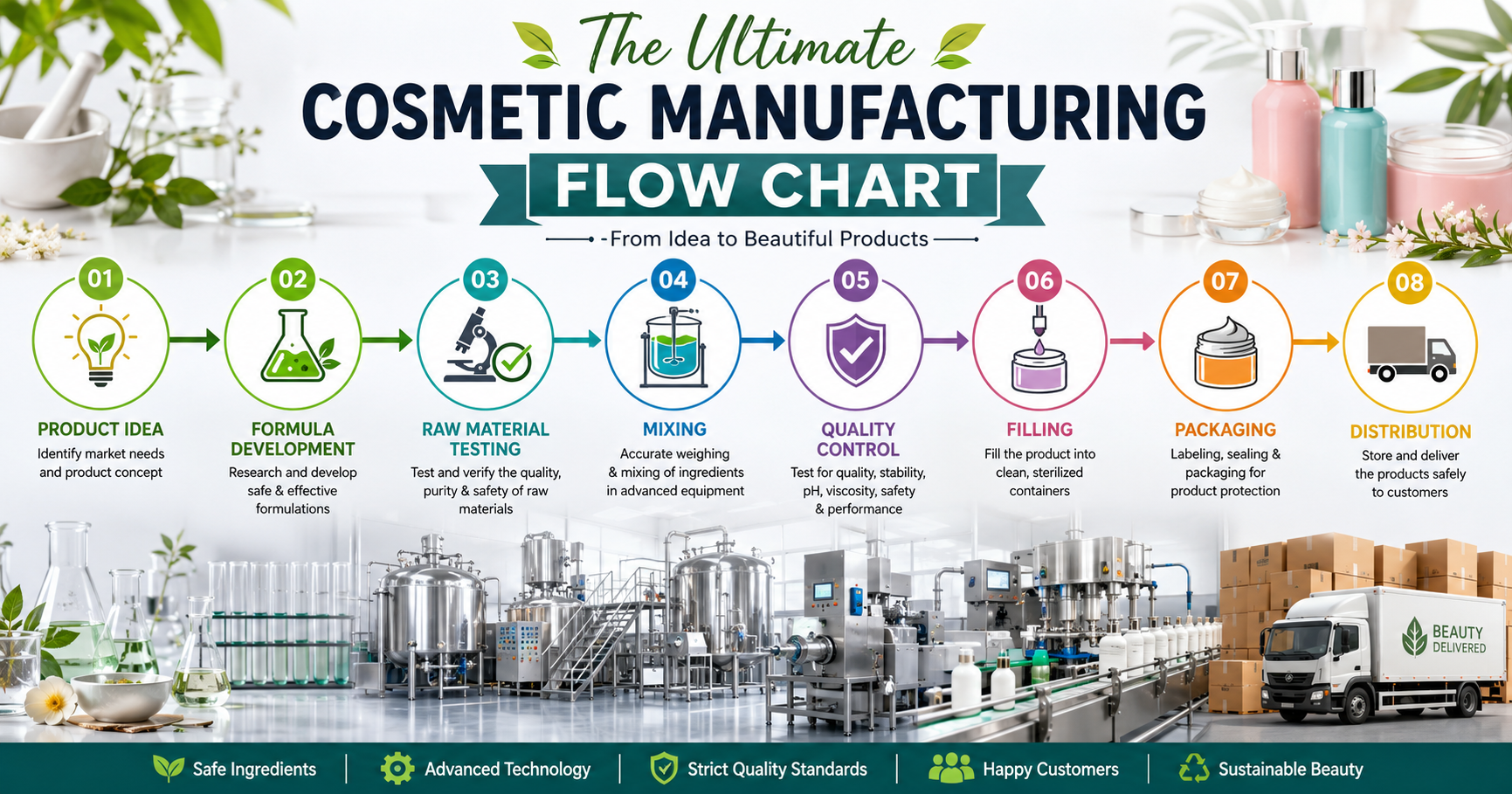
The cosmetic products we use every day—face washes, moisturizers, lipsticks, shampoos, sunscreens, and serums—go through a carefully planned manufacturing process before they reach store shelves. Every product follows a series of important steps that ensure it is safe, effective, stable, and meets quality standards.
Many beginners think cosmetic manufacturing simply means mixing ingredients together. In reality, it is a structured process that involves research, formulation, raw material testing, manufacturing, quality control, packaging, and final inspection. Missing even one step can affect the product’s performance, shelf life, or safety.
This is why cosmetic manufacturers use a well-defined cosmetic manufacturing flow chart. It provides a clear roadmap that helps production teams follow each stage in the correct order while maintaining consistent product quality.
In this beginner-friendly guide, you will learn the complete cosmetic manufacturing flow chart, understand why every stage matters, and discover how high-quality skincare and personal care products are produced from start to finish.
What Is a Cosmetic Manufacturing Flow Chart?
A cosmetic manufacturing flow chart is a visual representation of every step involved in producing cosmetic products. It shows how raw materials move through different stages until they become finished products ready for customers.
Instead of looking at dozens of written procedures, manufacturers can quickly understand the production sequence using a flow chart.
A typical cosmetic manufacturing flow chart includes:
- Product research
- Formula development
- Raw material procurement
- Ingredient testing
- Batch manufacturing
- Quality control
- Filling
- Packaging
- Final inspection
- Product release
Each step has its own purpose and quality checks.
Read More: What Is Cosmetic Research And Development (R&D)? A Complete Guide
Why Is a Manufacturing Flow Chart Important?
A flow chart is much more than a simple diagram. It helps manufacturers organize production while reducing mistakes and maintaining product consistency.
Some major benefits include:
Better Production Planning
Every department understands its responsibilities, making production smoother and more efficient.
Improved Product Quality
Following a fixed process helps reduce variations between different production batches.
Easier Employee Training
New employees can understand the manufacturing workflow much faster using a visual guide.
Regulatory Compliance
Many cosmetic manufacturers follow Good Manufacturing Practices (GMP). A documented manufacturing process helps demonstrate compliance during inspections.
Reduced Manufacturing Errors
Clear production steps minimize the chances of incorrect ingredient additions, contamination, or packaging mistakes.
Read More: Why Is PH Important In Skincare Products? Everything You Need To Know
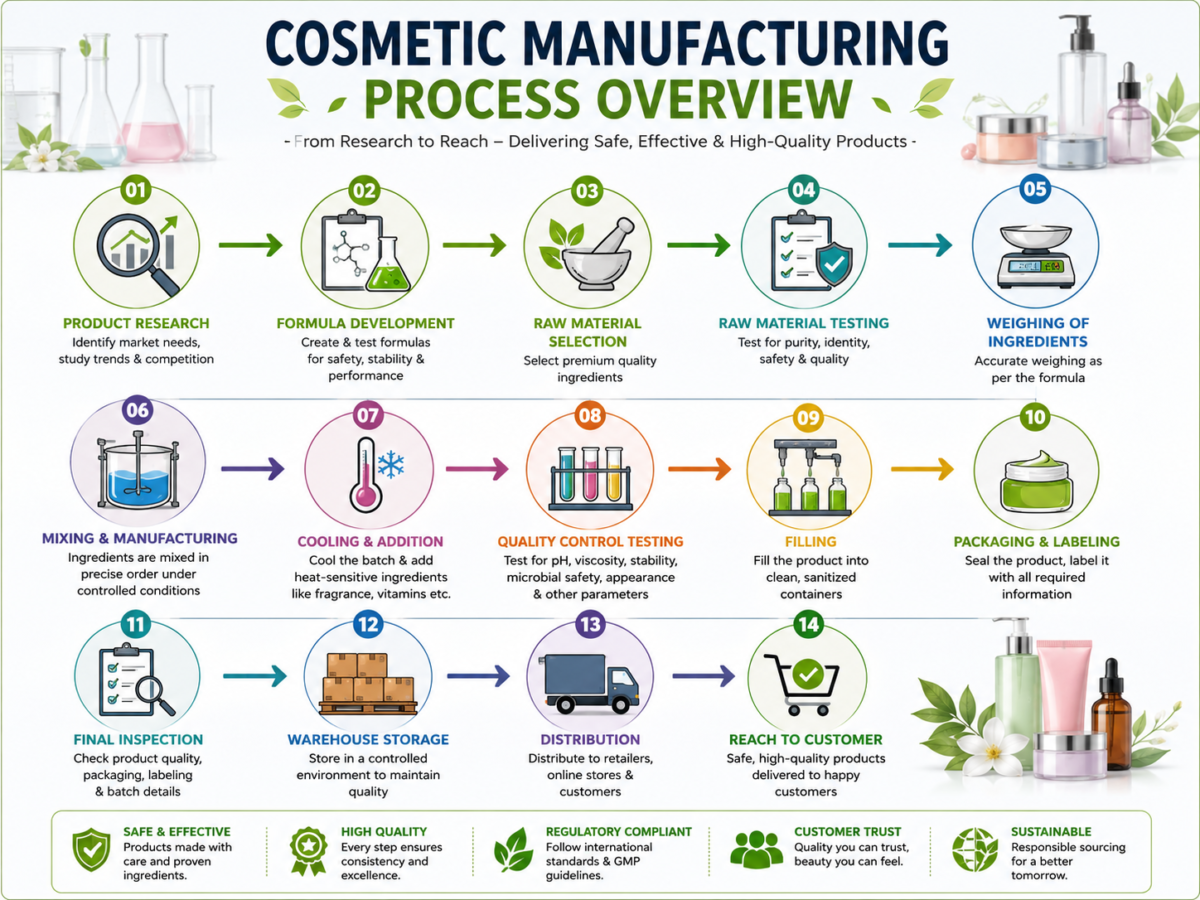
The Ultimate Cosmetic Manufacturing Flow Chart
Below is a simplified cosmetic manufacturing process that most skincare and personal care products follow.
Product Idea
↓
Market Research
↓
Formula Development
↓
Raw Material Selection
↓
Supplier Approval
↓
Raw Material Testing
↓
Weighing Ingredients
↓
Batch Manufacturing
↓
Mixing & Homogenization
↓
Cooling Process
↓
Quality Control Testing
↓
Filling
↓
Packaging
↓
Final Inspection
↓
Warehouse Storage
↓
Product Distribution
Although the exact sequence may vary depending on the product type, this flow chart represents the standard manufacturing process used across much of the cosmetics industry.
Step 1: Product Idea and Market Research
Every cosmetic product begins with an idea.
A company may identify a skincare concern that consumers frequently face, such as dry skin, acne, pigmentation, dandruff, or sun protection. Before creating a product, manufacturers study market demand, customer preferences, competitor products, and current beauty trends.
For example, if consumers are looking for lightweight moisturizers that work well in humid weather, a company may decide to develop a fast-absorbing gel cream instead of a heavy lotion.
During this stage, companies ask questions such as:
- Who will use the product?
- What skin type is it designed for?
- Which ingredients are currently popular?
- What makes this product different?
- What price range will customers accept?
Proper market research helps reduce the risk of launching products that fail to meet customer expectations.
Read More: What is Cosmetic Production? Complete Guide to Process, Stages & Departments.
Step 2: Formula Development
Once the product idea is approved, cosmetic chemists begin creating the formulation.
This is one of the most technical stages of cosmetic manufacturing.
The goal is to develop a formula that delivers the desired performance while remaining safe, stable, and pleasant to use.
During formulation, experts carefully balance different ingredient categories such as:
- Water phase
- Oils
- Emollients
- Humectants
- Emulsifiers
- Preservatives
- Active ingredients
- Fragrance
- Colorants
- Thickeners
For example, a hydrating facial moisturizer may include:
- Hyaluronic Acid for hydration
- Glycerin to attract moisture
- Ceramides to strengthen the skin barrier
- Emollients for smooth texture
- Preservatives to prevent microbial growth
The formulation is adjusted several times until it achieves the desired texture, stability, fragrance, appearance, and performance.
Step 3: Raw Material Selection
After the formula is finalized, manufacturers select the raw materials needed for production.
Choosing high-quality ingredients is essential because even the best formulation cannot compensate for poor-quality raw materials.
Raw materials may include:
- Botanical extracts
- Carrier oils
- Active ingredients
- Vitamins
- Surfactants
- Waxes
- Silicones
- Preservatives
- Fragrances
- Natural butters
- Pigments
Each ingredient must meet predefined quality standards before it enters the production facility.
Manufacturers also consider:
- Purity
- Stability
- Supplier reliability
- Safety documentation
- Regulatory approval
- Batch consistency
Using trusted suppliers helps maintain consistent product quality over time.
Step 4: Supplier Approval
Before any ingredient is used in production, manufacturers carefully evaluate the supplier. Choosing a trusted supplier is just as important as selecting the right ingredient because the quality of raw materials directly affects the quality of the final cosmetic product.
A supplier approval process helps ensure that every ingredient meets safety, quality, and regulatory requirements.
Manufacturers usually check:
- Supplier reputation and experience
- Manufacturing certifications (such as GMP or ISO)
- Product consistency between batches
- Technical documents and specifications
- Quality management system
- Ability to deliver materials on time
For example, if a company purchases Vitamin E from different suppliers each month, the purity and performance may vary. Working with an approved supplier reduces this risk and helps maintain consistent product quality.
Step 5: Raw Material Testing
Even after receiving ingredients from an approved supplier, manufacturers do not use them immediately. Every batch of raw material is tested to confirm that it matches the required specifications.
This step helps prevent poor-quality or contaminated ingredients from entering the production process.
Common quality checks include:
- Appearance (color and texture)
- Odor
- pH (where applicable)
- Purity
- Moisture content
- Identity testing
- Microbiological analysis
- Heavy metal testing (for selected ingredients)
For example, Aloe Vera extract should have the expected color and meet purity standards. If laboratory results do not match the specifications, the material is rejected instead of being used in production.
Testing every batch protects both the manufacturer and the consumer.
Step 6: Weighing the Ingredients
Once the raw materials are approved, each ingredient is weighed according to the product formula.
This may seem like a simple task, but it is one of the most critical steps in cosmetic manufacturing. Even a small weighing error can change the texture, fragrance, stability, or effectiveness of the product.
To avoid mistakes, manufacturers use:
- Calibrated digital weighing scales
- Clean weighing containers
- Clearly labeled ingredients
- Standard Operating Procedures (SOPs)
- Double-check systems for verification
For instance, adding too much thickener to a lotion can make it difficult to spread, while using too little preservative may reduce the product’s shelf life.
Accurate weighing ensures that every production batch performs the same way.
Step 7: Batch Manufacturing
After all ingredients have been weighed, the actual manufacturing process begins.
During batch manufacturing, ingredients are combined in a specific sequence under controlled conditions. The order of addition is important because different ingredients behave differently when mixed.
Manufacturers monitor factors such as:
- Mixing speed
- Temperature
- Mixing time
- Pressure (if required)
- Batch size
For example, many cream-based products require heating the oil phase and water phase separately before combining them to form a stable emulsion.
Following the correct manufacturing procedure helps create a smooth, stable, and high-quality product.
Step 8: Mixing and Homogenization
Mixing ensures that all ingredients are evenly distributed throughout the product.
For products such as creams, lotions, serums, and sunscreens, manufacturers often use a homogenizer. This equipment breaks down tiny oil droplets into smaller particles, creating a smooth and uniform texture.
Benefits of proper homogenization include:
- Smooth appearance
- Better product stability
- Improved spreadability
- Uniform distribution of active ingredients
- Reduced risk of ingredient separation
Imagine preparing homemade mayonnaise. If the ingredients are not mixed properly, the oil and water separate. Cosmetic emulsions behave in a similar way. Proper homogenization keeps the product stable throughout its shelf life.
Step 9: Cooling the Product
Many cosmetic products are manufactured at elevated temperatures. After mixing is complete, the batch is gradually cooled before adding heat-sensitive ingredients.
These ingredients may include:
- Fragrance
- Essential oils
- Certain vitamins
- Botanical extracts
- Some active ingredients
- Preservatives that are sensitive to heat
Cooling too quickly or too slowly can affect the final texture and stability. Manufacturers therefore follow controlled cooling procedures to maintain product quality.
For example, adding fragrance while the batch is still very hot may cause some of its aromatic compounds to evaporate, reducing the product’s scent.
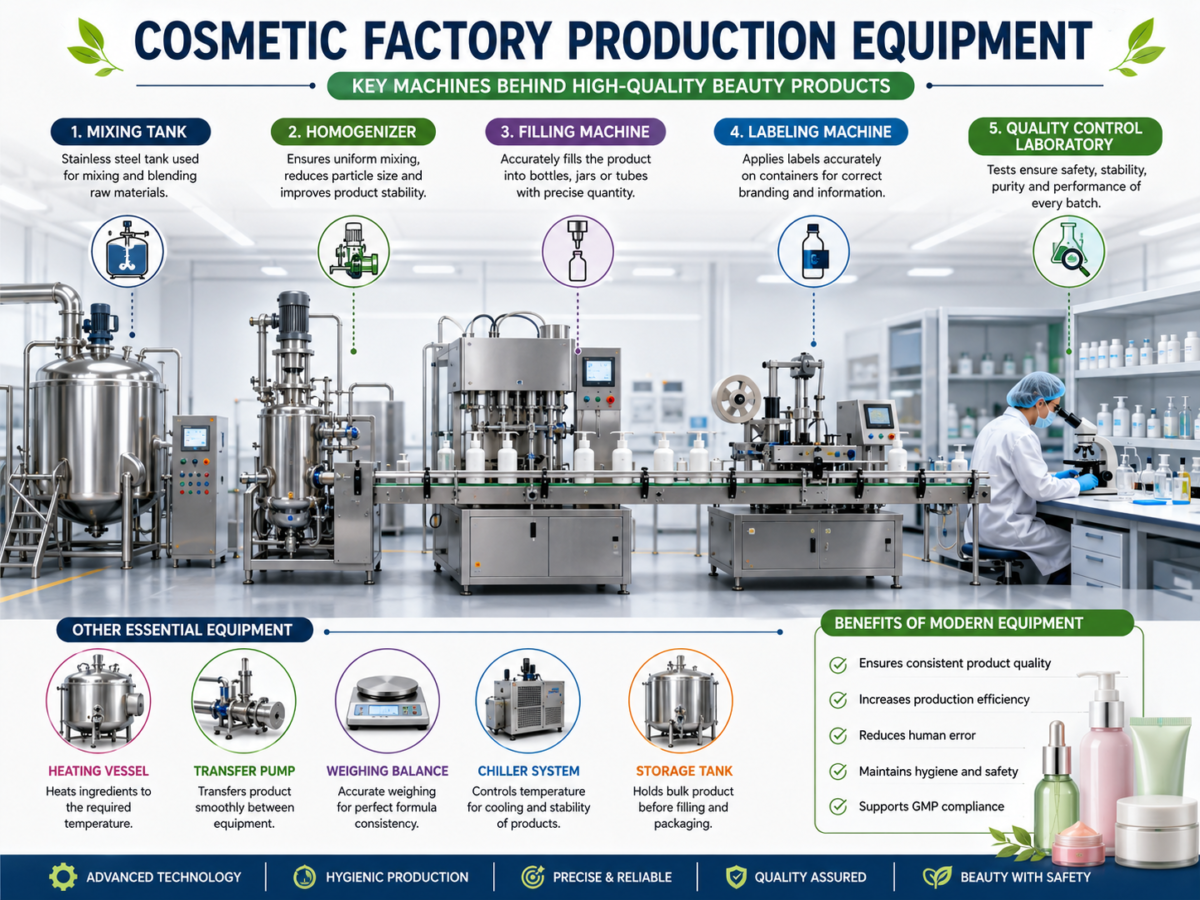
Common Equipment Used in Cosmetic Manufacturing
Different products require different types of equipment, but most cosmetic factories use the following machines during production:
| Equipment | Purpose |
|---|---|
| Mixing Tank | Combines ingredients into a uniform mixture |
| Homogenizer | Creates smooth emulsions and improves stability |
| Heating Vessel | Heats ingredients during manufacturing |
| Cooling System | Brings the product to the required temperature |
| Digital Weighing Scale | Measures ingredients accurately |
| Storage Tank | Holds the finished bulk product before filling |
| Transfer Pump | Moves the product between processing stages |
| Filling Machine | Dispenses the product into bottles, tubes, or jars |
| Capping Machine | Seals containers securely |
| Labeling Machine | Applies labels accurately to the packaging |
Modern factories often automate many of these processes to improve efficiency and reduce the chances of human error.
Common Mistakes to Avoid During Manufacturing
Even with a well-designed process, mistakes can occur if proper procedures are not followed. Some common manufacturing errors include:
- Using unapproved raw materials
- Incorrect ingredient weighing
- Poor cleaning of equipment
- Inadequate mixing time
- Adding ingredients in the wrong order
- Ignoring temperature requirements
- Skipping quality checks
- Improper documentation of production batches
Preventing these mistakes helps manufacturers produce safe, stable, and consistent cosmetic products.
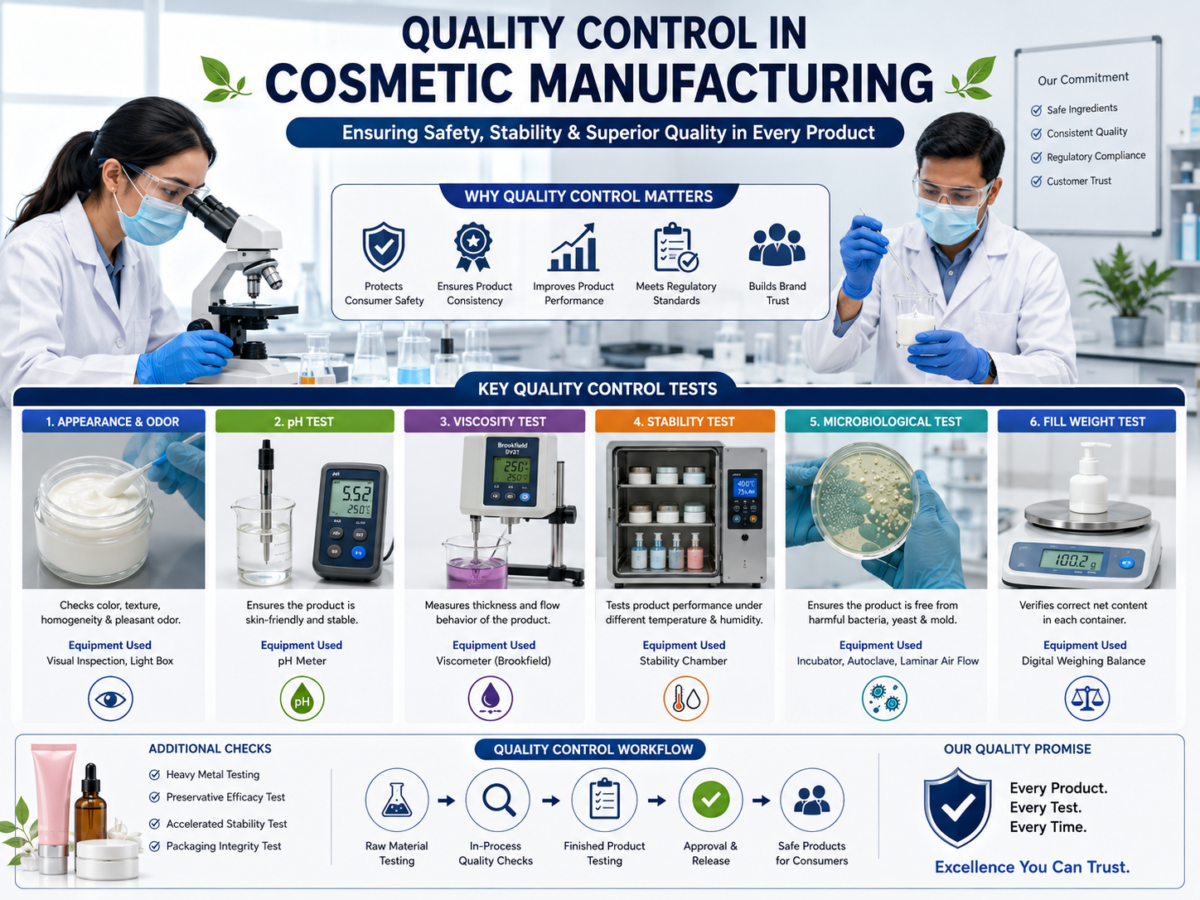
Step 10: Quality Control (QC) Testing
Before a cosmetic product is filled into its final container, it must pass a series of Quality Control (QC) tests. These tests help confirm that the product meets the company’s quality standards and performs as expected.
Quality control is one of the most important stages in the cosmetic manufacturing flow chart because it helps identify issues before products reach consumers.
Common QC tests include:
1. Appearance Test
Experts examine the product for:
- Color consistency
- Smooth texture
- Uniform appearance
- Absence of lumps or separation
For example, a moisturizing cream should have a smooth and creamy texture without visible oil droplets.
2. pH Testing
The pH level affects both product stability and skin compatibility.
Different products have different ideal pH ranges. For example:
- Facial cleansers often have a skin-friendly pH.
- Shampoos are formulated according to hair and scalp requirements.
- Exfoliating products may have a lower pH depending on their active ingredients.
Maintaining the correct pH helps improve product performance and user comfort.
3. Viscosity Testing
Viscosity measures how thick or thin a product is.
This test ensures consistency between production batches.
Examples:
- Lotion should flow smoothly.
- Serum should remain lightweight.
- Hair gel should have the intended thickness.
- Face cream should neither be too runny nor too stiff.
4. Microbiological Testing
Cosmetic products must be free from harmful microorganisms.
Laboratories test for:
- Bacteria
- Yeast
- Mold
- Other microbial contamination
This is especially important for water-based products, which are more prone to microbial growth if preservation is inadequate.
5. Stability Testing
Manufacturers evaluate how a product performs over time under different environmental conditions.
Products may be stored at:
- High temperatures
- Low temperatures
- Humid environments
- Room temperature
These tests help predict shelf life and ensure the product remains stable throughout its intended use period.
6. Fragrance Evaluation
The fragrance should remain pleasant and consistent.
Experts also check that the scent does not change during storage or interact negatively with other ingredients.
Step 11: Filling the Product
Once the product passes all quality tests, it is transferred to the filling line.
At this stage, the bulk cosmetic product is filled into its final packaging, such as:
- Bottles
- Tubes
- Jars
- Pumps
- Airless containers
- Sachets
Modern filling machines are designed to dispense accurate quantities while minimizing contamination.
For example, if a moisturizer is labeled as 50 ml, the filling equipment is calibrated to deliver that volume consistently across every unit.
Step 12: Packaging
Packaging is more than just making a product look attractive. It plays a crucial role in protecting the formula and enhancing the customer experience.
A good cosmetic package should:
- Protect the product from contamination
- Prevent leakage
- Shield sensitive ingredients from light or air
- Be convenient to use
- Support the brand’s identity
For example:
- Vitamin C serums are often packaged in opaque or amber bottles to reduce light exposure.
- Airless pumps help protect formulas from repeated air contact, improving product stability.
Choosing the right packaging can help maintain product quality throughout its shelf life.
Step 13: Labeling
Every cosmetic product must include clear and accurate labeling.
A typical cosmetic label may contain:
- Product name
- Brand name
- Ingredient list (INCI names where applicable)
- Net quantity
- Manufacturing date
- Batch or lot number
- Expiry date or Period After Opening (if applicable)
- Directions for use
- Storage instructions
- Manufacturer details
- Safety warnings (when necessary)
Clear labeling helps consumers use products correctly and supports product traceability if any issue arises.
Step 14: Final Inspection
Before products leave the factory, they undergo one final inspection.
This stage confirms that every unit meets the required quality standards.
Inspectors check:
- Proper filling level
- Secure caps or pumps
- Correct labels
- Clear printing of batch numbers
- Undamaged packaging
- Clean product appearance
Any product with defects—such as scratches, leaks, missing labels, or damaged seals—is removed from the batch.
This final check helps ensure customers receive products in excellent condition.
Step 15: Warehouse Storage
After passing the final inspection, products are stored in a warehouse until they are shipped.
Proper storage conditions are essential for maintaining product quality.
Manufacturers typically monitor:
- Temperature
- Humidity
- Cleanliness
- Stock rotation
- Protection from direct sunlight
Many companies follow the First In, First Out (FIFO) principle. This means products manufactured earlier are distributed before newer batches, helping reduce the risk of products remaining in storage beyond their recommended shelf life.
Step 16: Product Distribution
The final stage in the cosmetic manufacturing flow chart is distribution.
Products are transported from warehouses to:
- Retail stores
- Pharmacies
- Supermarkets
- Beauty retailers
- E-commerce warehouses
- Distributors
During transportation, products should be handled carefully to avoid:
- Excessive heat
- Physical damage
- Moisture exposure
- Packaging deformation
Proper logistics help ensure that consumers receive products in the same condition as when they left the factory.
Good Manufacturing Practices (GMP) in Cosmetic Manufacturing
Good Manufacturing Practices (GMP) are a set of quality guidelines that help manufacturers produce cosmetics safely and consistently.
GMP focuses on controlling every stage of production—from raw material handling to finished product storage.
Key GMP principles include:
- Clean manufacturing facilities
- Well-maintained equipment
- Proper employee hygiene
- Documented procedures
- Accurate production records
- Regular equipment calibration
- Controlled manufacturing environments
- Quality assurance at every stage
Following GMP helps reduce manufacturing errors, improve product consistency, and strengthen consumer confidence.
Real-World Example: How a Facial Moisturizer Is Manufactured
Let’s see how the cosmetic manufacturing flow chart works in a real production environment.
Imagine a company wants to launch a hydrating facial moisturizer for dry and sensitive skin.
Step 1: Product Planning
The company researches customer needs and discovers that many people want a lightweight moisturizer that hydrates without leaving a greasy feel.
Step 2: Formula Development
Cosmetic chemists create a formula using ingredients such as:
- Glycerin for hydration
- Hyaluronic Acid to attract moisture
- Ceramides to support the skin barrier
- Shea Butter for nourishment
- Preservatives to maintain product safety
Several trial batches are prepared until the desired texture and stability are achieved.
Step 3: Raw Material Testing
Each ingredient is tested to verify its identity, purity, and quality before it is approved for manufacturing.
Step 4: Manufacturing
The ingredients are weighed accurately, mixed in stainless steel vessels, homogenized, and cooled under controlled conditions.
Step 5: Quality Control
The finished moisturizer undergoes tests for:
- pH
- Viscosity
- Appearance
- Microbiological safety
- Stability
Only batches that meet all specifications proceed to the next stage.
Step 6: Filling and Packaging
The moisturizer is filled into airless pump bottles, labeled with product information, and packed into cartons.
Step 7: Final Inspection and Distribution
After passing the final inspection, the products are stored in the warehouse and shipped to retailers and online marketplaces.
This example shows how every stage of the manufacturing process contributes to delivering a safe, high-quality skincare product.
Common Mistakes Beginners Should Avoid
Whether you are studying cosmetic manufacturing or planning to start a skincare brand, avoiding these common mistakes can save time, money, and effort.
Choosing Ingredients Based Only on Price
Low-cost ingredients may compromise product quality, stability, or customer satisfaction. Always evaluate quality, documentation, and supplier reliability—not just cost.
Ignoring Compatibility Between Ingredients
Not all ingredients work well together. Some combinations may reduce effectiveness or affect product stability.
Skipping Quality Testing
Never assume a product is safe simply because the formula looks correct. Laboratory testing is essential to verify quality and performance.
Poor Documentation
Incomplete manufacturing records make it difficult to investigate quality issues or reproduce successful batches.
Inadequate Cleaning Procedures
Improperly cleaned equipment can lead to contamination and affect the quality of future batches.
Incorrect Storage
Heat, humidity, or direct sunlight can degrade certain cosmetic ingredients and finished products. Always follow recommended storage conditions.
Final Thoughts
Cosmetic manufacturing is much more than blending ingredients. It is a carefully controlled process that combines scientific formulation, quality assurance, regulatory compliance, and efficient production practices.
From the first product idea to the final package on a store shelf, every step in the cosmetic manufacturing flow chart plays an important role in ensuring product safety, consistency, and customer satisfaction.
For beginners, understanding this workflow provides valuable insight into how skincare and personal care products are developed and produced. Whether you’re a student, skincare enthusiast, entrepreneur, or future cosmetic manufacturer, learning these manufacturing stages will help you appreciate the science and precision behind every cosmetic product.
As the beauty industry continues to evolve, manufacturers are also embracing innovations such as automation, sustainable packaging, environmentally responsible ingredients, and advanced quality control systems. Staying informed about these practices will help you better understand the future of cosmetic manufacturing.
Frequently Asked Questions (FAQs)
1. What is a cosmetic manufacturing flow chart?
A cosmetic manufacturing flow chart is a visual guide that outlines each stage involved in producing cosmetic products, from product development and ingredient selection to quality testing, packaging, and distribution.
2. Why is a manufacturing flow chart important?
It helps manufacturers standardize production, improve efficiency, reduce errors, maintain product quality, and ensure compliance with quality standards.
3. What is the first step in cosmetic manufacturing?
The process begins with product planning and market research to identify consumer needs and define the product concept.
4. What is homogenization in cosmetic manufacturing?
Homogenization is a mixing process that creates a smooth, stable, and uniform product by evenly dispersing ingredients, especially in creams and lotions.
5. Why is quality control necessary?
Quality control helps ensure that cosmetic products meet specifications for appearance, pH, viscosity, microbiological safety, stability, and overall performance before they reach consumers.
6. What types of equipment are commonly used in cosmetic manufacturing?
Common equipment includes mixing tanks, homogenizers, heating vessels, cooling systems, weighing scales, filling machines, capping machines, labeling machines, and storage tanks.
7. What is GMP in cosmetic manufacturing?
Good Manufacturing Practices (GMP) are quality guidelines that help manufacturers produce safe, consistent, and reliable cosmetic products through controlled processes and proper documentation.
8. Can small cosmetic brands follow the same manufacturing flow?
Yes. While the scale may differ, small brands should follow the same core steps—formulation, ingredient verification, manufacturing, quality testing, packaging, and documentation—to ensure product quality and consumer safety.