Cosmetic products such as face creams, shampoos, cleansers, sunscreens, serums, body lotions, and makeup products are used by millions of people every day. But have you ever wondered how a cosmetic product goes from a list of ingredients to the finished product sitting on a store shelf?
The cosmetic manufacturing process is a carefully controlled series of steps. It involves product formulation, raw material selection, weighing, mixing, processing, quality testing, filling, packaging, and final inspection. Each stage is important because even a small mistake in the manufacturing process can affect the product’s texture, appearance, stability, safety, or performance.
For example, when a company manufactures a moisturizing cream, it cannot simply mix oil, water, and active ingredients together. The ingredients must be added in the correct order, at suitable temperatures, and under controlled mixing conditions. The finished cream must then pass several quality checks before it can be packed and released.
In this beginner-friendly guide, we will explain the cosmetic manufacturing process step by step, from raw material receipt to final packaging. Understanding these stages can be useful for cosmetic science students, beginners, skincare enthusiasts, manufacturers, and anyone interested in how beauty products are made.
What Is Cosmetic Manufacturing?
Cosmetic manufacturing is the process of converting selected cosmetic raw materials into finished products that are suitable for consumer use.
The process may vary depending on the type of cosmetic product being manufactured. A shampoo requires a different manufacturing method from a lipstick, while a face cream needs a different process from a loose powder.
A typical cosmetic manufacturing process may include:
- Product formulation
- Raw material selection
- Raw material testing
- Dispensing and weighing
- Manufacturing or batch processing
- In-process quality checks
- Homogenization or mixing
- Cooling and adjustment
- Finished product testing
- Filling and packaging
- Final inspection
- Product release
The goal is not only to make a product that looks attractive. A properly manufactured cosmetic product should have consistent quality, acceptable stability, appropriate physical characteristics, and meet the company’s established specifications.
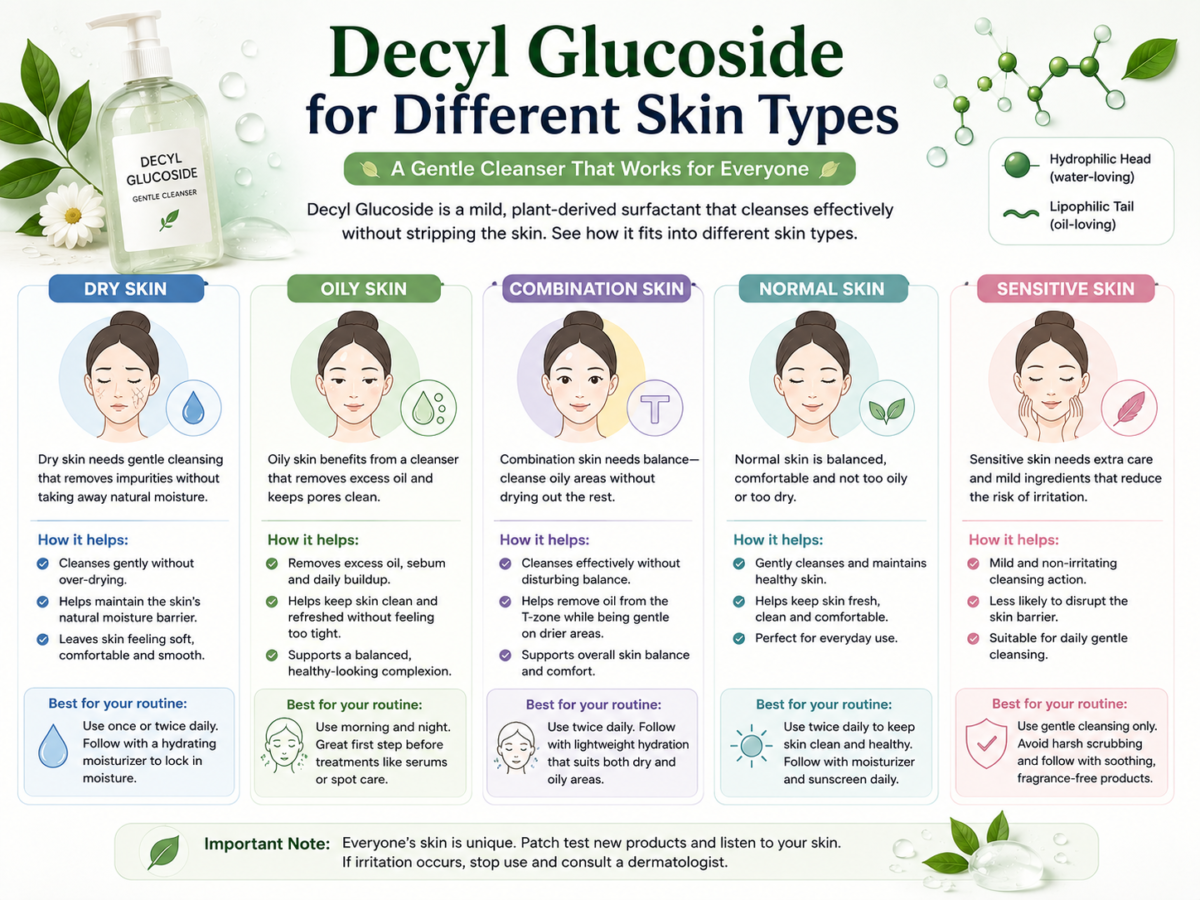
Read More: What Is Decyl Glucoside? A Complete Guide for Beginners(2026)
Why Is the Cosmetic Manufacturing Process Important?
A well-controlled manufacturing process helps ensure that every batch of a cosmetic product is as consistent as possible.
Imagine buying the same moisturizer twice. The first bottle has a smooth texture and absorbs easily, while the second bottle is extremely thick and separates into oil and water. This type of variation can indicate problems with formulation, processing, raw materials, storage, or quality control.
Manufacturing controls help reduce such variations.
For skincare products, manufacturing is particularly important because products are often applied directly to the skin. Factors such as ingredient concentration, pH, viscosity, microbial quality, packaging compatibility, and product stability can influence the overall quality of the finished product.
For example, a facial cleanser may contain surfactants, humectants, preservatives, fragrance, color, and other ingredients. These components must be combined properly so the final cleanser has the expected appearance, viscosity, cleansing properties, and stability.
Main Stages of the Cosmetic Manufacturing Process
Although manufacturing procedures differ from product to product, most cosmetic factories follow a structured workflow.
A simplified cosmetic manufacturing flow is:
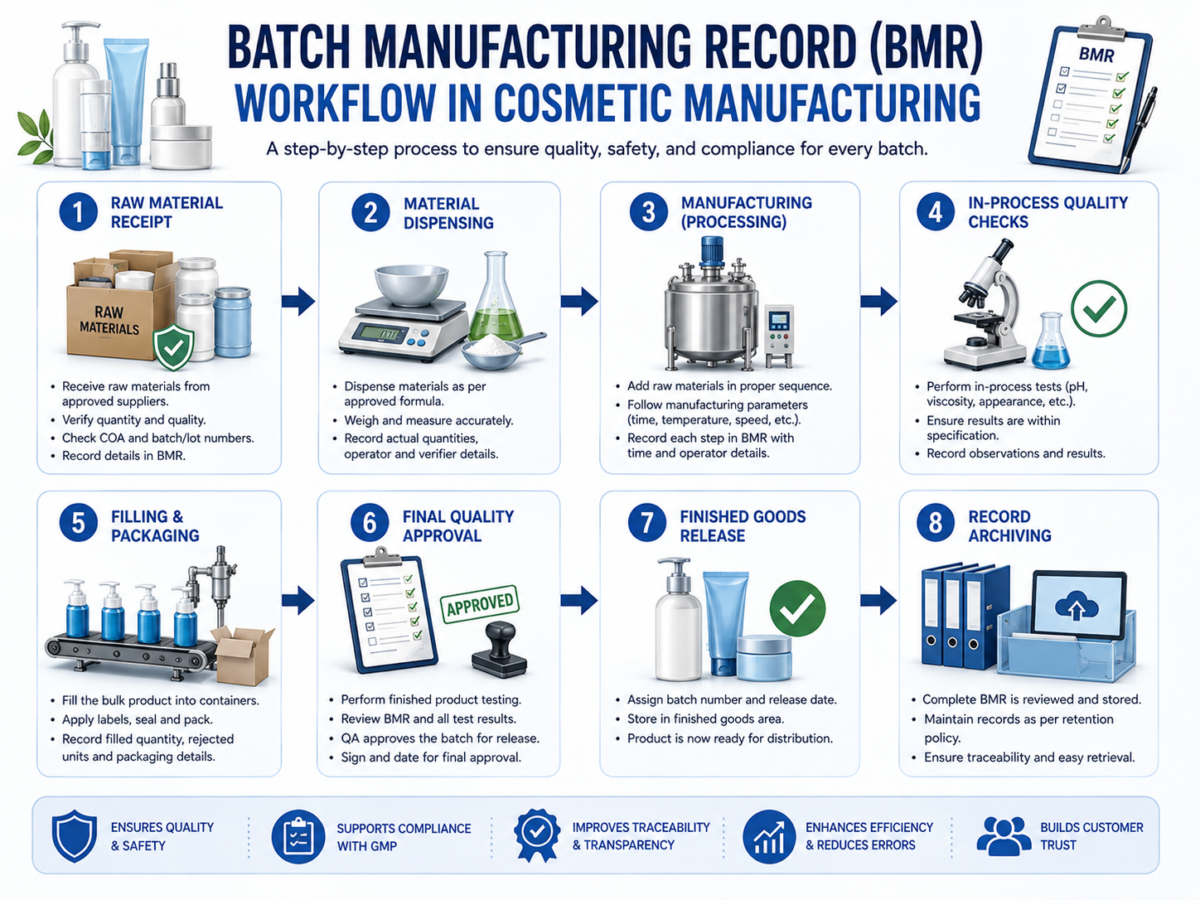
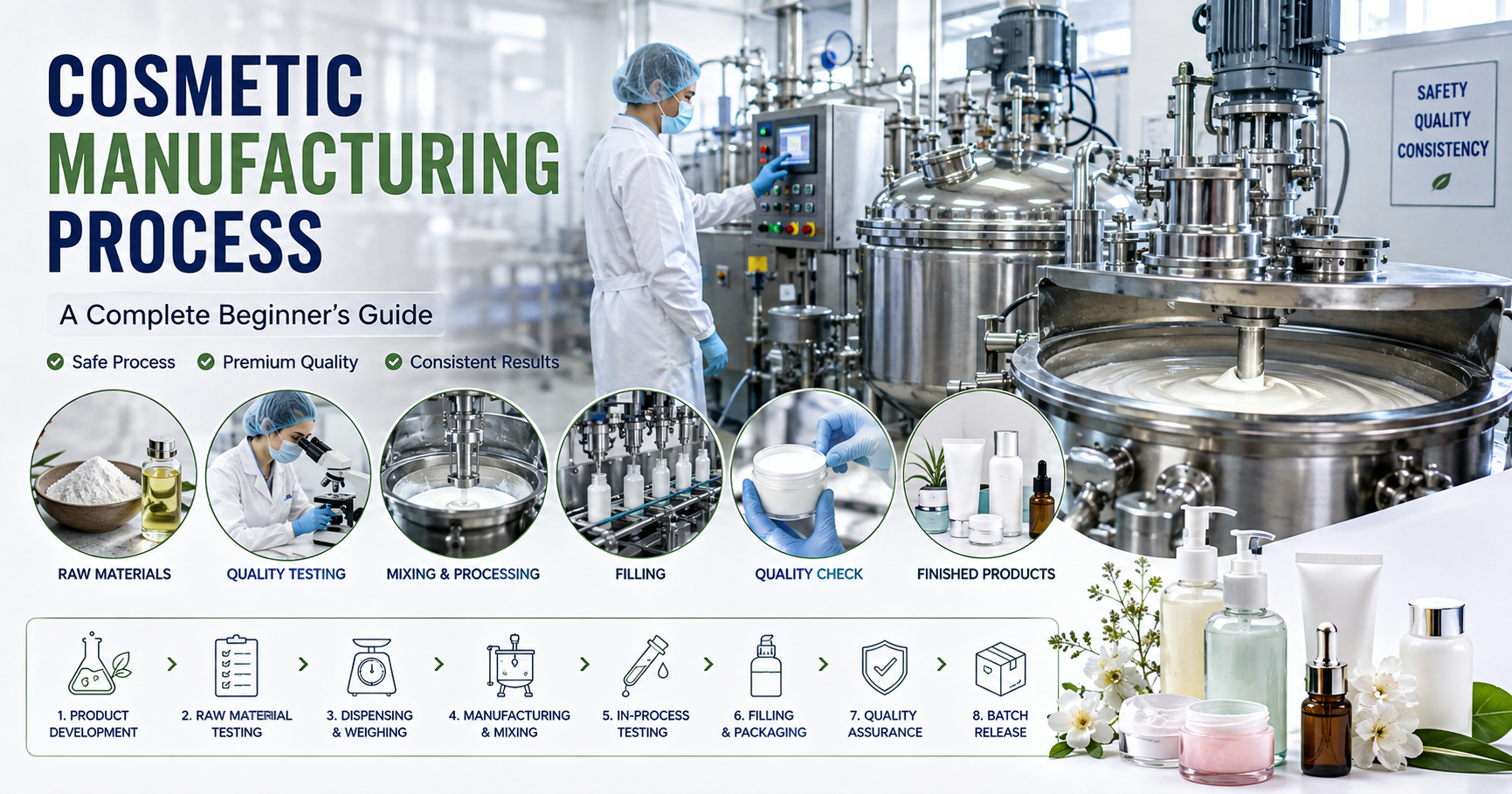
Raw Material Receipt → Testing → Storage → Dispensing → Manufacturing → In-Process Testing → Filling → Packaging → Finished Product Testing → Release
Let’s understand these stages in detail.
1. Product Formulation and Development
The cosmetic manufacturing process starts long before the actual production batch begins. The first stage is generally product development and formulation.
A cosmetic formulator decides what type of product needs to be created and determines which ingredients can provide the desired properties.
For example, if the company wants to develop a lightweight moisturizer for oily skin, the formulation team may focus on ingredients that provide hydration without making the skin feel excessively greasy.
A basic moisturizer may contain:
- Water
- Humectants
- Emollients
- Emulsifiers
- Thickening agents
- Preservatives
- Skin-conditioning ingredients
- Fragrance, if required
The formulator determines the percentage of each ingredient and develops a manufacturing procedure describing how and when each ingredient should be added.
This stage may involve laboratory trials, prototype development, stability testing, compatibility studies, and several formulation adjustments.
A formula that looks good in a laboratory beaker may not always behave the same way when produced in a large manufacturing vessel. Therefore, scale-up is an important part of product development.
2. Selection of Raw Materials
After the formulation is finalized, the required raw materials need to be selected and sourced.
Cosmetic raw materials can include many different types of ingredients. Depending on the product, a manufacturer may use oils, waxes, surfactants, emulsifiers, humectants, polymers, botanical extracts, preservatives, colors, fragrances, vitamins, and other cosmetic ingredients.
The quality of these materials matters because raw materials directly influence the quality of the finished product.
For example, two materials may have the same general ingredient name but different grades, specifications, purity levels, or physical characteristics. Using an unsuitable grade can affect the final formulation.
Manufacturers generally establish specifications for incoming raw materials. These specifications may include characteristics such as appearance, odor, identification, purity, pH, viscosity, moisture, or other relevant parameters depending on the material.
3. Receipt of Raw Materials
When raw materials arrive at a cosmetic manufacturing facility, they are not normally sent directly into production.
The materials are received by the appropriate department and checked against the purchasing and delivery documents.
The receiving process may involve checking:
- Material name
- Supplier information
- Batch or lot number
- Quantity received
- Container condition
- Manufacturing or expiry information, where applicable
- Required documentation
- Labeling and identification
Damaged, leaking, incorrectly labeled, or questionable materials may be placed on hold until the issue is investigated.
Proper identification at this stage helps prevent one of the most serious manufacturing mistakes: using the wrong material in a batch.
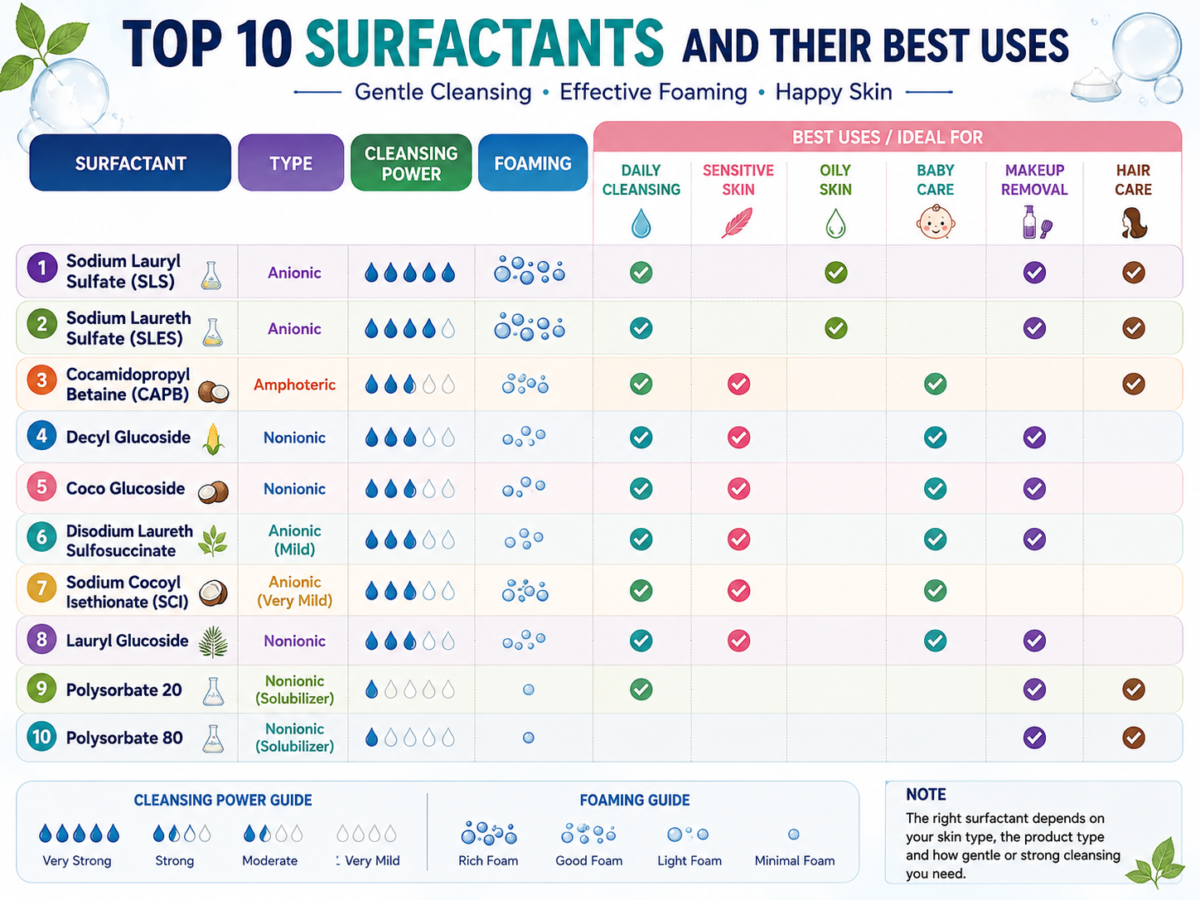
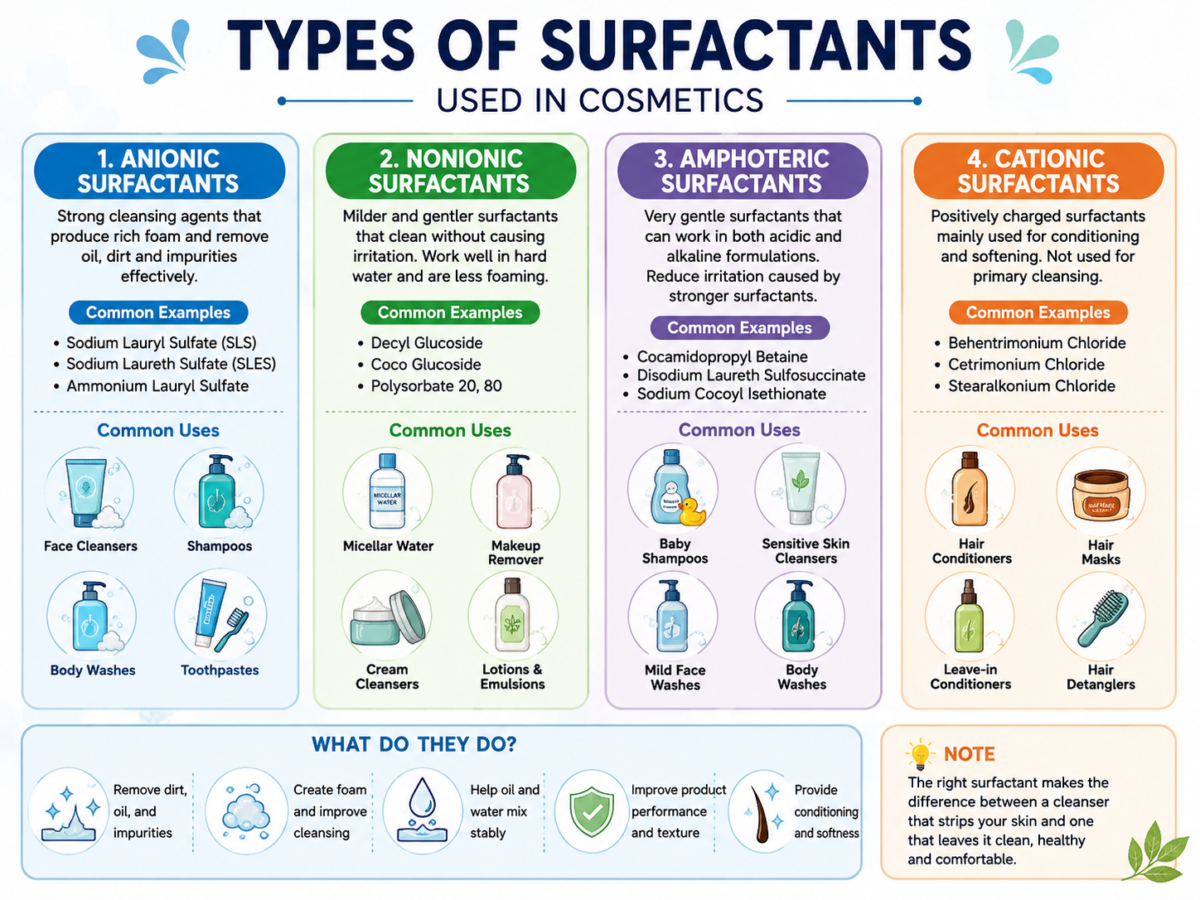
Read More: The Ultimate Guide to the Top 10 Surfactants Used in Cosmetics
4. Quality Control Testing of Raw Materials
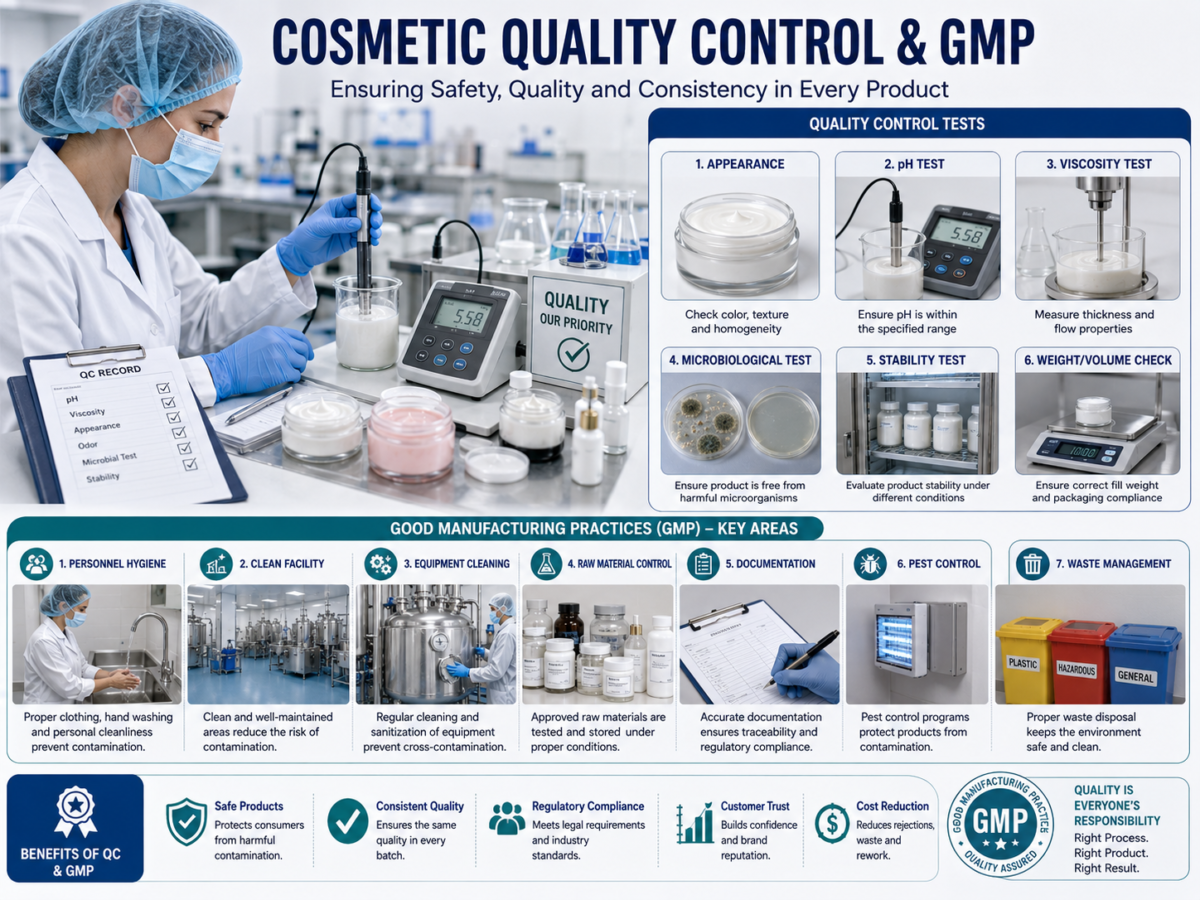
After receipt, raw materials may be sampled according to the company’s approved procedure and tested by the Quality Control (QC) department.
The exact tests depend on the material and its specifications.
For example, an incoming raw material may be checked for appearance, odor, identification, pH, viscosity, moisture, or other relevant quality parameters.
Some materials may also require supplier documentation such as a Certificate of Analysis (COA).
A COA provides information about specified quality characteristics of a particular material batch. However, manufacturers should follow their own approved quality procedures when deciding how incoming materials are evaluated and released.
Raw materials that meet the required specifications can be approved for use. Materials that do not meet requirements are typically rejected or placed under investigation according to the company’s quality system.
5. Raw Material Storage
Approved materials are stored under appropriate conditions until they are required for production.
Storage conditions depend on the characteristics of each raw material. Some materials may need protection from excessive heat, moisture, light, or contamination.
Good warehouse practices are important because even a high-quality raw material can deteriorate if it is stored incorrectly.
Materials should also be clearly identified so that operators can distinguish between approved, rejected, quarantined, or other status categories.
Proper stock management helps ensure that the correct material and batch are issued for manufacturing.
6. Dispensing and Weighing of Ingredients
Once a manufacturing batch is scheduled, the required raw materials are issued from the warehouse and taken to the dispensing area.
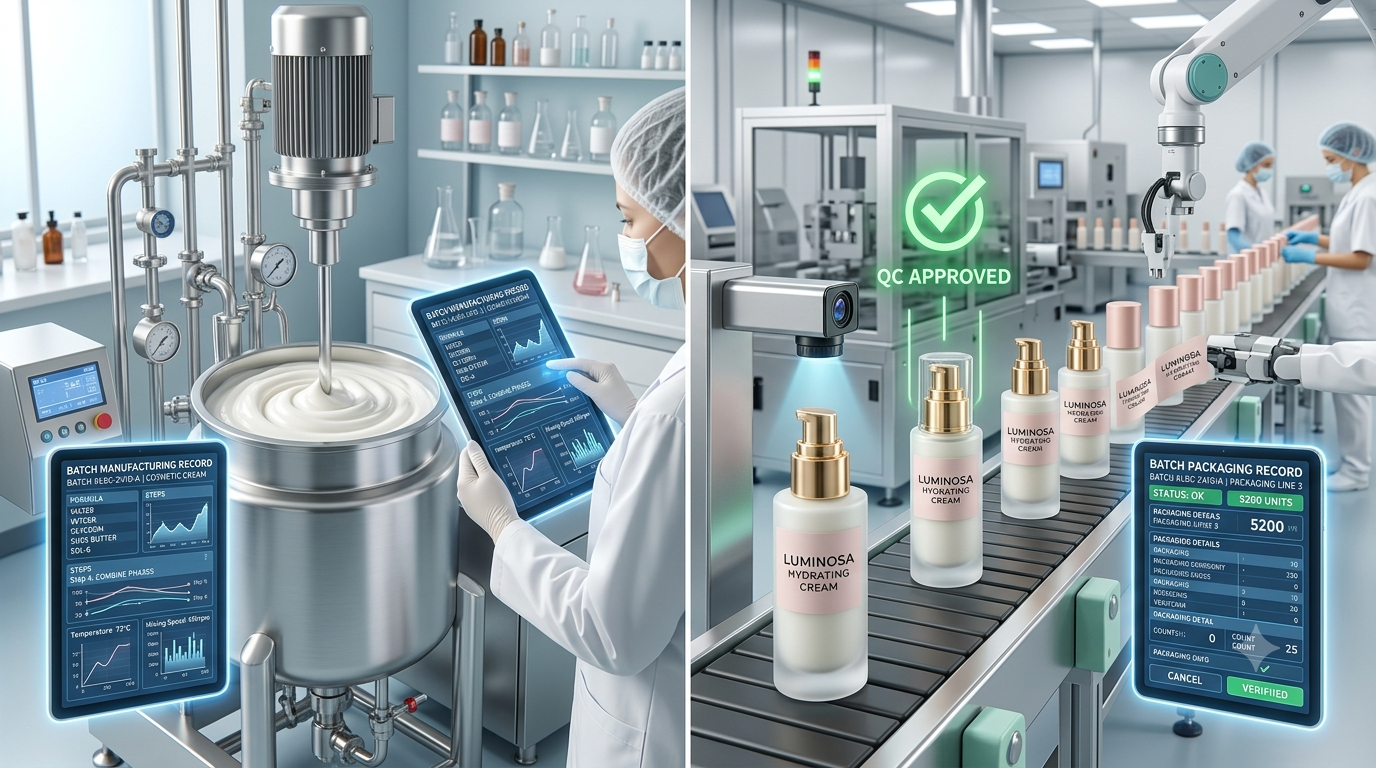
Here, ingredients are accurately weighed according to the approved Batch Manufacturing Record (BMR) or manufacturing instructions.
This is a critical step.
Suppose a face cream formula requires 2% of a particular active ingredient, but the operator accidentally adds 4%. The final product may no longer match the approved formulation.
For this reason, weighing and verification procedures are carefully controlled.
The dispensing area should also be maintained in a clean and organized condition to reduce the possibility of contamination or mix-ups.
7. Batch Manufacturing Record
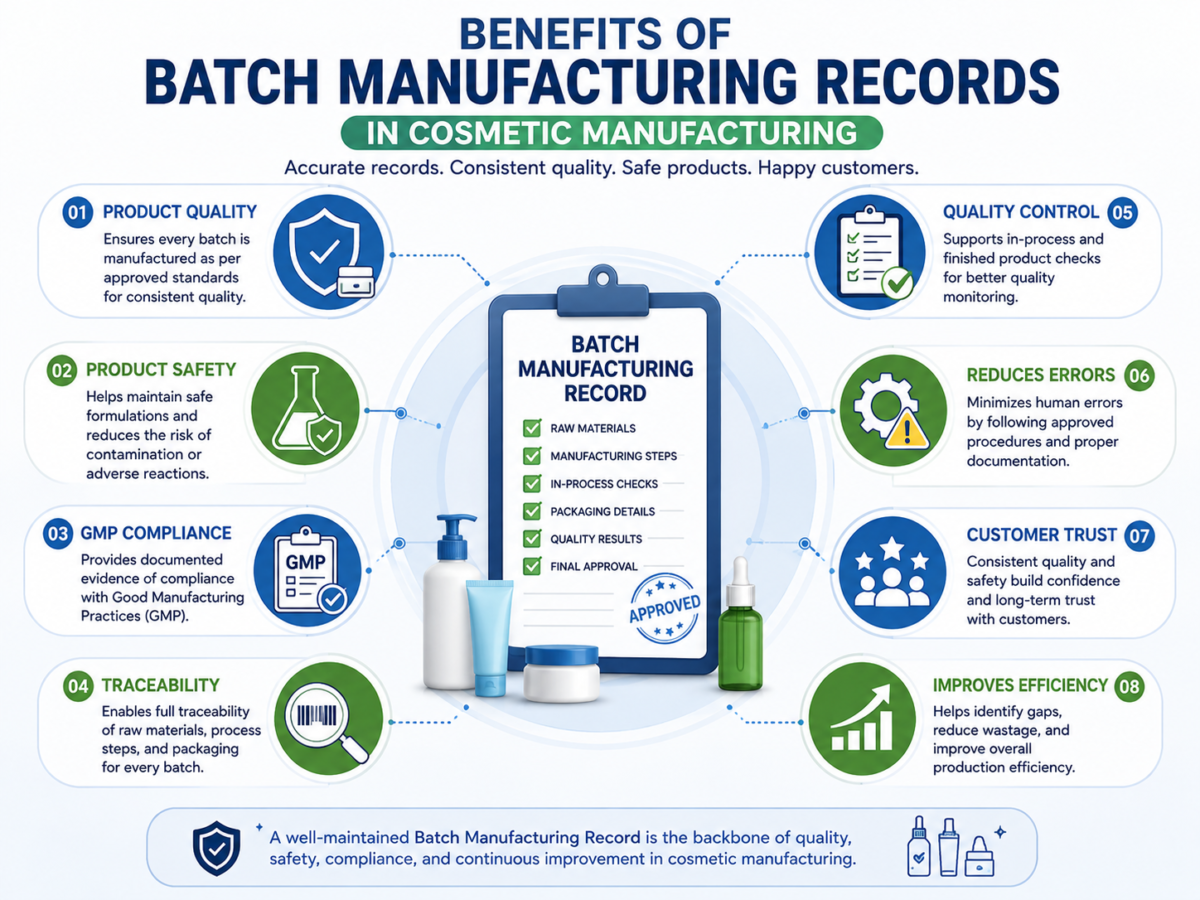
A Batch Manufacturing Record, commonly called a BMR, contains important instructions and information for producing a specific batch.
It may include:
- Product name
- Batch number
- Batch size
- Raw material names
- Required quantities
- Manufacturing steps
- Equipment details
- Processing conditions
- In-process checks
- Operator records
- Production dates
- Signatures or verification records
The BMR provides a documented history of how the batch was manufactured.
For example, if a 500 kg shampoo batch is being produced, the BMR can guide the manufacturing team on which ingredients should be added, the required quantities, mixing instructions, and applicable process checks.
Accurate documentation is an essential part of professional cosmetic manufacturing because it supports traceability and consistency.
8. Manufacturing and Mixing
After dispensing, the ingredients move to the manufacturing area.
The actual process depends heavily on the type of cosmetic product.
For a simple liquid product, ingredients may be dissolved or mixed in a manufacturing vessel.
For an emulsion such as a face cream, the process can involve separate water and oil phases that are heated and processed before being combined.
For a shampoo, surfactants and other ingredients may be added gradually under controlled mixing conditions.
During manufacturing, operators monitor factors such as:
- Mixing speed
- Temperature
- Processing time
- Addition sequence
- Product appearance
- pH, where applicable
- Viscosity, where applicable
The order in which ingredients are added can make a significant difference.
For example, adding a thickening polymer too quickly can sometimes result in lumps or incomplete hydration. Similarly, adding certain heat-sensitive ingredients at excessively high temperatures may negatively affect their performance.
Therefore, the manufacturing procedure is usually developed and validated or otherwise controlled according to the manufacturer’s quality system and the characteristics of the product.
9. Different Cosmetic Products Require Different Manufacturing Methods
There is no single manufacturing method that works for every cosmetic product.
A cream may require emulsification and homogenization.
A shampoo may require controlled surfactant addition, mixing, and viscosity adjustment.
A lipstick may involve melting waxes and oils, blending pigments, molding, cooling, and finishing.
A face powder may require powder blending, milling or sieving, and controlled filling.
A serum may involve dissolving or dispersing ingredients into a suitable base followed by pH and viscosity adjustment.
This is why cosmetic manufacturing requires both a suitable formulation and a suitable manufacturing procedure.
10. In-Process Quality Checks
Quality control does not begin only after the finished product is manufactured. Important checks can also be performed during production.
These are known as in-process quality checks.
Depending on the product, the manufacturing team may check parameters such as:
- Appearance
- Color
- Odor
- pH
- Viscosity
- Homogeneity
- Temperature
- Weight or volume
- Specific physical characteristics
For example, if a face wash is expected to have a particular viscosity range, the batch can be checked during manufacturing to ensure that it is progressing toward the required specification.
If an unexpected result is observed, the batch can be investigated before the product proceeds to the next stage.
This makes in-process testing an important part of maintaining batch-to-batch consistency.
What Happens After Manufacturing?
Once the main manufacturing process is complete, the product may undergo additional adjustments, cooling, homogenization, or holding steps depending on its formulation.
After the bulk product meets the required manufacturing and in-process requirements, it can move toward finished product testing and filling.
The next stages include finished product quality testing, filling into containers, labeling, packaging, inspection, and final batch release.
These stages are equally important because a well-made bulk product can still face problems if filling, packaging, labeling, or final inspection is not properly controlled.
Cosmetic Manufacturing Process: Testing, Filling and Packaging
In Part 1, we discussed the early stages of the cosmetic manufacturing process, including formulation, raw material selection, dispensing, batch documentation, manufacturing, and in-process checks. Once the bulk product has been successfully manufactured, the process moves toward another important stage: finished product testing, filling, packaging, and release.
These steps help ensure that the product reaching the customer has the expected quality, appearance, quantity, and packaging condition.
11. Bulk Product Inspection
After manufacturing is completed, the bulk cosmetic product is inspected before it moves to filling.
At this stage, the production and quality teams may check the product against approved specifications. The checks depend on the type of cosmetic being manufactured.
For a face cream, the team may examine its color, odor, texture, pH, viscosity, and uniformity. For a shampoo, appearance, pH, viscosity, color, fragrance, and homogeneity may be important. A serum may require checks related to clarity, pH, viscosity, and appearance.
The purpose is to confirm that the bulk product is suitable for the next stage.
For example, if a moisturizer is supposed to have a smooth, uniform texture but visible lumps are found, the batch should not simply move to filling without investigation.
12. Homogenization
Some cosmetic products require homogenization to achieve a more uniform texture and distribution of ingredients.
Homogenization uses mechanical energy to reduce the size of dispersed droplets or particles and improve uniformity.
This is particularly relevant for emulsions such as creams and lotions.
For example, a moisturizer may contain both water-soluble and oil-soluble components. During processing, these phases need to be combined into a stable and uniform emulsion. Appropriate homogenization can help produce the desired texture and consistency.
However, the exact homogenization conditions depend on the formulation, equipment, batch size, and product requirements.
Too little processing may result in poor uniformity, while excessive processing can sometimes affect the texture or other properties of a formulation.
Read More : What Is Allantoin in Skincare? A Beginner’s Complete Guide(2026)
13. Cooling and Addition of Heat-Sensitive Ingredients
Many cosmetic products are manufactured using controlled heating and cooling steps.
This is common in creams, lotions, conditioners, and other products containing waxes, fatty materials, or ingredients that need to be melted before mixing.
After the required processing temperature is reached, the batch may be cooled gradually.
Certain ingredients are added during the cooling stage because they may not be suitable for exposure to higher processing temperatures.
Examples can include some fragrances, botanical extracts, preservatives, vitamins, or other heat-sensitive components, depending on their individual specifications.
The exact addition temperature should always come from the approved formulation and manufacturing procedure rather than a general rule.
For instance, adding a delicate fragrance at an inappropriate temperature could change its odor profile or increase unnecessary loss during processing.
14. pH Adjustment
pH is an important quality parameter for many water-based cosmetic products.
The final pH can influence product stability, preservative performance, skin feel, and compatibility with the intended application.
Products such as face washes, shampoos, conditioners, toners, and some creams may have a defined pH range in their specifications.
If the measured pH is outside the required range, the formulation may be adjusted using suitable ingredients according to the approved manufacturing procedure.
For example, a facial cleanser designed for regular skin use may require a particular pH range. The manufacturer should not adjust the pH randomly because an excessive amount of an acid or alkali can create new formulation problems.
This is why pH adjustment should be controlled, documented, and verified.
15. Viscosity Adjustment
Viscosity describes how easily a liquid flows.
A watery toner has low viscosity, while a thick cream has much higher viscosity.
Cosmetic manufacturers establish viscosity requirements depending on the product and its intended use.
A shampoo that is too thin may feel inconvenient to use, while a shampoo that is excessively thick may be difficult to dispense from the bottle.
Viscosity can be influenced by several factors, including:
- Thickening agents
- Polymers
- Surfactants
- Temperature
- Mixing conditions
- Electrolytes
- pH
- Ingredient concentration
Therefore, viscosity adjustment should be performed carefully according to the approved formulation.
16. Finished Product Quality Testing
After the bulk product is manufactured, samples may be submitted to the Quality Control department for finished product testing.
The exact tests depend on the cosmetic product.
Typical evaluations can include:
Appearance
The product is examined for its expected color, texture, clarity, uniformity, and overall appearance.
A cream, for example, should generally appear smooth and homogeneous if that is its approved specification.
Odor
The fragrance or odor is checked against the established product specification.
An unusual odor may indicate a formulation, raw material, processing, packaging, or stability issue and may require investigation.
pH
pH is measured for products where it is a relevant specification.
Viscosity
Viscosity testing helps confirm whether the product has the expected thickness and flow characteristics.
Specific Physical Tests
Depending on the product, other tests may be required to confirm characteristics such as density, spreadability, foam properties, particle size, or other relevant parameters.
Microbiological Quality
Water-containing cosmetic products can be susceptible to microbial contamination. Therefore, appropriate microbiological quality testing and controls are important.
The exact testing program should be established based on the product, formulation, manufacturing process, packaging, intended use, and applicable requirements.
17. Stability Testing
A cosmetic product should remain within its required quality specifications during its intended shelf life when stored under appropriate conditions.
This is why stability testing is an important part of cosmetic product development and quality evaluation.
Stability studies can help identify changes in:
- Color
- Odor
- Texture
- pH
- Viscosity
- Separation
- Appearance
- Packaging compatibility
- Microbiological quality
For example, a cream may look perfectly stable when it is first manufactured but develop oil separation after several weeks under certain storage conditions.
Stability testing can help manufacturers understand how the formulation behaves over time.
Different types of stability studies may be used during product development, including long-term and accelerated studies, depending on the company’s procedures and applicable requirements.
18. Packaging Material Selection
Packaging is not simply about making a cosmetic product look attractive.
The package must also be suitable for the product.
Common cosmetic packaging materials include:
- Plastic bottles
- Glass bottles
- Tubes
- Jars
- Pumps
- Droppers
- Airless containers
- Sachets
- Compacts
- Lipstick containers
The choice depends on the formulation, product type, dispensing method, protection requirements, consumer convenience, and compatibility.
For example, a lightweight facial serum may be packed in a dropper bottle or pump container, while a face wash may be supplied in a tube or pump bottle.
Packaging compatibility is important because the formulation and container are in contact with each other during storage.
19. Filling Process
Once the bulk product has been approved for filling, it is transferred to the filling area according to the approved procedure.
The filling machine is selected based on the product and package.
For example:
- Liquid products may use liquid filling machines.
- Creams and lotions may use piston or other suitable filling systems.
- Shampoos may use liquid filling equipment.
- Thick products may require specialized filling arrangements.
- Powders may use powder filling systems.
Before filling begins, the production area and equipment should be appropriately prepared and checked.
The correct packaging components must also be available.
For example, if the product is supposed to be filled into 100 mL bottles, the team must ensure that the correct bottles, caps, labels, pumps, and other components are being used.
20. Filling Weight or Volume Checks
During filling, the quantity of product going into each container needs to be controlled.
Depending on the product and packaging format, the process may involve checks of fill weight or volume.
For example, if a body lotion is sold in a 200 g pack, the filling process should be controlled so that containers consistently meet the applicable quantity requirements.
Regular checks during filling can help identify problems such as:
- Underfilling
- Overfilling
- Filling variation
- Leakage
- Incorrect container placement
- Machine-related problems
These checks are important for both product consistency and consumer expectations.
21. Capping and Sealing
After filling, the container needs to be properly closed.
The closure may be a screw cap, flip-top cap, pump, dropper, induction seal, or another suitable system.
Proper closure helps protect the product from contamination, leakage, moisture loss, and other packaging-related problems.
For example, if a face serum uses a dropper bottle, the dropper and cap need to fit correctly. If a tube is not properly sealed, the product may leak during transportation.
The closure system should therefore be checked during the packaging process.
22. Labeling of Cosmetic Products
Once the containers are filled and closed, labels and other packaging components are applied.
The exact labeling requirements depend on the market and applicable regulations.
A cosmetic label may contain important information such as:
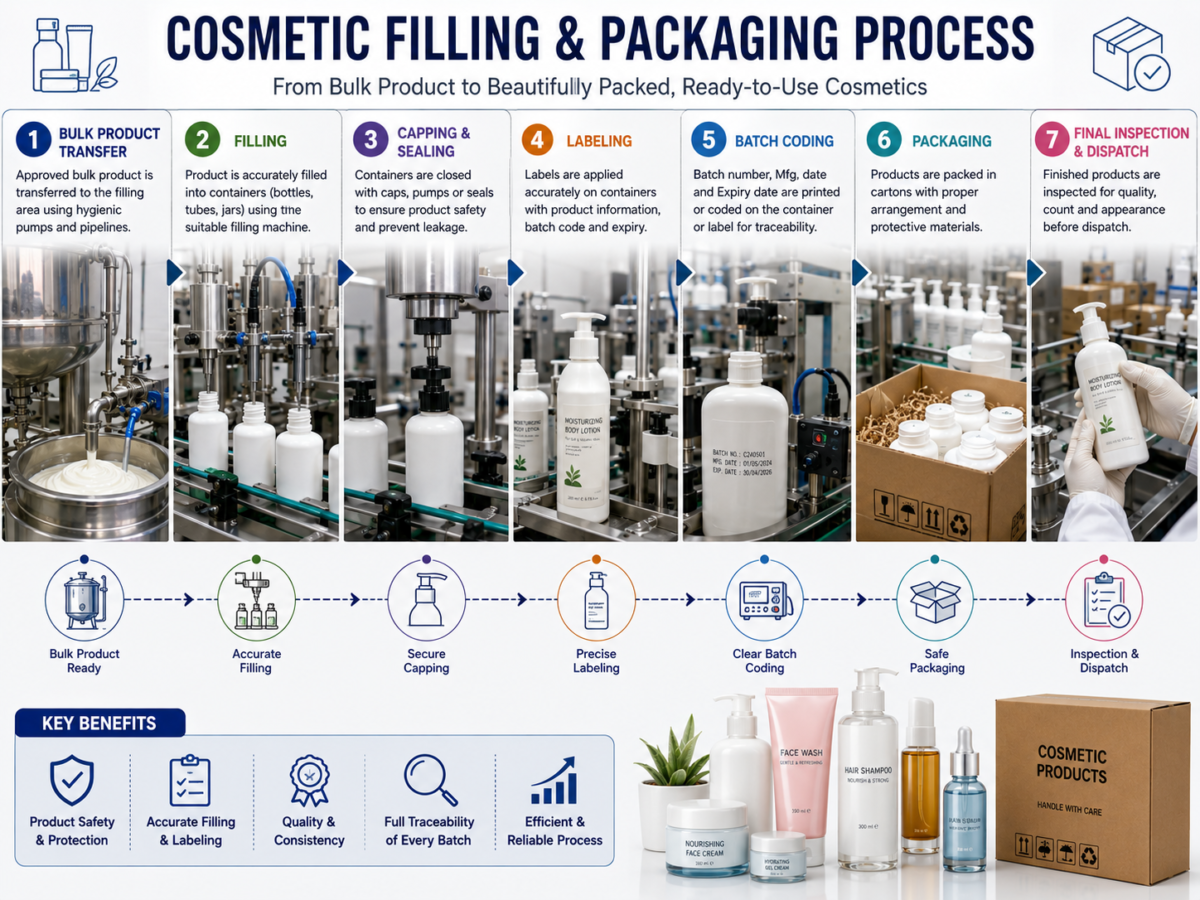
- Product name
- Net quantity
- Ingredient information
- Batch or lot identification
- Manufacturing information where required
- Expiry or best-before information where applicable
- Manufacturer or marketer details
- Directions for use
- Warnings or precautions where applicable
Correct labeling is essential because consumers depend on this information when selecting and using a cosmetic product.
A label mix-up can be a serious quality issue. Therefore, packaging operations generally include checks to confirm that the correct labels and printed materials are being used.
23. Packaging Inspection
The packaged product is inspected before it is placed into final storage.
The inspection may look for:
- Correct label
- Correct product
- Correct batch information
- Correct quantity
- Proper closure
- Clean container
- Proper appearance
- Damaged packaging
- Leakage
- Printing defects
For example, if a shampoo bottle has the wrong label or an incorrect batch code, it should be identified during inspection rather than reaching the customer.
24. Quality Assurance Review
Quality Assurance (QA) plays an important role in the overall cosmetic manufacturing system.
While Quality Control focuses heavily on testing and evaluation, Quality Assurance focuses on the broader system used to maintain consistent quality.
QA may review manufacturing records, testing results, deviations, investigations, packaging records, and other relevant documentation before a batch is released according to the company’s established procedures.
This documentation provides traceability.
If a customer reports a problem with a particular batch, the manufacturer should be able to investigate relevant records and identify information about the raw materials, manufacturing process, testing, packaging, and release of that batch.
25. Final Product Release
The final stage before distribution is batch release.
The responsible quality function reviews the required records and results to determine whether the batch meets the established requirements.
Only after the necessary release process is completed should the product move into approved finished-goods storage and distribution.
This step is important because manufacturing completion does not automatically mean that the product is ready for sale.
The batch must satisfy the applicable quality requirements and internal release procedures.
Cosmetic Manufacturing Process for Common Products
The basic manufacturing concept is similar across the industry, but each product has its own process.
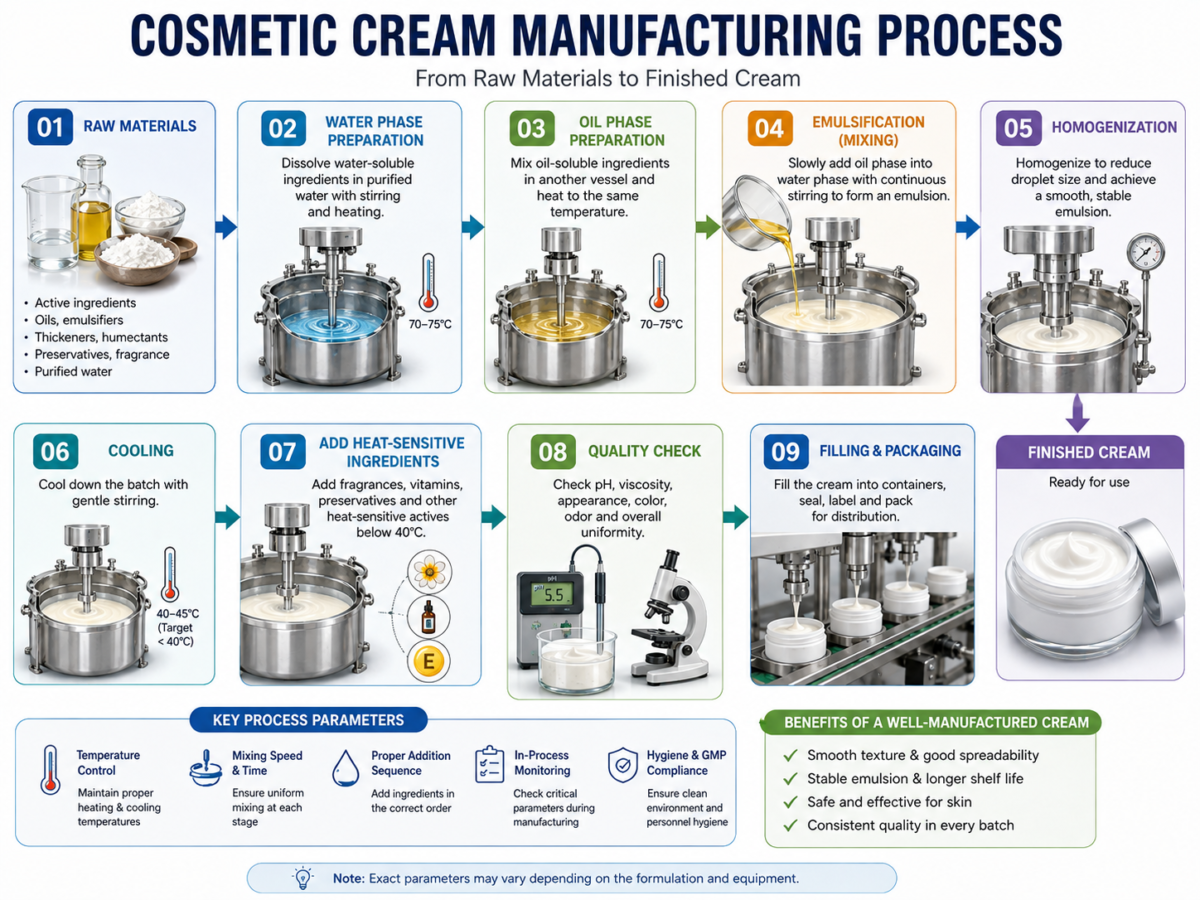
Face Cream Manufacturing
A typical cream manufacturing process may involve:
Water Phase Preparation → Oil Phase Preparation → Heating → Emulsification → Homogenization → Cooling → Addition of Heat-Sensitive Ingredients → pH Adjustment → Viscosity Check → Bulk Testing → Filling
Cream manufacturing requires careful control because the product usually contains both water and oil components.
Shampoo Manufacturing
A simplified shampoo process may include:
Water Preparation → Surfactant Addition → Mixing → Conditioning Ingredients → Thickener or Viscosity Adjustment → pH Adjustment → Fragrance/Other Suitable Ingredients → Quality Checks → Filling
The addition sequence is important because excessive foaming or poor mixing can create processing difficulties.
Face Wash Manufacturing
A face wash may involve:
Water Phase Preparation → Surfactant Addition → Mixing → Humectant/Conditioning Ingredients → Thickening → pH Adjustment → Appearance and Viscosity Checks → Filling
The final product should have the intended cleansing properties, appearance, texture, and packaging performance.
Serum Manufacturing
Depending on its formulation, a serum may involve:
Water or Suitable Base Preparation → Ingredient Dissolution/Dispersion → Active Ingredient Addition → Mixing → pH Adjustment → Filtration if Applicable → Quality Testing → Filling
Serums can be particularly sensitive to ingredient compatibility and stability, so the manufacturing procedure should be designed around the specific formulation.
Why Documentation Matters in Cosmetic Manufacturing
One of the most important lessons for beginners is that cosmetic manufacturing is not just about mixing ingredients.
Documentation is a major part of the process.
A manufacturing facility needs records that show what happened during production.
Important records can include:
- Raw material records
- Dispensing records
- Batch Manufacturing Records
- Equipment cleaning records
- In-process test results
- Finished product test results
- Packaging records
- Deviation records
- Investigation records
- Release documentation
Good documentation helps improve traceability and supports consistent manufacturing practices.
Cosmetic Manufacturing Equipment and Good Manufacturing Practices
The quality of a cosmetic product depends not only on its ingredients and formula but also on the equipment, people, environment, and procedures used during manufacturing. A well-designed manufacturing process helps reduce contamination, processing errors, batch variation, and packaging problems.
For beginners, it is useful to think of a cosmetic factory as a controlled system. Every stage, from weighing a raw material to cleaning a manufacturing vessel, has a purpose.
26. Common Equipment Used in Cosmetic Manufacturing
Different cosmetic products require different types of manufacturing equipment. The equipment selected depends on the product’s viscosity, batch size, formulation, processing temperature, and manufacturing method.
Some commonly used equipment includes:
Manufacturing Vessels
Manufacturing vessels are used for mixing and processing cosmetic formulations.
They may be designed for products such as shampoos, lotions, creams, conditioners, liquid cleansers, and gels.
The vessel may include features such as an agitator, heating system, cooling arrangement, temperature sensor, and controlled mixing system.
Homogenizer
A homogenizer is commonly used when a formulation requires intensive mixing or emulsification.
It can help produce a more uniform product by reducing droplet or particle size under suitable processing conditions.
Homogenizers are frequently associated with creams, lotions, emulsions, and other products where uniformity is important.
Planetary Mixer
Planetary mixers are useful for some high-viscosity cosmetic products.
They may be used for thick creams, masks, pastes, and other formulations that require strong mixing.
The mixer design allows the mixing tools to move through the product while helping distribute the ingredients.
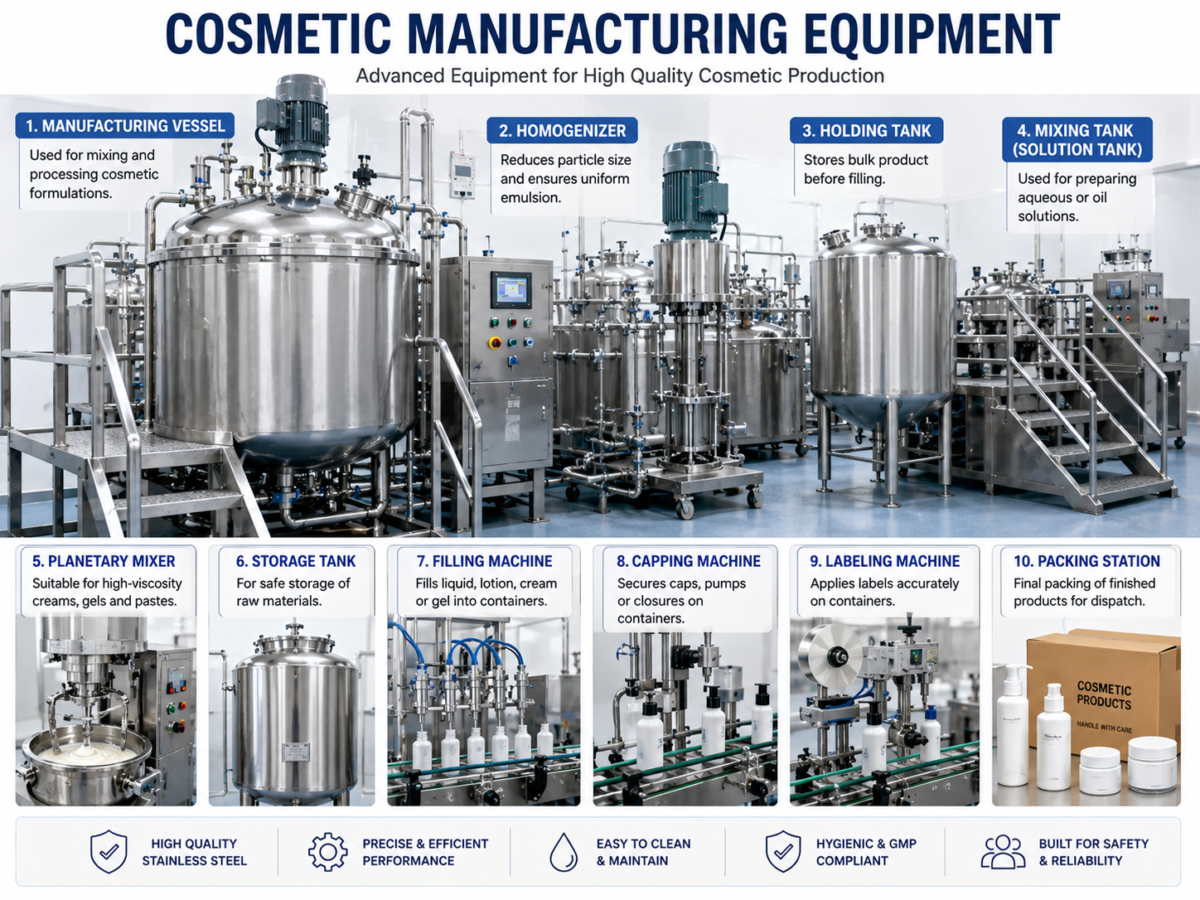
Storage or Holding Tanks
After manufacturing, some bulk products may be held in suitable tanks before filling.
These tanks should be appropriate for the product and maintained according to the facility’s procedures.
Filling Machine
Filling machines transfer the finished bulk product into its final containers.
The type of filling equipment depends on whether the product is a liquid, lotion, cream, gel, paste, powder, or another form.
Labeling Machine
Labeling equipment may be used to apply labels to bottles, tubes, jars, cartons, or other packaging.
For high-volume production, automated or semi-automated labeling can improve efficiency and consistency.
27. Importance of Equipment Selection
Choosing the correct equipment is important because the same equipment may not be suitable for every cosmetic formulation.
For example, a thin toner and a thick hair mask have completely different flow characteristics. A machine designed for a low-viscosity liquid may not work effectively with a thick paste.
Equipment selection should consider:
- Product viscosity
- Batch size
- Mixing requirements
- Heating requirements
- Cooling requirements
- Material compatibility
- Cleaning requirements
- Production capacity
- Product sensitivity
Poor equipment selection can result in problems such as incomplete mixing, excessive air incorporation, product sticking, difficult cleaning, or inconsistent batches.
28. Good Manufacturing Practices in Cosmetics
Good Manufacturing Practices (GMP) are procedures and controls designed to help ensure that products are consistently manufactured and controlled according to appropriate quality standards.
GMP is an important concept in the cosmetic industry because product quality cannot depend only on final testing.
For example, imagine a batch of face cream that accidentally becomes contaminated during manufacturing. Even if the final product looks normal, appearance alone cannot prove that the product is acceptable.
Good manufacturing practices focus on preventing such problems through controlled procedures.
Important GMP areas include:
- Personnel hygiene
- Facility cleanliness
- Equipment maintenance
- Raw material control
- Manufacturing procedures
- Documentation
- Quality control
- Storage
- Pest control
- Cleaning
- Contamination prevention
- Traceability
The exact regulatory requirements vary by country and market, so manufacturers should follow the applicable requirements for the location where their products are made and sold.
29. Personal Hygiene in Cosmetic Manufacturing
Employees working in production areas can potentially introduce contamination if proper hygiene practices are not followed.
For this reason, personnel may be required to follow procedures such as:
- Washing hands properly
- Wearing appropriate protective clothing
- Using hair restraints
- Wearing suitable gloves where required
- Following controlled entry procedures
- Avoiding unnecessary contact with products
- Reporting illness or conditions that could affect product safety
- Following designated movement routes
A person working in a manufacturing area should understand that personal hygiene is part of product quality.
For example, an operator handling a facial cream should not touch their face, mobile phone, or other potentially contaminated surfaces and then immediately return to the manufacturing operation without following the required hygiene procedure.
30. Cleaning and Sanitation
Cleaning is one of the most important routine activities in a cosmetic manufacturing facility.
Manufacturing equipment can contain traces of the previous product after production is completed. If the equipment is not cleaned properly, residues may contaminate the next batch.
For example, suppose a strongly colored hair conditioner is manufactured in a vessel and a light-colored body lotion is produced afterward. Inadequate cleaning could result in unwanted color carryover.
Cleaning procedures may include:
- Removal of remaining product
- Initial cleaning
- Use of an appropriate cleaning agent where required
- Rinsing
- Final inspection
- Drying where applicable
- Documentation
The cleaning procedure should be suitable for the equipment and product.
31. Cleaning Validation and Verification
Manufacturers may establish procedures to demonstrate that their cleaning process is effective.
This is particularly important where equipment is shared between different products.
The goal is to reduce the risk of:
- Product carryover
- Microbial contamination
- Cleaning-agent residues
- Cross-contamination
- Foreign material contamination
The exact approach depends on the manufacturing operation and applicable quality requirements.
Good cleaning practices protect both the current product and the products manufactured afterward.
32. Contamination Control
Cosmetic products can potentially be affected by physical, chemical, or microbiological contamination.
Physical contamination may involve unwanted particles or foreign materials.
Chemical contamination may occur through accidental contact with unsuitable substances.
Microbiological contamination can be especially important in water-containing products.
Manufacturers therefore use controls such as:
- Clean equipment
- Controlled production areas
- Appropriate personnel hygiene
- Proper raw material storage
- Suitable water quality
- Effective cleaning procedures
- Controlled manufacturing practices
- Appropriate packaging
- Microbiological testing where applicable
A clean-looking factory is helpful, but contamination control requires more than visual cleanliness. It depends on procedures, monitoring, training, and verification.
33. Water Quality in Cosmetic Manufacturing
Water is one of the most frequently used ingredients in cosmetics.
It may be present in creams, lotions, shampoos, conditioners, face washes, gels, toners, and many other products.
Because water can support microbial growth under suitable conditions, its quality is an important consideration.
Manufacturers may use treated or purified water systems appropriate for their products and processes.
The water system should be controlled according to established specifications and procedures.
For example, if a manufacturer produces a water-based facial cleanser, simply using ordinary untreated water without considering its quality would not provide adequate manufacturing control.
34. Temperature Control During Manufacturing
Temperature can influence the physical properties and stability of cosmetic formulations.
Some ingredients need to be melted before they can be properly incorporated. Others may be sensitive to high temperatures.
For example, waxes used in certain creams or lip products may need controlled heating to become sufficiently fluid. On the other hand, some delicate ingredients may be introduced during a later cooling stage.
Temperature should therefore be monitored according to the approved manufacturing process.
Sudden or uncontrolled temperature changes can sometimes affect:
- Texture
- Viscosity
- Emulsion stability
- Ingredient performance
- Appearance
- Fragrance
- Product consistency
35. Mixing Speed and Time
Mixing is another important manufacturing parameter.
If mixing is too slow, some ingredients may not distribute properly. If mixing is too aggressive, the process may introduce excessive air or cause unnecessary foaming.
For example, shampoo formulations can generate significant foam during processing. If the mixing method is not suitable, the production vessel may become difficult to handle or fill.
Similarly, a cream requires appropriate mixing to obtain a uniform emulsion.
Therefore, mixing speed and processing time should be defined in the manufacturing procedure rather than selected randomly during production.
36. Common Problems During Cosmetic Manufacturing
Even with a well-designed process, manufacturers may encounter production problems.
Some common examples include:
Separation of Cream or Lotion
A cream may separate into oil and water phases if the emulsion is not sufficiently stable.
Possible contributing factors can include formulation design, emulsifier selection, processing conditions, temperature, mixing, or raw material variation.
Excessive Foaming
Shampoo, body wash, and other surfactant-based products can produce excessive foam during mixing.
This can make manufacturing and filling more difficult.
Incorrect Viscosity
A product may become too thin or too thick compared with its approved specification.
Possible factors include incorrect ingredient quantities, pH, temperature, mixing conditions, or raw material variation.
Lumps in Gel or Cream
Poor dispersion or hydration of certain polymers or powders can result in lumps.
The addition sequence and mixing procedure are therefore important.
Color Variation
Changes in raw materials, processing conditions, ingredient concentration, or storage can sometimes affect product color.
Fragrance Variation
Fragrance may be affected by raw material variation, processing temperature, storage, or interaction with the formulation.
Microbial Contamination
Water-based products require appropriate controls because microorganisms can affect product quality and consumer safety.
If contamination is suspected, the batch should be handled according to the manufacturer’s investigation and quality procedures rather than simply being released.
37. How Manufacturers Maintain Batch-to-Batch Consistency
Customers expect the same product to perform consistently each time they purchase it.
To achieve this, manufacturers control several variables.
These can include:
Raw Material Quality + Formula + Manufacturing Process + Equipment + Environment + Testing + Packaging = Consistent Product Quality
Suppose a company manufactures the same moisturizer every month.
The company needs to control the identity and quality of raw materials, ingredient quantities, processing conditions, equipment, mixing, temperature, filling, packaging, and testing.
If one of these factors changes significantly, the final product may also change.
This is why manufacturing procedures and specifications are so important.
38. Role of Production Department
The Production department is responsible for carrying out the manufacturing process according to approved procedures.
Typical responsibilities may include:
- Following the manufacturing instructions
- Operating equipment
- Recording production information
- Monitoring process parameters
- Maintaining workplace cleanliness
- Reporting abnormalities
- Coordinating with Quality Control and Quality Assurance
- Following safety and hygiene procedures
Production employees play a direct role in turning the approved formulation into a finished bulk product.
39. Role of Quality Control Department
The Quality Control (QC) department focuses on testing and evaluating raw materials, in-process samples, packaging materials, and finished products as applicable.
QC may perform or coordinate tests such as:
- Appearance
- Odor
- pH
- Viscosity
- Identification
- Microbiological testing
- Other product-specific quality tests
The testing requirements depend on the formulation and established specifications.
QC results provide important information about whether materials and products meet the required standards.
40. Role of Quality Assurance Department
The Quality Assurance (QA) department focuses on the overall quality system.
QA may be involved in:
- Documentation review
- SOP management
- Deviations
- Investigations
- Corrective and preventive actions
- Change control
- Internal audits
- Training systems
- Batch record review
- Product release procedures
Production, QC, and QA work together, but their responsibilities are not identical.
A simple way to understand the difference is:
Production makes the product.
QC tests the product and materials.
QA manages the quality system.
All three functions are important for a reliable cosmetic manufacturing operation.
41. Training of Cosmetic Manufacturing Employees
Proper employee training is essential.
An operator may know how to operate a mixing machine, but that alone is not enough. They also need to understand the manufacturing procedure, hygiene requirements, safety precautions, documentation, and what to do if something goes wrong.
Training can cover:
- GMP principles
- SOPs
- Equipment operation
- Cleaning procedures
- Personal hygiene
- Documentation
- Safety
- Contamination control
- Handling deviations
Regular training helps employees stay familiar with current procedures.
42. Why Small Manufacturing Errors Matter
A cosmetic batch can contain hundreds or thousands of units, depending on the production scale.
A small mistake during manufacturing can therefore affect a large number of products.
For example, if an incorrect ingredient quantity is used in a 1 kg laboratory trial, the impact may be limited. But if the same mistake occurs in a 1,000 kg commercial batch, thousands of finished units could potentially be affected.
This is why manufacturing controls become increasingly important as production scale increases.
43. From Small Trial to Commercial Production
Before a cosmetic product reaches large-scale manufacturing, companies may produce laboratory or pilot batches.
The purpose is to understand how the formulation behaves under different processing conditions and whether the manufacturing procedure can be transferred successfully to larger equipment.
For example, a cream may be easy to mix in a 5 kg laboratory vessel but behave differently in a 500 kg production vessel.
Large-scale manufacturing can involve differences in:
- Mixing efficiency
- Heating rate
- Cooling rate
- Shear
- Processing time
- Ingredient addition
- Equipment geometry
Therefore, scale-up should be carefully planned.
44. Practical Example: Manufacturing a Moisturizing Cream
Consider a simple moisturizing cream.
First, the required raw materials are approved and dispensed according to the batch formula.
The water-soluble ingredients are prepared in the water phase, while suitable oil-soluble ingredients are prepared in the oil phase.
The phases may be processed under controlled temperature conditions and then combined using appropriate mixing and emulsification equipment.
The batch is homogenized when required to achieve the desired uniformity.
As the product cools, selected temperature-sensitive ingredients may be added according to the approved procedure.
The manufacturer then checks parameters such as appearance, pH, viscosity, and other applicable specifications.
Once the bulk is approved for filling, it is transferred to the filling line and packed into the selected containers.
Finally, the packaged batch goes through the required inspection and release process.
This example shows why cosmetic manufacturing is a combination of science, equipment, people, process control, and documentation.
45. Safety Should Remain a Priority
Cosmetic manufacturing involves chemicals, machinery, heating systems, electrical equipment, pressurized systems, and other workplace hazards.
Employees should follow the facility’s safety procedures and use appropriate personal protective equipment.
Safety measures can include:
- Proper chemical handling
- Suitable protective clothing
- Eye protection where required
- Safe equipment operation
- Proper storage
- Spill response procedures
- Fire safety
- Emergency procedures
- Equipment lockout procedures where applicable
Product quality and employee safety should be treated as connected priorities in a professional manufacturing environment.
What Makes a Good Cosmetic Manufacturing Process?
A strong manufacturing process should be:
- Consistent
- Controlled
- Documented
- Hygienic
- Traceable
- Efficient
- Suitable for the formulation
- Supported by appropriate testing
- Designed to minimize contamination and errors
The ultimate objective is to manufacture a cosmetic product that consistently meets its approved quality requirements.
Complete Cosmetic Manufacturing Process Flow Chart
The cosmetic manufacturing process can look complicated when each department and activity is considered separately. However, the complete process becomes easier to understand when it is arranged in a simple sequence.
A basic cosmetic manufacturing flow can be represented as:
Product Development → Raw Material Selection → Raw Material Receipt → Quality Testing → Storage → Dispensing → Manufacturing → In-Process Testing → Bulk Approval → Filling → Labeling → Packaging → Finished Product Testing → QA Review → Batch Release → Finished Goods Storage → Distribution
Each stage has a specific purpose, and the process may be modified depending on the type of cosmetic product, manufacturing facility, formulation, packaging, and applicable requirements.
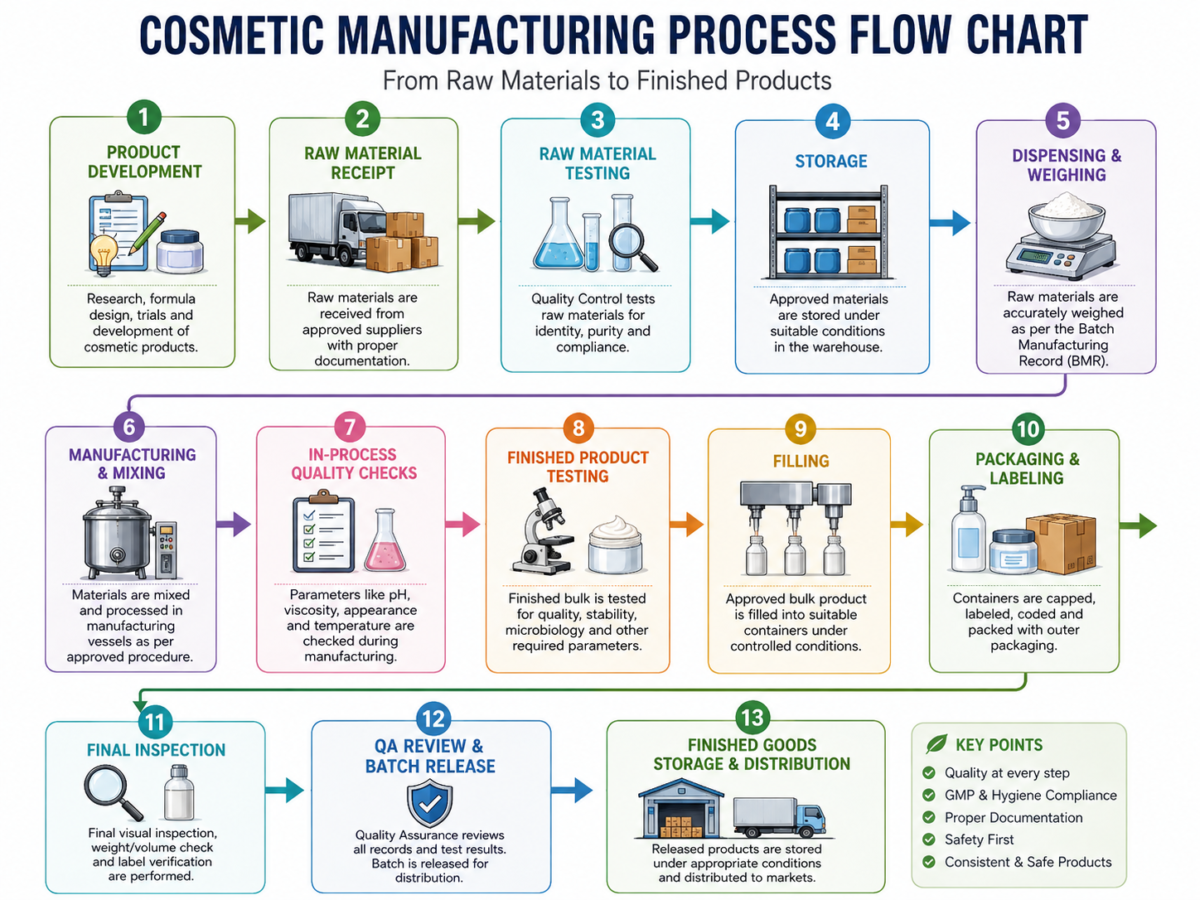
Step-by-Step Cosmetic Manufacturing Process
Let’s summarize the complete process in simple language.
Step 1: Product Development
The company first decides what type of cosmetic product it wants to develop.
For example, it may develop a moisturizing cream, anti-dandruff shampoo, facial cleanser, sunscreen, body lotion, or hair conditioner.
The formulation team creates and evaluates the formula before commercial production.
Step 2: Raw Material Selection
Suitable raw materials are selected according to the approved formulation.
The company considers the required specifications, supplier information, quality requirements, compatibility, and intended use of each ingredient.
Step 3: Raw Material Receipt
Materials are received at the manufacturing facility and checked for identity, quantity, packaging condition, labeling, and documentation.
Step 4: Quality Evaluation
Materials are evaluated according to the company’s approved procedures.
Only materials that meet the required specifications should be made available for production.
Step 5: Storage
Approved raw materials are stored under suitable conditions.
Proper identification and stock control help prevent material mix-ups and deterioration.
Step 6: Dispensing
The required ingredients are accurately weighed according to the approved batch formula.
Verification at this stage helps reduce the risk of using incorrect materials or quantities.
Step 7: Manufacturing
Ingredients are processed according to the approved manufacturing instructions.
Depending on the product, this may involve dissolving, heating, cooling, mixing, emulsification, homogenization, dispersion, or other processing steps.
Step 8: In-Process Checks
The batch is monitored during production.
Relevant parameters may include pH, viscosity, temperature, appearance, mixing conditions, and other product-specific characteristics.
Step 9: Bulk Product Evaluation
After manufacturing, the bulk product is checked against the required specifications before filling.
Step 10: Filling
The approved bulk product is filled into the appropriate containers.
Fill weight or volume is controlled during the operation.
Step 11: Labeling and Packaging
Containers are closed, labeled, coded, and packed using the approved packaging components.
Step 12: Finished Product Testing
Samples of the finished product may undergo applicable quality tests.
Step 13: QA Review
Quality Assurance reviews the relevant manufacturing, testing, packaging, and documentation records according to the company’s procedures.
Step 14: Batch Release
After the required review is completed, the batch can be released according to the applicable quality system.
Step 15: Storage and Distribution
Released finished products are stored under appropriate conditions and then distributed to warehouses, retailers, online platforms, salons, clinics, or other approved channels.
Cosmetic Manufacturing vs Cosmetic Formulation
These two terms are often confused by beginners.
Cosmetic formulation is mainly concerned with deciding what ingredients should be used and in what proportions to create the desired product.
Cosmetic manufacturing is the controlled process of turning that approved formula into a consistent finished product.
For example, a formulator may develop a face cream containing water, an oil phase, an emulsifier, humectants, a thickener, preservative, and skin-conditioning ingredients.
The manufacturing team then follows the approved procedure to weigh, process, mix, heat, cool, adjust, test, and fill that formula.
In simple words:
Formulation answers: “What should the product contain?”
Manufacturing answers: “How should we consistently make it?”
Both are important, but they involve different activities.
Practical Tips for Beginners in Cosmetic Manufacturing
If you are new to the cosmetic industry, understanding a few basic principles can make the manufacturing process much easier to learn.
Always Understand the Formula
Do not look at a formula as only a list of percentages.
Try to understand why each ingredient is present.
For example, a humectant helps attract and retain water, an emollient can improve skin feel, an emulsifier helps support an emulsion, and a preservative system helps control microbial growth where appropriate.
Understanding ingredient functions makes manufacturing decisions easier to follow.
Follow the Addition Sequence
Ingredient addition order can influence the final product.
Adding a polymer, surfactant, active ingredient, fragrance, or other material at the wrong stage can sometimes affect dispersion, viscosity, appearance, or stability.
Always follow the approved manufacturing procedure rather than relying on memory.
Record What Actually Happened
Good manufacturing documentation should reflect what actually happened during production.
If there is a deviation from the approved procedure, it should be handled according to the facility’s deviation and investigation procedures rather than silently changing the record.
Never Ignore Small Changes
A small change in raw material, temperature, mixing time, or addition sequence can sometimes produce a noticeable difference in the final product.
For example, a slight change in a thickening system can change a lotion from light and easy to spread to heavy and difficult to dispense.
Understand the Finished Product From the Consumer’s Point of View
A cosmetic product should not only pass technical checks. It should also provide the expected consumer experience.
For a moisturizer, this could include spreadability, absorption, skin feel, appearance, and fragrance.
For a shampoo, it may include cleansing performance, viscosity, foam characteristics, fragrance, and ease of dispensing.
This consumer perspective is useful during product development and manufacturing.
How Technology Is Improving Cosmetic Manufacturing
Modern cosmetic manufacturing is becoming increasingly automated.
Manufacturers may use automated weighing systems, electronic batch records, computerized process monitoring, automated filling equipment, barcode systems, and advanced quality-control instruments.
Automation can help reduce manual errors and improve production efficiency, but technology does not eliminate the need for trained employees.
People are still required to develop formulations, establish procedures, review data, investigate problems, maintain equipment, and make appropriate quality decisions.
The future of cosmetic manufacturing is likely to involve a combination of formulation science, automation, data management, sustainability, and improved process control.
Sustainable Cosmetic Manufacturing
Sustainability is also becoming increasingly important in the cosmetic industry.
Manufacturers may look for ways to reduce:
- Water consumption
- Energy usage
- Manufacturing waste
- Packaging waste
- Raw material waste
- Cleaning-related waste
For example, optimized batch sizes and better process control can reduce material losses.
Packaging choices can also influence the environmental impact of a cosmetic product.
However, sustainability should be balanced with product protection, stability, safety, functionality, and applicable requirements.
Frequently Asked Questions About Cosmetic Manufacturing
What is the cosmetic manufacturing process?
The cosmetic manufacturing process is the controlled series of activities used to convert cosmetic raw materials into finished products. It can include formulation, raw material testing, dispensing, manufacturing, quality checks, filling, packaging, and final release.
What are the main stages of cosmetic manufacturing?
The main stages generally include product development, raw material receipt and testing, storage, dispensing, manufacturing, in-process testing, finished product testing, filling, packaging, quality review, and batch release.
What is a BMR in cosmetic manufacturing?
BMR stands for Batch Manufacturing Record. It contains important information and instructions related to the manufacturing of a particular batch, including raw material quantities, processing steps, equipment information, and manufacturing records.
Why is pH important in cosmetic manufacturing?
pH can influence product stability, skin feel, preservative performance, and compatibility with the intended application. Products with a defined pH specification should be checked and adjusted according to their approved formulation and manufacturing procedure.
What is the role of Quality Control in cosmetics?
Quality Control is responsible for relevant testing and evaluation of raw materials, in-process samples, packaging materials, and finished products according to established specifications and procedures.
What is the role of Quality Assurance?
Quality Assurance manages and supports the broader quality system. It can include documentation review, SOPs, deviations, investigations, change control, training, audits, and batch release activities.
What equipment is used in cosmetic manufacturing?
Common equipment includes manufacturing vessels, agitators, homogenizers, planetary mixers, storage tanks, filling machines, labeling machines, and other product-specific processing equipment.
How is a cosmetic cream manufactured?
A typical cream manufacturing process may involve preparing water and oil phases, controlled heating, combining the phases, emulsification, homogenization, cooling, addition of suitable heat-sensitive ingredients, pH or viscosity adjustment, quality checks, and filling.
How is shampoo manufactured?
Shampoo manufacturing generally involves preparing the appropriate base, adding surfactants and other ingredients according to the formulation, mixing, adjusting viscosity and pH where required, performing quality checks, and filling the finished product into suitable packaging.
Why is cleaning important in cosmetic manufacturing?
Cleaning helps reduce product residues, contamination, and unwanted carryover between batches. It is particularly important when the same equipment is used to manufacture different products.
What is GMP in cosmetic manufacturing?
GMP stands for Good Manufacturing Practices. It refers to organized practices and controls used to help ensure that cosmetic products are consistently manufactured and controlled according to appropriate quality requirements.
How long does cosmetic manufacturing take?
There is no single manufacturing time for all cosmetics. A simple liquid product may be processed relatively quickly, while creams, emulsions, gels, and complex products may require additional heating, cooling, mixing, holding, testing, or adjustment stages.
Is cosmetic manufacturing different for every product?
Yes. Creams, shampoos, face washes, serums, lipsticks, powders, conditioners, and sunscreens can require different ingredients, equipment, processing conditions, and quality tests.
Final Thoughts
The cosmetic manufacturing process is much more than simply mixing ingredients together. It is a carefully organized system that combines formulation science, raw material control, equipment, production procedures, quality testing, hygiene, documentation, packaging, and final release.
A good manufacturing process begins with the right raw materials and an appropriate formulation. It continues through accurate dispensing, controlled processing, in-process monitoring, finished product testing, and proper packaging.
For beginners entering the cosmetic industry, one of the most important things to understand is that quality must be built into the process rather than checked only at the end. A beautiful-looking cream or shampoo is not enough. The product needs to be manufactured consistently and controlled throughout its lifecycle.