
Cosmetic products such as face washes, moisturizers, serums, sunscreens, shampoos, lip balms, and body lotions may look simple on the store shelf, but creating them is a detailed scientific process. Every product begins with a carefully planned cosmetic formulation that determines how well it performs, how safe it is for the skin, and how pleasant it feels during use.
A lightweight moisturizer that absorbs quickly, a vitamin C serum that remains stable for months, or a gentle cleanser that removes dirt without drying the skin are all the result of good cosmetic formulation. Behind every successful beauty product is a combination of science, research, testing, and creativity.
For beginners, the word cosmetic formulation can sound technical. However, the concept is actually quite simple. It means selecting the right ingredients and combining them in the correct amounts to create a cosmetic product that is safe, effective, stable, and enjoyable to use.
What Is Cosmetic Formulation?
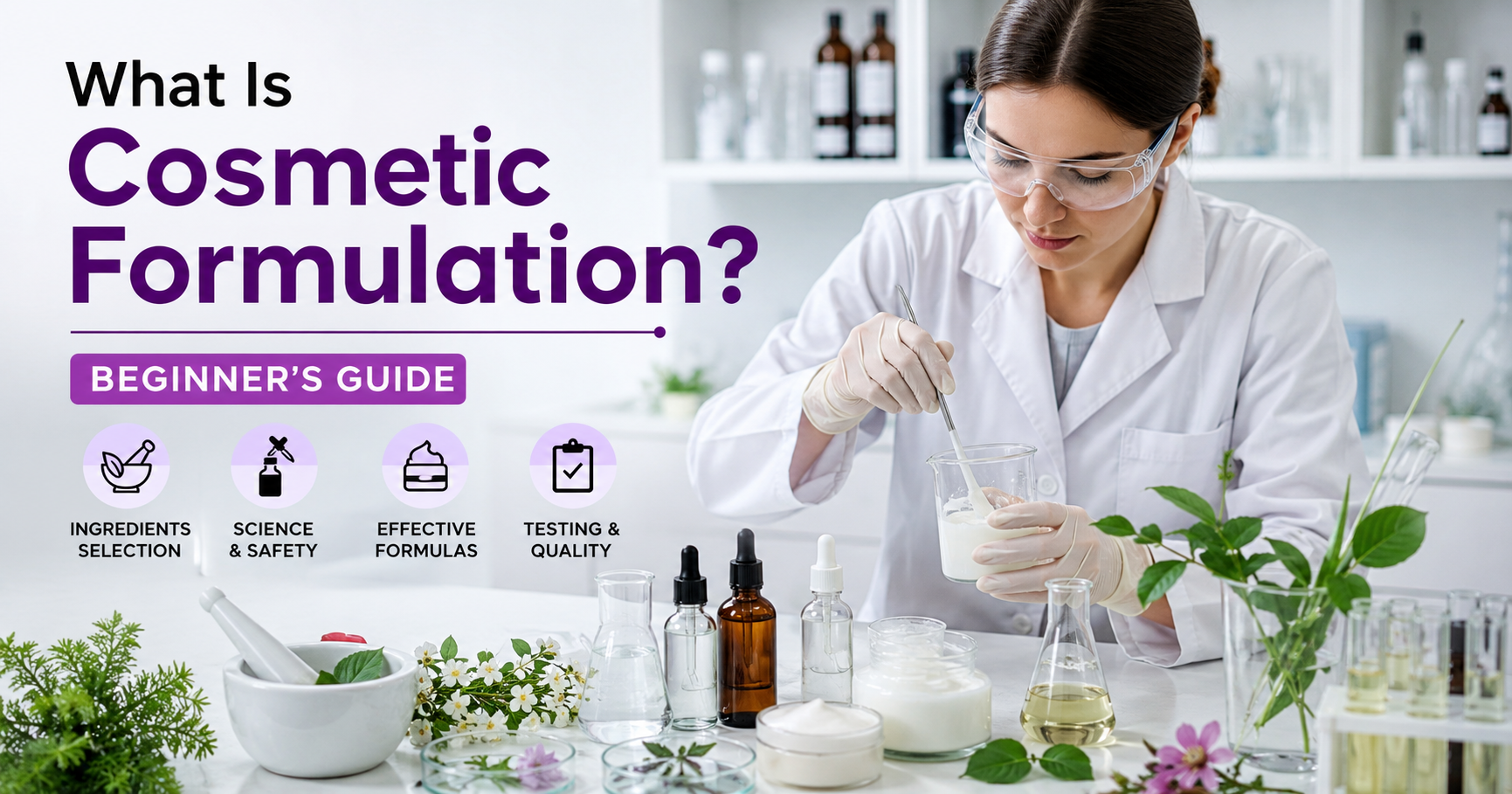
Cosmetic formulation is the scientific process of designing and developing cosmetic and personal care products by combining different ingredients in specific proportions to achieve a desired purpose.
The goal is not simply to mix ingredients together. Instead, each ingredient is selected because it performs a specific function while working safely with the other ingredients in the formula.
For example, a simple facial moisturizer may contain:
- Water for hydration
- Humectants to attract moisture
- Emollients to soften the skin
- Emulsifiers to keep oil and water mixed
- Preservatives to prevent microbial growth
- Thickeners for the right texture
- Antioxidants for product stability
- Skin-beneficial active ingredients
- Fragrance or fragrance-free components depending on the product
Each ingredient plays an important role. Removing or changing even one ingredient can affect the product’s texture, stability, effectiveness, or shelf life.
Read More: Why Is PH Important In Skincare Products? Everything You Need To Know
A cosmetic formulation is like following a recipe, but instead of baking a cake, cosmetic chemists create products that must remain safe, stable, and effective for months or even years.
Why Is Cosmetic Formulation Important?
Many people think that expensive ingredients alone create a high-quality skincare product. In reality, even premium ingredients cannot perform well without proper formulation.
A well-designed cosmetic formulation ensures that the product:
1. Delivers Effective Results
The ingredients should reach the skin properly and perform their intended function.
For example, niacinamide helps improve the skin barrier, but it must be formulated at an appropriate concentration and in a stable environment to provide visible benefits.
2. Remains Safe During Use
Every cosmetic product should be gentle enough for regular use while meeting safety standards.
Professional formulators carefully select ingredient levels to minimize irritation while maintaining product performance.
3. Stays Stable Throughout Its Shelf Life
Consumers expect products to look and perform the same from the first use until the last.
A properly formulated moisturizer should not:
- Separate into oil and water
- Change color unexpectedly
- Develop an unpleasant smell
- Lose its texture
- Become contaminated with bacteria
This is why stability testing is an essential part of cosmetic formulation.
Read More: What is Cosmetic Production? Complete Guide to Process, Stages & Departments.
4. Provides a Pleasant User Experience
People often continue using products that feel comfortable on the skin.
A good formulation considers:
- Smooth texture
- Easy application
- Fast absorption
- Non-greasy finish
- Comfortable after-feel
- Suitable fragrance (or fragrance-free option)
The overall experience is just as important as the ingredients themselves.
5. Supports Product Compatibility
Many skincare users apply several products during one routine.
A good formulation helps products work well alongside cleansers, serums, moisturizers, and sunscreens without causing unnecessary pilling or irritation.
Main Goals of Cosmetic Formulation
Professional cosmetic formulators focus on several important objectives while developing products.
Safety
Every ingredient should be used within recommended limits and should comply with cosmetic regulations.
Safety is always the first priority before considering appearance or performance.
Stability
The product should remain consistent under different storage conditions.
It should maintain:
- Color
- Texture
- Fragrance
- Performance
- Microbiological safety
Effectiveness
The product should perform its intended purpose.
Examples include:
- Hydrating dry skin
- Reducing oiliness
- Supporting the skin barrier
- Brightening dull skin
- Improving skin texture
- Cleansing impurities
Consumer Experience
People expect skincare products to feel pleasant.
A good formulation balances science with comfort by providing:
- Smooth consistency
- Easy spreading
- Quick absorption
- Elegant finish
- Minimal stickiness
Manufacturing Efficiency
The formula should also be practical for large-scale production.
Manufacturers need products that can be produced consistently without quality variations.
Cosmetic Formulation vs Mixing Ingredients
One of the biggest misconceptions among beginners is believing that cosmetic formulation simply means mixing ingredients together.
This is not true.
Imagine making lemonade.
Anyone can mix water, sugar, and lemon juice.
Now imagine creating a sunscreen that remains stable in hot weather, protects the skin from UV rays, spreads evenly, stays effective for months, and passes safety testing. That requires scientific knowledge, careful calculations, specialized equipment, and extensive testing.
Professional cosmetic formulation involves understanding:
- Ingredient compatibility
- pH balance
- Chemical stability
- Preservation systems
- Product texture
- Skin compatibility
- Manufacturing methods
- Packaging interaction
- Regulatory requirements
This is why experienced cosmetic chemists spend months developing a single product before it reaches the market.
Read More: The Best Acne Patches 2026 : Your Complete Guide
Real-Life Example of Cosmetic Formulation
Let’s look at a simple example.
Suppose a company wants to develop a lightweight moisturizer for oily skin.
Instead of adding random ingredients, the formulator carefully plans the formula.
The product may include:
| Ingredient Type | Purpose |
|---|---|
| Water | Main base of the product |
| Glycerin | Attracts moisture to the skin |
| Lightweight Emollient | Softens skin without feeling greasy |
| Emulsifier | Combines oil and water into a smooth cream |
| Niacinamide | Supports the skin barrier and improves skin appearance |
| Preservative | Protects the product from harmful microorganisms |
| Thickener | Creates the desired cream texture |
| pH Adjuster | Maintains the ideal pH for stability and skin comfort |
The formulator then performs multiple rounds of testing to ensure the moisturizer remains stable, safe, and effective before it is released to consumers.
This careful process is what makes cosmetic formulation both a science and an art
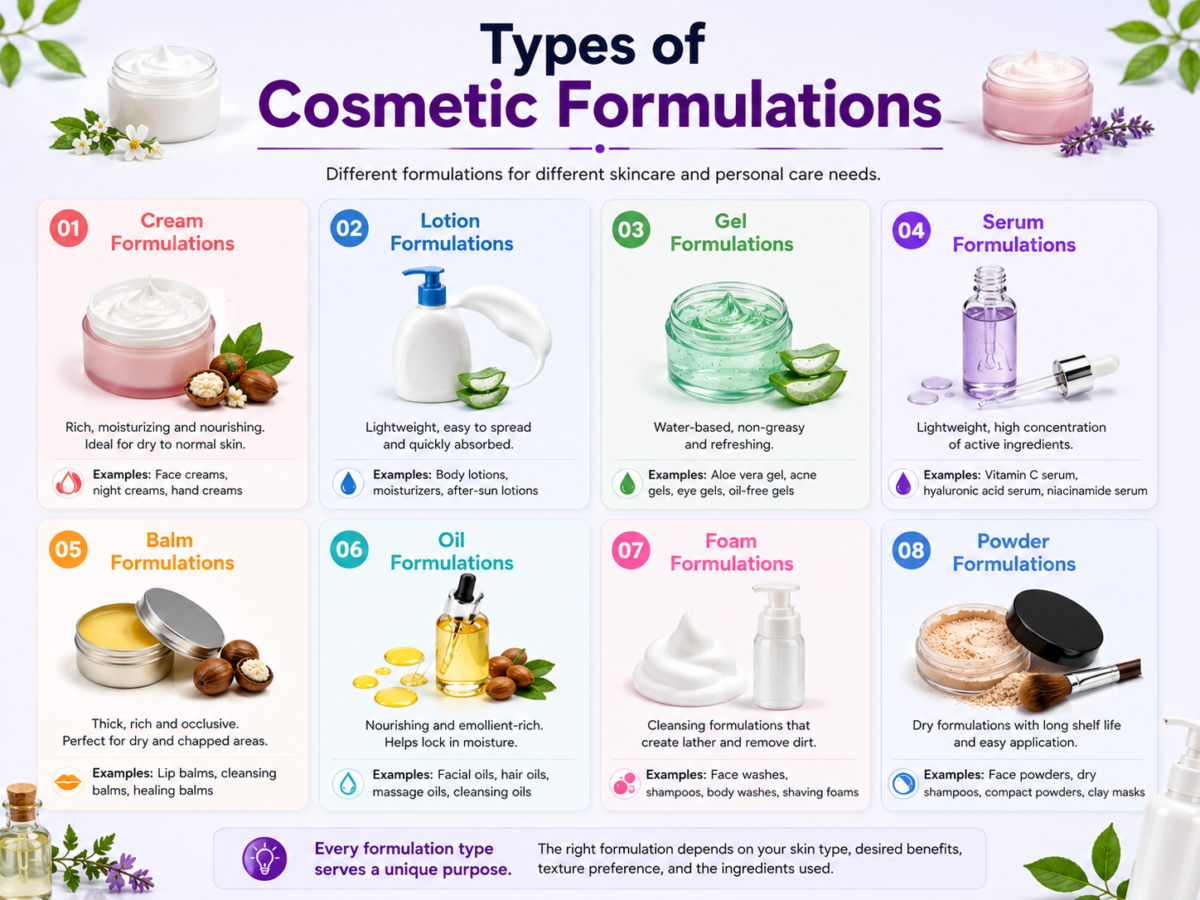
Types of Cosmetic Formulations
Not all cosmetic products are made in the same way. A face serum feels very different from a body lotion, and a shampoo behaves differently from a sunscreen. This is because each product is created using a specific type of cosmetic formulation that matches its purpose and the way it will be used.
Choosing the right formulation is one of the most important decisions during product development. Even if two products contain similar active ingredients, their performance can vary greatly depending on how they are formulated.
Below are the most common types of cosmetic formulations used in the beauty and personal care industry.
1. Cream Formulations
Creams are one of the most popular cosmetic formulations because they provide both hydration and nourishment.
They usually contain a balanced mixture of water and oils, held together by emulsifiers to create a smooth, stable texture.
Cream formulations are commonly used for:
- Face moisturizers
- Night creams
- Anti-aging creams
- Eye creams
- Hand creams
- Foot creams
Benefits
- Deeply moisturize the skin
- Help strengthen the skin barrier
- Suitable for normal to dry skin
- Easy to spread evenly
Example:
A winter moisturizing cream often contains shea butter, glycerin, ceramides, and plant oils to protect dry skin from moisture loss.
2. Lotion Formulations
Lotions contain more water and less oil than creams, making them lighter in texture.
They absorb quickly without leaving a heavy or greasy feeling, making them ideal for everyday use.
Lotions are commonly used for:
- Body lotions
- Facial moisturizers
- Baby lotions
- After-sun products
Benefits
- Lightweight feel
- Quick absorption
- Comfortable in warm weather
- Suitable for oily and combination skin
Example:
A lightweight daily body lotion may contain glycerin, aloe vera, and lightweight emollients to provide hydration without stickiness.
3. Gel Formulations
Gels are water-based formulations that provide hydration with little or no oil.
They are especially popular for oily and acne-prone skin because they feel refreshing and absorb quickly.
Common gel products include:
- Aloe vera gels
- Oil-free moisturizers
- Acne treatment gels
- Cooling gels
- Eye gels
Benefits
- Non-greasy texture
- Fast absorption
- Cooling effect
- Ideal for humid climates
Example:
An oil-free hydrating gel with hyaluronic acid provides moisture while keeping the skin feeling fresh.
4. Serum Formulations
Serums are designed to deliver concentrated active ingredients directly to the skin.
Unlike creams, serums are usually thinner and focus on addressing specific skin concerns.
Popular serum ingredients include:
- Vitamin C
- Niacinamide
- Hyaluronic acid
- Peptides
- Retinol
- Tranexamic acid
Benefits
- High concentration of active ingredients
- Lightweight texture
- Targets specific concerns
- Easily layered into skincare routines
Example:
A Vitamin C serum is formulated to brighten dull skin while helping protect against environmental stress.
5. Oil-Based Formulations
Some cosmetic products rely mainly on oils instead of water.
These formulations help soften the skin and reduce moisture loss.
Examples include:
- Facial oils
- Beard oils
- Massage oils
- Cleansing oils
- Hair oils
Benefits
- Excellent for dry skin
- Supports the skin barrier
- Rich, nourishing feel
- Helps lock in moisture
6. Foam Formulations
Foaming products are created using surfactants that generate lather when mixed with water.
They are commonly used for cleansing products.
Examples include:
- Face washes
- Body washes
- Shampoos
- Shaving foams
Benefits
- Easy cleansing
- Removes dirt and excess oil
- Pleasant user experience
- Simple to rinse off
7. Powder Formulations
Powders contain little or no water, which often gives them a longer shelf life.
Examples include:
- Face powders
- Compact powders
- Loose powders
- Dry shampoos
- Clay masks
Benefits
- Lightweight
- Easy storage
- Long-lasting
- Convenient to carry
8. Balm Formulations
Balms are thick, semi-solid products made with waxes, oils, and butters.
Examples include:
- Lip balms
- Cleansing balms
- Healing balms
- Cuticle balms
Benefits
- Forms a protective layer
- Helps reduce moisture loss
- Rich and nourishing
- Ideal for dry areas
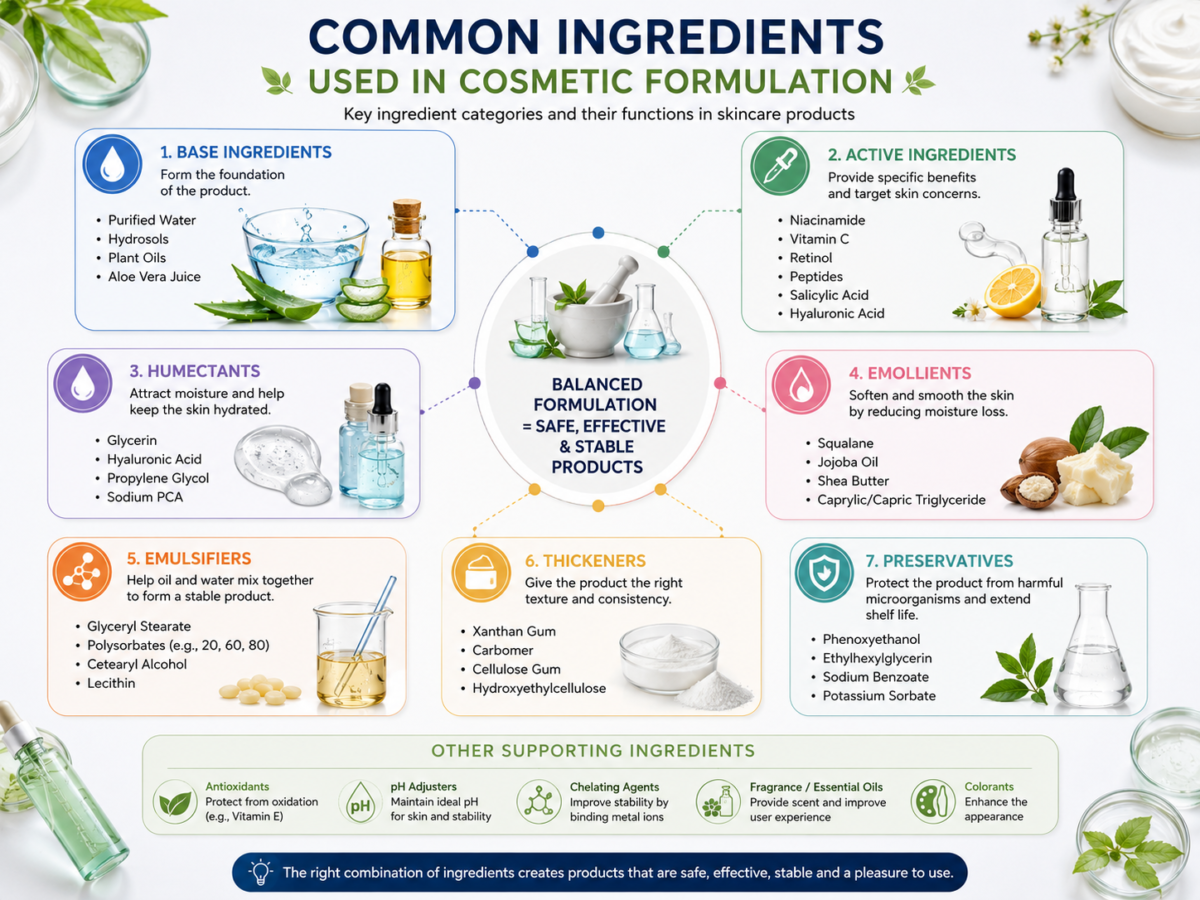
Main Categories of Ingredients Used in Cosmetic Formulation
Every cosmetic formula is made up of different ingredient groups. Each group has a specific purpose, and together they create a balanced, effective product.
Let’s explore the most common ingredient categories.
1. Base Ingredients
Base ingredients form the foundation of the product.
Without a suitable base, active ingredients cannot be distributed evenly.
Examples include:
- Purified water
- Plant oils
- Mineral oils
- Aloe vera juice
The base determines whether the product becomes a cream, lotion, gel, or serum.
2. Active Ingredients
Active ingredients provide the main skincare benefits.
These are the ingredients consumers often look for when purchasing skincare products.
Examples include:
- Niacinamide
- Vitamin C
- Hyaluronic acid
- Salicylic acid
- Azelaic acid
- Ceramides
- Peptides
- Panthenol
Each active ingredient is selected based on the product’s intended purpose.
For example:
- A brightening serum may contain Vitamin C.
- A hydrating serum may include hyaluronic acid.
- A product for oily skin may use niacinamide to help improve the appearance of excess shine.
3. Emollients
Emollients soften and smooth the skin by improving its surface feel.
They also help reduce water loss from the skin.
Examples include:
- Shea butter
- Squalane
- Jojoba oil
- Caprylic/Capric Triglyceride
These ingredients contribute to the luxurious feel of creams and lotions.
4. Humectants
Humectants attract moisture and help keep the skin hydrated.
They are among the most commonly used ingredients in moisturizers and serums.
Examples include:
- Glycerin
- Hyaluronic acid
- Propylene glycol
- Sodium PCA
A well-formulated moisturizer often combines humectants with emollients for long-lasting hydration.
5. Emulsifiers
Oil and water naturally separate. Emulsifiers keep them blended into a smooth, uniform product.
Without emulsifiers, many creams and lotions would split into separate layers.
Common examples include:
- Glyceryl Stearate
- Cetearyl Alcohol (when used in emulsifying systems)
- Polysorbates
- Lecithin
These ingredients help create stable emulsions with an appealing texture.
6. Thickeners
Thickeners give products their desired consistency.
Without them, a cream might become too runny or difficult to apply.
Examples include:
- Xanthan Gum
- Carbomer
- Cellulose Gum
- Hydroxyethylcellulose
The right thickness improves both usability and consumer satisfaction.
7. Preservatives
Most cosmetics contain water, which can allow bacteria, mold, and yeast to grow if left unprotected.
Preservatives help keep products safe throughout their shelf life.
Examples include:
- Phenoxyethanol
- Sodium Benzoate
- Potassium Sorbate
- Ethylhexylglycerin
A properly preserved product remains safer to use after opening when stored as directed.
Step-by-Step Cosmetic Formulation Process
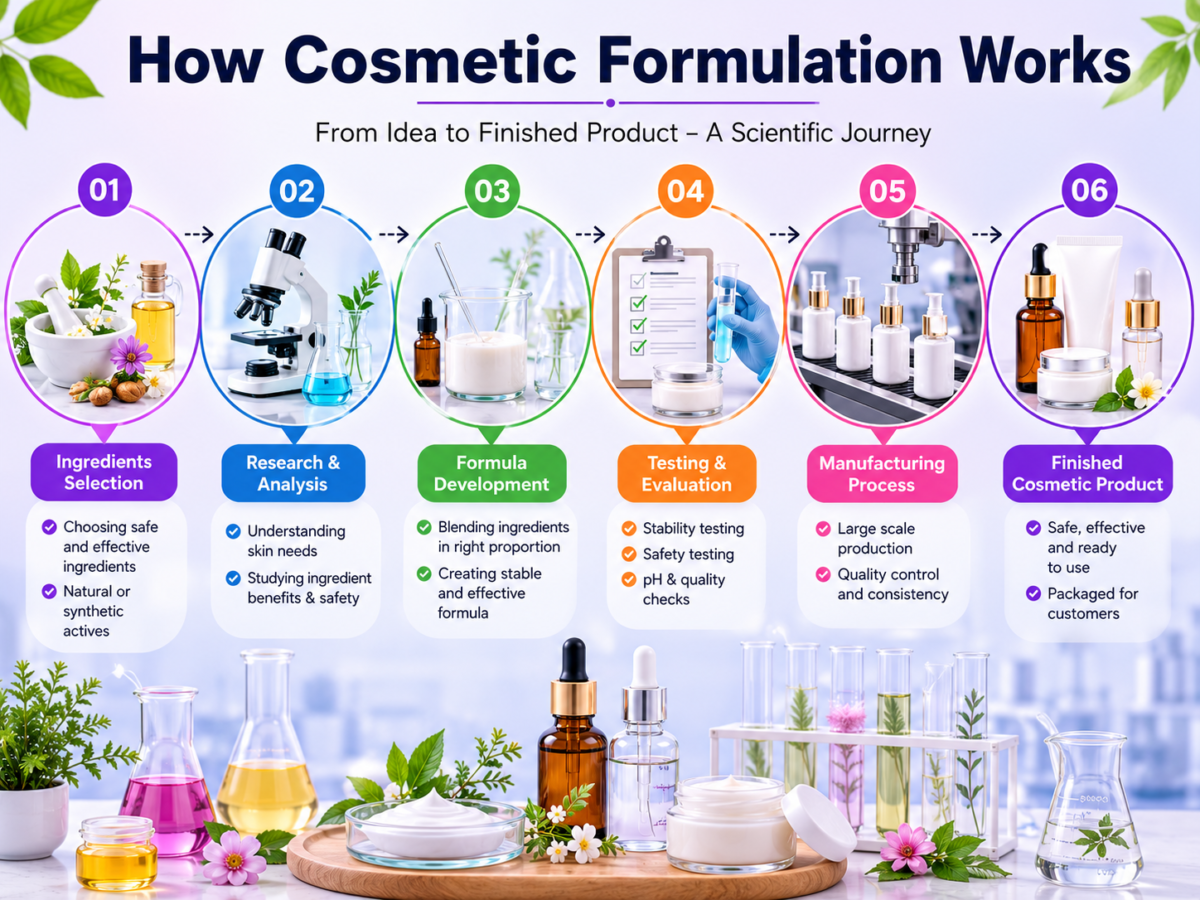
Creating a cosmetic product involves much more than combining ingredients in a mixing vessel. Professional formulators follow a structured development process to ensure every product is safe, stable, effective, and pleasant to use.
From the first idea to the finished product on store shelves, each stage plays an important role.
Let’s look at how cosmetic formulation works in real life.
Step 1: Define the Product Goal
Every cosmetic formulation begins with a clear objective.
Before selecting any ingredients, formulators ask questions such as:
- What problem should this product solve?
- Who will use it?
- Which skin type is it designed for?
- Will it be a cream, gel, lotion, or serum?
- Should it feel lightweight or rich?
- Will it be fragrance-free or scented?
These answers guide every decision during formulation.
Example
Imagine a company wants to create a daily moisturizer for oily skin.
The product should:
- Hydrate without feeling greasy
- Absorb quickly
- Support the skin barrier
- Layer well under sunscreen and makeup
- Be suitable for everyday use
Once these goals are defined, ingredient selection becomes much easier.
Step 2: Select the Right Ingredients
This is one of the most important stages in cosmetic formulation.
Each ingredient is chosen for a specific purpose. A successful formula contains ingredients that work together rather than compete with one another.
A formulator typically selects:
- A base ingredient
- Moisturizing ingredients
- Active ingredients
- Texture enhancers
- Preservatives
- pH adjusters
- Stabilizers
- Antioxidants, if needed
Example
A beginner-friendly hydrating serum might include:
- Purified water as the base
- Glycerin to attract moisture
- Hyaluronic acid for hydration
- Panthenol to support the skin barrier
- A preservative to help maintain product quality
- A pH adjuster to keep the formula stable
Every ingredient is carefully measured and evaluated before production begins.
Step 3: Prepare the Formula
Once the ingredients have been selected, the formulator develops the first version of the formula.
This includes deciding:
- Ingredient percentages
- Mixing order
- Heating temperature (if required)
- Cooling process
- Mixing speed
- Processing time
Even small changes can affect the final product.
For example, adding an ingredient too early or at the wrong temperature may reduce its effectiveness or alter the texture.
Step 4: Create the First Prototype
The first batch is known as a prototype.
It allows the formulator to evaluate how the product performs before moving to large-scale manufacturing.
During this stage, they examine:
- Texture
- Color
- Fragrance
- Thickness
- Spreadability
- Absorption
- Overall appearance
The first prototype is rarely perfect. Several improvements are often made before reaching the final version.
Step 5: Adjust the pH
The pH of a cosmetic product affects both product stability and skin comfort.
A formula with an unsuitable pH may:
- Reduce ingredient performance
- Increase the risk of irritation
- Affect preservative effectiveness
- Shorten shelf life
Most skincare products are formulated within a pH range that supports both skin compatibility and ingredient stability. However, the ideal pH depends on the product type and the ingredients used.
Practical Tip
Consumers should avoid changing the pH of homemade skincare products without proper testing. Even small adjustments can affect safety and performance.
Step 6: Stability Testing
A product may look perfect on the day it is made, but it also needs to remain stable over time.
Stability testing helps determine whether the formulation maintains its quality under different storage conditions.
During stability testing, formulators check whether the product:
- Separates into layers
- Changes color
- Develops an unusual odor
- Becomes too thick or too thin
- Maintains its intended performance
Products are often evaluated after exposure to different temperatures, humidity levels, and storage conditions to understand how they behave over time.
Step 7: Microbiological Safety Testing
Many cosmetics contain water, making them more vulnerable to contamination by bacteria, yeast, and mold.
To help ensure product safety, manufacturers perform microbiological testing to confirm that the preservative system works as intended and that the product remains suitable for use during its expected shelf life.
This testing is especially important for products such as:
- Face creams
- Lotions
- Serums
- Cleansers
- Hair conditioners
Without proper preservation, even a well-formulated product may become unsafe.
Read More: How to Make Perfume Last Longer-Expert Tips
Step 8: Performance Evaluation
A cosmetic product should deliver the benefits promised on its label.
Performance evaluation helps determine whether the product meets its intended purpose.
Depending on the product, assessments may focus on:
- Hydration
- Smooth application
- Cleansing ability
- Shine reduction
- Skin feel
- Ease of rinsing
Consumer feedback also plays an important role in improving product performance before launch.
Step 9: Packaging Compatibility
Packaging is not just about appearance.
The container must protect the product throughout its shelf life.
Formulators evaluate whether the packaging:
- Prevents leakage
- Protects ingredients from light or air when necessary
- Dispenses the correct amount of product
- Maintains product quality during normal use
For example, ingredients that are sensitive to light or air are often packaged in opaque or air-reducing containers to help preserve their stability.
Step 10: Quality Control Before Production
Before a cosmetic product reaches consumers, manufacturers perform quality control checks to help ensure consistency.
These checks may include:
- Appearance
- Color
- Odor
- Texture
- Viscosity
- pH
- Filling accuracy
- Packaging quality
Only batches that meet the company’s quality standards move forward for distribution.
Common Challenges in Cosmetic Formulation
Even experienced cosmetic chemists face challenges while developing new products.
Here are some of the most common ones.
1. Ingredient Compatibility
Not all ingredients work well together.
Some combinations may reduce product stability or affect performance, so compatibility must be evaluated during development.
2. Texture Optimization
Consumers expect products to feel pleasant on the skin.
If a cream feels too heavy or a serum feels sticky, the formula may need further refinement.
3. Product Stability
A product should remain consistent throughout its intended shelf life.
Achieving long-term stability often requires repeated testing and adjustments.
4. Preservative Balance
Using too little preservative may not provide adequate protection, while excessive amounts may affect the product’s sensory feel or increase the likelihood of irritation for some users.
Finding the right balance is an important part of formulation.
5. Cost and Performance
Developing a high-quality product also involves balancing performance with manufacturing costs.
Formulators aim to create products that deliver reliable results while remaining practical to produce.
Future Trends in Cosmetic Formulation
The cosmetic industry is constantly evolving as consumer preferences, scientific research, and technology continue to advance. Modern cosmetic formulation is no longer focused only on creating effective products—it also emphasizes sustainability, transparency, and personalization.
Here are some of the major trends shaping the future of cosmetic formulation.
1. Sustainable Formulations
Consumers are increasingly looking for products that are environmentally responsible.
Many brands are now focusing on:
- Biodegradable ingredients
- Responsibly sourced raw materials
- Water-saving formulations
- Recyclable packaging
- Reduced manufacturing waste
Sustainability is becoming an important consideration from product development through packaging.
2. Skin Barrier-Focused Products
Instead of using harsh ingredients, many modern formulations aim to support the skin’s natural protective barrier.
Common ingredients used for this purpose include:
- Ceramides
- Panthenol
- Glycerin
- Squalane
- Oat extracts
These ingredients help improve skin comfort and hydration while supporting overall skin health.
3. Multi-Functional Products
Consumers often prefer products that offer multiple benefits in a single step.
Examples include:
- Moisturizers with added hydration-supporting ingredients
- Cleansers that remove impurities while helping maintain the skin barrier
- Lip balms with nourishing botanical oils
- Tinted moisturizers that combine hydration with light coverage
Well-designed multifunctional formulations can simplify daily skincare routines.
4. Personalized Skincare
Personalized beauty is becoming more popular as consumers recognize that every skin type has different needs.
Rather than creating one product for everyone, brands are developing formulations designed for concerns such as:
- Dry skin
- Oily skin
- Sensitive skin
- Mature skin
- Acne-prone skin
Some companies also use digital skin assessments to recommend products based on individual needs.
5. Gentle and Minimalist Formulas
Many people now prefer simple skincare routines with fewer ingredients.
As a result, formulators are creating products that focus on essential ingredients while avoiding unnecessary complexity.
Minimalist formulations are often appreciated by people with sensitive skin because they reduce the number of potential irritants.
Common Beginner Mistakes to Avoid
Learning about cosmetic formulation can also help you avoid common skincare mistakes.
Buying Products Only Because of One Trending Ingredient
A product should never be judged by a single ingredient on the label.
For example, two niacinamide serums may contain the same active ingredient but perform differently because of differences in formulation, supporting ingredients, texture, and stability.
Always consider the complete formulation rather than focusing on one popular ingredient.
Using Too Many Active Ingredients at Once
Many beginners believe that using several active ingredients together will produce faster results.
In reality, using multiple products without understanding how they fit into a routine may increase the chance of irritation for some people.
A simple, consistent routine is often easier to manage and evaluate.
Ignoring Your Skin Type
Even a well-formulated product may not be suitable for everyone.
For example:
- Rich creams may feel too heavy on oily skin.
- Lightweight gels may not provide enough comfort for very dry skin.
Choosing products that match your skin type is just as important as choosing products with quality ingredients.
Believing Marketing Claims Without Reading Labels
Words such as “natural,” “premium,” or “advanced” do not automatically indicate product quality.
Instead, consider:
- The ingredient list
- Product purpose
- Directions for use
- Suitability for your skin type
- Brand transparency
An informed purchase is usually better than one based solely on advertising.
How Understanding Cosmetic Formulation Helps Consumers
Learning the basics of cosmetic formulation offers several practical benefits.
It can help you:
- Understand ingredient labels with greater confidence.
- Choose products that suit your skin type and goals.
- Appreciate why product texture, pH, and stability matter.
- Compare products based on their overall formulation instead of marketing trends.
- Build a simple, effective skincare routine with realistic expectations.
Whether you are a skincare enthusiast, a student, or someone planning to start a cosmetic business, this knowledge provides a strong foundation for making informed decisions.
Conclusion
Cosmetic formulation is the science of creating skincare and personal care products that are safe, stable, effective, and enjoyable to use. Every cleanser, serum, moisturizer, sunscreen, or shampoo is the result of careful planning, ingredient selection, testing, and quality control.
A successful cosmetic formulation is much more than a list of popular ingredients. It is about ensuring that each ingredient works well with the others, remains stable over time, and delivers the intended benefits while providing a pleasant user experience.
For consumers, understanding cosmetic formulation makes it easier to choose products based on quality rather than marketing claims. Instead of focusing only on trendy ingredients, you can evaluate the complete product, consider your skin type, and build a skincare routine that meets your individual needs.
As cosmetic science continues to evolve, formulations are becoming more innovative, sustainable, and personalized. Knowing the basics today will help you make smarter skincare decisions for years to come.
Frequently Asked Questions (FAQs)
1. What is cosmetic formulation?
Cosmetic formulation is the scientific process of selecting and combining ingredients in specific proportions to create safe, stable, and effective cosmetic and personal care products.
2. Who develops cosmetic formulations?
Cosmetic formulations are typically developed by cosmetic chemists, formulation scientists, or research and development (R&D) teams with expertise in cosmetic ingredients, product stability, and safety.
3. Why is cosmetic formulation important?
A good formulation helps ensure that a product performs as intended, remains stable throughout its shelf life, provides a pleasant user experience, and meets appropriate safety and quality standards.
4. What are the main ingredients used in cosmetic formulation?
Common ingredient categories include:
- Base ingredients
- Active ingredients
- Humectants
- Emollients
- Emulsifiers
- Thickeners
- Preservatives
- Antioxidants
- pH adjusters
Each ingredient serves a specific purpose within the formula.
5. Can two products with the same active ingredient perform differently?
Yes. The overall formulation—including ingredient combinations, concentrations, pH, texture, and stability—can influence how a product performs.
6. Is cosmetic formulation only for skincare products?
No. Cosmetic formulation is used to develop a wide range of personal care products, including hair care, makeup, body care, oral care, fragrances, and personal hygiene products.
7. What is the difference between cosmetic formulation and cosmetic manufacturing?
Cosmetic formulation focuses on designing and developing the product recipe, while cosmetic manufacturing involves producing that formula on a larger scale under controlled conditions.
8. Can beginners learn cosmetic formulation?
Yes. Beginners can start by understanding ingredient functions, formulation basics, product types, and cosmetic safety. Advanced formulation requires specialized training, practical experience, and laboratory testing.