
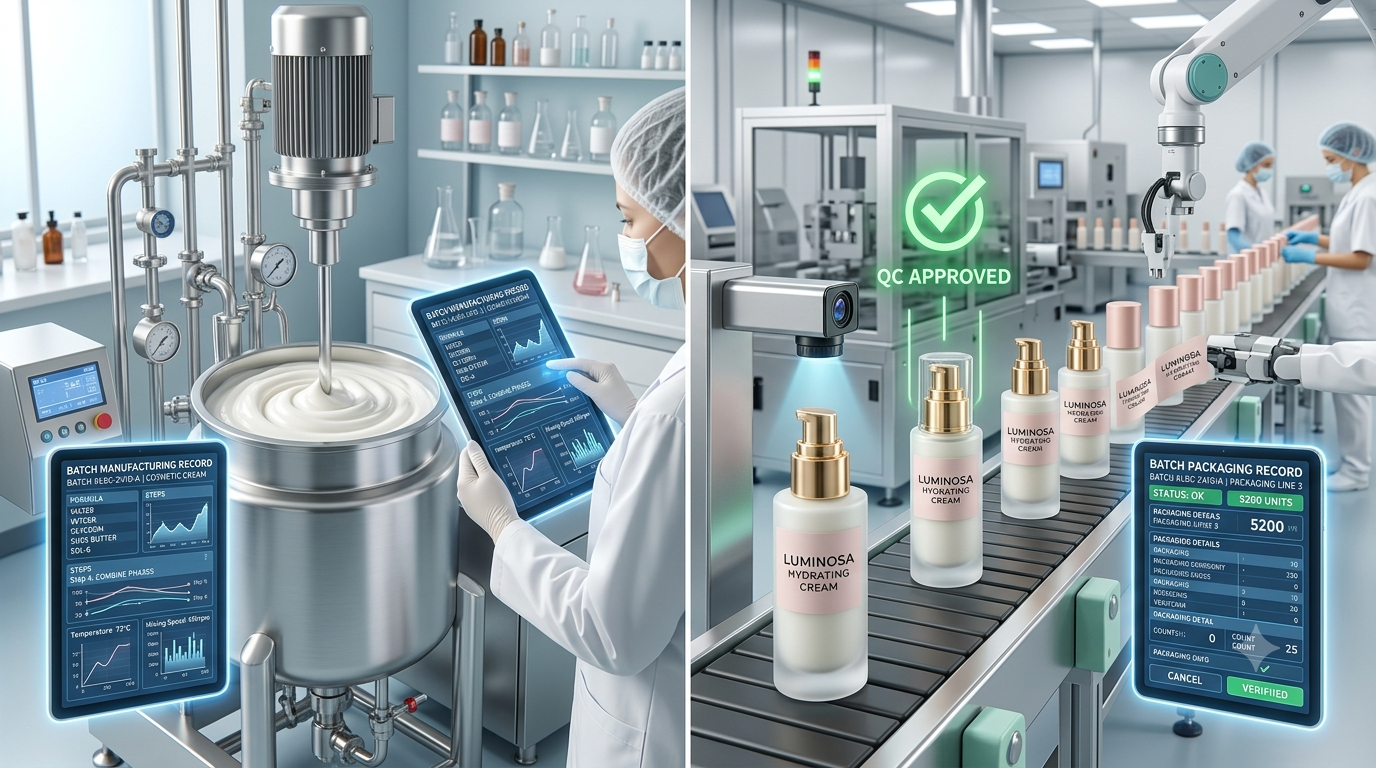
Have you ever wondered how cosmetic companies make sure that every bottle of face serum, moisturizer, shampoo, or sunscreen is produced exactly the same way every single time? Imagine buying your favorite face cream today and getting a completely different texture or fragrance next month. Such inconsistency would reduce customer trust and could even become a safety concern.
This is where the Batch Manufacturing Record (BMR) plays an important role.
A Batch Manufacturing Record is one of the most essential documents used during cosmetic manufacturing. It acts like a detailed production diary that records every activity performed while manufacturing a specific batch of cosmetic products. Instead of relying on memory, manufacturers document every step so that the entire production process can be verified, repeated, and improved whenever necessary.
Whether a company manufactures face wash, lipstick, body lotion, shampoo, sunscreen, or hair serum, a properly maintained BMR helps ensure that every batch meets the same quality standards before reaching customers.
If you are a beginner interested in cosmetic manufacturing, quality assurance, cosmetic formulation, or regulatory documentation, understanding Batch Manufacturing Records is one of the first concepts you should learn.
In this complete guide, you’ll discover what a BMR is, why it matters, what information it contains, how it differs from other manufacturing documents, and why it is considered the backbone of cosmetic quality control.
What Is a Batch Manufacturing Record (BMR)?
A Batch Manufacturing Record (BMR) is a written or electronic document that records every manufacturing activity carried out for one specific production batch of a cosmetic product.
Simply put, it provides complete evidence that a product was manufactured according to the approved manufacturing instructions.
Every cosmetic batch receives a unique batch number. During production, operators, supervisors, and quality personnel record important information such as:
- Raw materials used
- Quantity of each ingredient
- Manufacturing date
- Equipment used
- Mixing time
- Processing temperatures
- Operator signatures
- Quality control checks
- Packaging details
- Final product approval
Once production is completed, the Batch Manufacturing Record becomes a permanent record that can be referred to whenever needed.
Instead of guessing what happened during production, companies can simply review the BMR to understand every step that took place.
Read More: What Is the Cosmetic Industry? A Beginner’s Complete Guide (2026)
Simple Definition of BMR
In simple words,
A Batch Manufacturing Record is a document that records the complete manufacturing history of one batch of cosmetic products from raw materials to finished goods.
Think of it as a detailed report card for every batch produced in a cosmetic factory.
Understanding BMR with a Real-Life Example
Imagine a cosmetic company manufactures 1,000 bottles of Vitamin C Face Serum.
The production team assigns the batch number:
VCS240801
During manufacturing, the Batch Manufacturing Record includes information like:
- Date of manufacturing
- Batch number
- Formula version
- Ingredient quantities
- Supplier details
- Mixing sequence
- Processing temperature
- Mixing duration
- Equipment identification
- Operator names
- In-process quality checks
- Filling machine details
- Number of bottles filled
- Number of rejected bottles
- Final Quality Control approval
- Release date
Months later, if a customer reports a quality issue, the company can review this BMR and identify exactly how that batch was manufactured.
Without this record, investigating the problem would be extremely difficult.
Why Is a Batch Manufacturing Record Important?
Many beginners think BMR is simply paperwork. In reality, it is one of the most valuable quality documents in cosmetic manufacturing.
It protects both the manufacturer and the customer by ensuring that every batch follows approved manufacturing procedures.
Some of the biggest reasons why BMR is important include:
Ensures Product Consistency
Customers expect the same product quality every time they make a purchase.
Whether they buy a face cream today or six months later, the product should have the same:
- Texture
- Color
- Fragrance
- Thickness
- Performance
- Stability
The Batch Manufacturing Record helps manufacturers achieve this consistency by documenting every production step.
Cosmetic products come into direct contact with the skin, hair, lips, and sometimes the eyes.
Read more: What Is Cosmetic Research And Development (R&D)? A Complete Guide
Improves Product Safety
Even a small manufacturing mistake can affect product safety.
For example:
- Incorrect ingredient quantity
- Wrong mixing temperature
- Short mixing time
- Incorrect preservative level
- Poor cleaning of equipment
A properly maintained BMR helps identify these issues before products reach consumers.
Supports Quality Control
Quality Control (QC) teams use the Batch Manufacturing Record throughout production.
They verify that:
- Correct raw materials were used
- Ingredients matched specifications
- Manufacturing followed approved procedures
- Testing results met acceptance limits
If anything goes wrong, QC can quickly identify the exact stage where the deviation occurred.
Helps During Audits
Regulatory authorities and certification bodies often inspect cosmetic manufacturing facilities.
One of the first documents auditors request is the Batch Manufacturing Record.
A complete and accurate BMR demonstrates that the company follows Good Manufacturing Practices (GMP) and maintains proper documentation.
Makes Product Recall Easier
Although every manufacturer aims to produce high-quality cosmetics, problems can occasionally occur.
If a specific batch needs to be recalled due to contamination, labeling errors, or packaging defects, the Batch Manufacturing Record helps identify:
- Which batch is affected
- When it was manufactured
- Which ingredients were used
- Which packaging materials were involved
- Where the products were distributed
This allows companies to recall only the affected batch instead of every product in the market.
Who Uses Batch Manufacturing Records?
Many departments rely on BMRs throughout the manufacturing process.
Each department contributes important information that creates a complete production history.
Some of the main users include:
Production Department
The production team records:
- Material dispensing
- Manufacturing steps
- Equipment usage
- Processing conditions
- Yield calculations
Quality Assurance (QA)
QA verifies that:
- Documentation is complete
- Procedures were followed correctly
- Deviations are investigated
- Batch records are reviewed before product release
Quality Control (QC)
QC records:
- Raw material testing
- In-process testing
- Finished product testing
- Laboratory observations
- Approval or rejection decisions
Warehouse Team
The warehouse department tracks:
- Raw material issue
- Material returns
- Packaging material usage
- Inventory reconciliation
Regulatory Affairs
Regulatory professionals may use Batch Manufacturing Records to demonstrate compliance with manufacturing standards and support documentation during inspections or product reviews.
What Information Does a Batch Manufacturing Record (BMR) Contain?
A Batch Manufacturing Record is much more than a simple production sheet. It contains detailed information that documents every stage of manufacturing, from collecting raw materials to releasing the finished cosmetic product.
Although the format may vary from one company to another, most cosmetic manufacturers include the following sections in their BMR.
Product Information
The first section identifies the cosmetic product being manufactured.
It usually includes:
- Product name
- Product code
- Batch number
- Batch size
- Manufacturing date
- Expiry date (if assigned during production)
- Formula version
- Packaging type
This information ensures that the record belongs to one specific production batch and prevents confusion between different products.
For example, if a company manufactures Aloe Vera Gel, Vitamin C Serum, and Face Wash on the same day, each product will have its own separate Batch Manufacturing Record.
Read More:What Is Cosmetic Formulation? The Complete Beginner’s Guide (2026)
Raw Material Details
Every cosmetic product contains multiple ingredients, and all of them must be recorded accurately.
The BMR lists details such as:
- Ingredient name
- Material code
- Supplier name
- Lot or batch number
- Required quantity
- Actual quantity issued
- Verification by production or quality personnel
This section ensures that only approved raw materials are used in manufacturing.
For example, if a face cream formula requires 15 kg of shea butter, the production team must record the exact quantity taken from the warehouse. Any difference between the required and actual quantity is documented and investigated if necessary.
Material Dispensing Record
Before manufacturing begins, ingredients are weighed according to the approved formula.
The dispensing section records:
- Date of dispensing
- Ingredient quantities
- Weighing equipment used
- Operator name
- Checker or verifier signature
Accurate dispensing is critical because even a small mistake can affect the quality and stability of the final cosmetic product.
Imagine adding twice the required amount of fragrance to a body lotion. The product may become too strong, cause skin irritation, or fail quality testing. Proper documentation helps prevent such errors.
Equipment Details
The Batch Manufacturing Record also identifies the equipment used during production.
This section generally includes:
- Mixing tank number
- Homogenizer identification
- Filling machine number
- Storage vessel number
- Cleaning status
- Equipment verification
Recording equipment details helps trace production if any issue arises later.
For example, if several batches made using one mixing tank show similar quality problems, the company can inspect that equipment for maintenance or cleaning issues.
Manufacturing Instructions
This is one of the most important sections of the BMR.
It contains step-by-step instructions that operators must follow during production.
These instructions may include:
- Order of ingredient addition
- Mixing speed
- Heating temperature
- Cooling temperature
- Mixing duration
- Homogenization time
- Holding time
- Appearance checks
Operators document each completed step along with the date, time, and signature.
This confirms that the manufacturing process followed the approved procedure without skipping any important stage.
In-Process Quality Checks
Quality checks are performed while production is still in progress, not just after the product is finished.
The Batch Manufacturing Record includes observations such as:
- Product appearance
- Color
- Odor
- pH value
- Viscosity
- Temperature
- Homogeneity
- Weight verification
If any value falls outside the acceptable range, corrective action is documented immediately.
For example, if the pH of a facial cleanser is higher than expected, adjustments can be made before filling the product into bottles.
This helps reduce product wastage and improves quality.
Packaging Material Details
Once manufacturing is complete, the product is transferred to the packaging department.
The BMR records packaging information such as:
- Bottle type
- Tube type
- Jar type
- Cap details
- Labels used
- Cartons
- Leaflets
- Packaging material batch numbers
Recording packaging materials helps companies trace packaging-related issues if they occur in the future.
For instance, if a supplier provides defective pump bottles, the manufacturer can identify which production batches used those bottles.
Filling and Packing Record
The filling process is also documented carefully.
This section usually records:
- Filling date
- Filling machine number
- Number of units filled
- Number of rejected units
- Number of packed units
- Packaging operator details
These records help calculate production efficiency and identify any unusual losses during packaging.
Yield Calculation
Yield refers to the quantity of finished product obtained after manufacturing.
The Batch Manufacturing Record includes:
- Theoretical yield
- Actual yield
- Percentage yield
- Material loss
- Production wastage
- Investigation of excessive losses
For example, if the expected output is 5,000 bottles but only 4,850 bottles are produced, the production team investigates the reason for the difference.
Common causes may include:
- Filling losses
- Equipment residue
- Spillage
- Sampling during quality testing
Monitoring yield helps improve manufacturing efficiency over time.
How Is a Batch Manufacturing Record Prepared?
Creating a Batch Manufacturing Record begins long before production starts.
The document is prepared based on the approved Master Manufacturing Formula, which contains the official manufacturing process for a cosmetic product.
The general process includes the following steps:
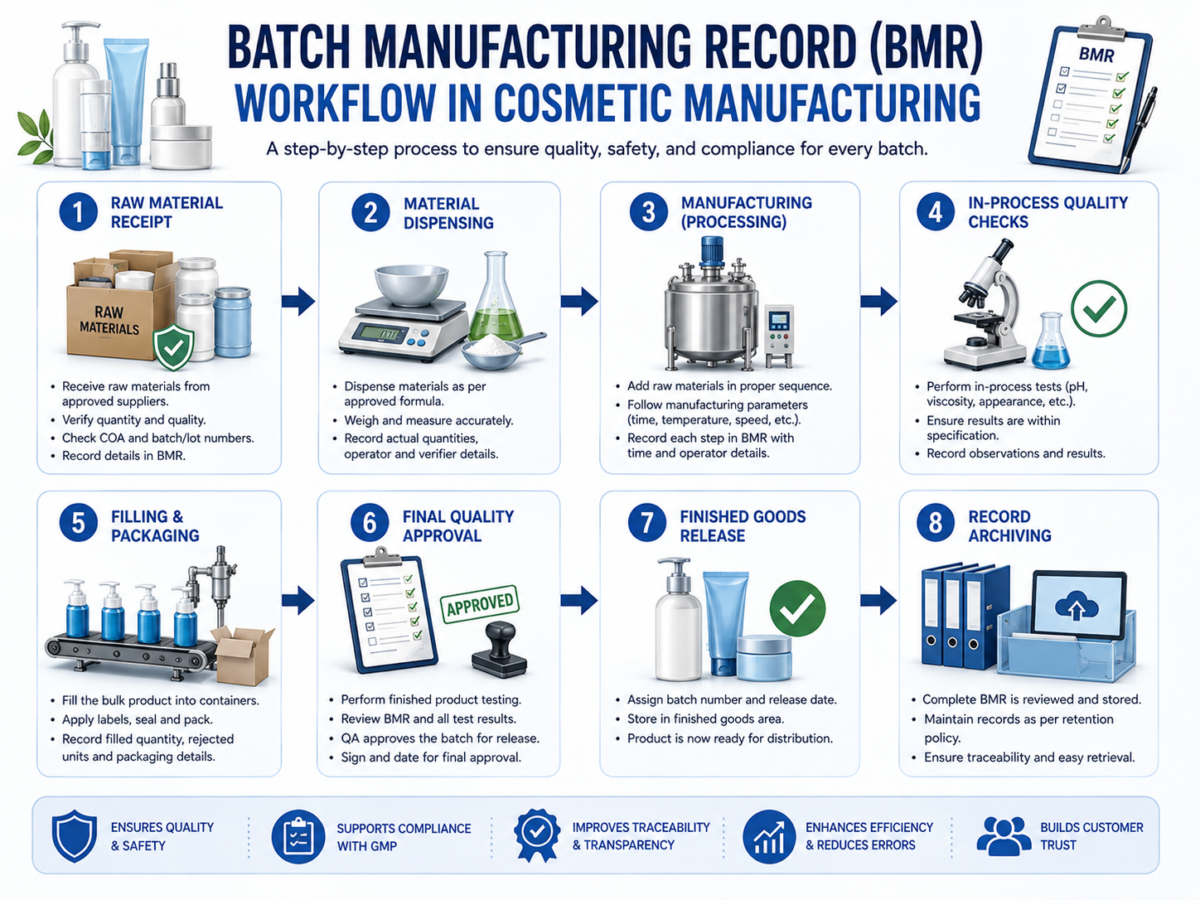
Step 1: Prepare the Approved BMR
The Quality Assurance department prepares a standardized Batch Manufacturing Record using the approved manufacturing formula.
The document is reviewed and approved before production begins.
Step 2: Issue the BMR to Production
Before manufacturing starts, the approved Batch Manufacturing Record is issued to the production department.
Only authorized personnel are allowed to make entries in the document.
Step 3: Record Every Manufacturing Activity
As production progresses, operators record each activity immediately after completing it.
Information is never filled in later from memory.
This practice improves accuracy and maintains data integrity.
Step 4: Review by Quality Assurance
After production is completed, the Quality Assurance team reviews the entire Batch Manufacturing Record.
They verify that:
- Every section is completed
- Signatures are present
- Calculations are correct
- Deviations are documented
- Quality results meet specifications
Only after successful review can the batch move toward final approval.
Common Mistakes to Avoid While Filling a BMR
Even experienced manufacturing teams can make documentation errors if they are not careful.
Some of the most common mistakes include:
- Leaving blank fields in the record
- Writing incorrect batch numbers
- Using unapproved abbreviations
- Recording information after production instead of during production
- Missing operator signatures
- Incorrect yield calculations
- Overwriting values without proper correction
- Forgetting to document deviations
Proper training and regular documentation reviews help reduce these mistakes and maintain reliable production records.
Benefits of Using a Batch Manufacturing Record in the Cosmetic Industry
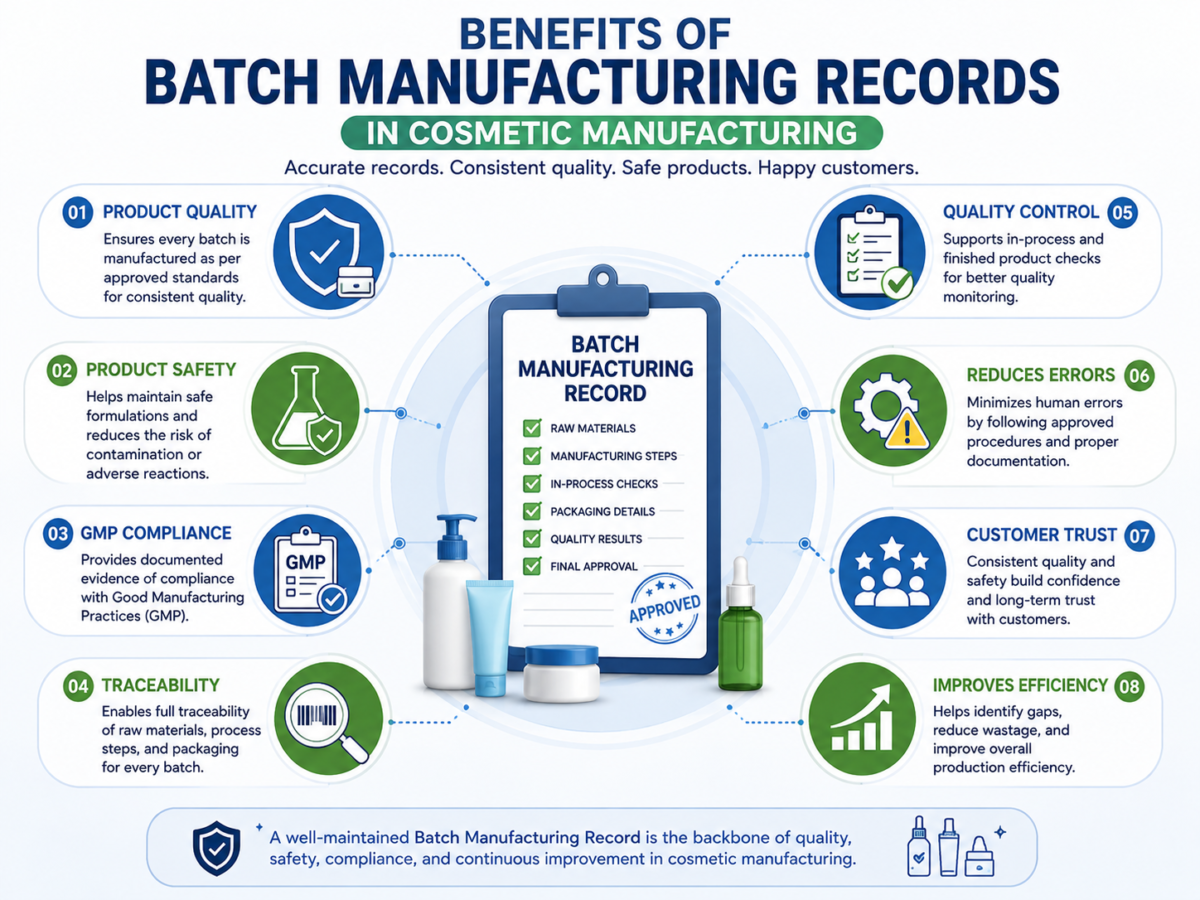
A Batch Manufacturing Record is much more than a regulatory document. It helps cosmetic manufacturers produce safe, consistent, and high-quality products while reducing production errors. Whether a company is manufacturing 500 bottles of face serum or 50,000 jars of moisturizer, a properly maintained BMR supports every stage of the production process.
Let’s explore the major benefits of using a Batch Manufacturing Record.
Maintains Consistent Product Quality
Customers expect the same quality every time they purchase a cosmetic product. A moisturizer bought today should have the same texture, fragrance, color, and performance as one purchased months later.
The Batch Manufacturing Record helps manufacturers achieve this consistency by ensuring that every batch follows the same approved process.
For example, if a shampoo is always mixed for 45 minutes at a specific speed, the BMR ensures that this procedure is followed for every batch.
Reduces Manufacturing Errors
Mistakes during cosmetic manufacturing can be expensive. Using the wrong ingredient, incorrect quantity, or improper mixing time may result in an entire batch being rejected.
Since every manufacturing step is documented and verified, the Batch Manufacturing Record helps production teams identify and prevent errors before they become major problems.
This not only saves raw materials but also reduces production costs.
Improves Traceability
Traceability means being able to track every ingredient and manufacturing activity connected to a finished cosmetic product.
A complete Batch Manufacturing Record allows manufacturers to answer important questions such as:
- Which supplier provided a particular ingredient?
- Which equipment was used?
- Who manufactured the batch?
- When was the product filled?
- Which packaging materials were used?
This information becomes extremely valuable if a quality concern is reported after the product reaches the market.
Supports Customer Safety
Cosmetic products are applied directly to the skin, lips, scalp, and hair. Poor manufacturing practices can affect product safety and customer satisfaction.
The Batch Manufacturing Record helps ensure that:
- Approved ingredients are used.
- Manufacturing instructions are followed correctly.
- Quality checks are completed.
- Products meet predefined specifications before release.
As a result, customers receive products that are manufactured under controlled conditions.
Helps During Investigations
Sometimes manufacturers receive customer complaints related to leakage, unusual odor, color changes, or packaging defects.
Instead of guessing the cause, the Quality Assurance team can review the Batch Manufacturing Record to investigate:
- Raw material details
- Processing conditions
- Equipment used
- Packaging records
- Quality control observations
This allows problems to be identified much faster.
Improves Manufacturing Efficiency
BMRs also help companies improve their manufacturing process over time.
By reviewing previous records, manufacturers can identify recurring issues such as:
- Frequent production delays
- High material losses
- Equipment downtime
- Filling inefficiencies
- Packaging defects
Corrective actions based on these findings can improve productivity and reduce waste.
Role of Batch Manufacturing Record in Good Manufacturing Practices (GMP)
Good Manufacturing Practices (GMP) are guidelines that help manufacturers produce safe and high-quality cosmetic products.
One of the key principles of GMP is:
“If it isn’t documented, it didn’t happen.”
This is exactly why the Batch Manufacturing Record is so important.
A properly completed BMR provides documented evidence that manufacturing was carried out according to approved procedures.
It demonstrates that:
- Production followed standard operating procedures (SOPs).
- Approved raw materials were used.
- Equipment was cleaned before use.
- Quality checks were performed.
- Deviations were recorded and investigated.
- The finished batch met quality requirements.
Without proper documentation, it becomes difficult to prove that manufacturing was performed correctly.
Batch Manufacturing Record vs Batch Packing Record (BPR)
Beginners often confuse the Batch Manufacturing Record (BMR) with the Batch Packing Record (BPR). While both are essential manufacturing documents, they serve different purposes.
| Feature | Batch Manufacturing Record (BMR) | Batch Packing Record (BPR) |
|---|---|---|
| Main Purpose | Records the manufacturing process | Records the packaging process |
| Focus | Product preparation | Filling, labeling, and packing |
| Covers | Ingredients, mixing, processing, quality checks | Bottles, labels, cartons, packaging materials |
| Prepared By | Production department | Packaging department |
| Used For | Manufacturing history | Packaging history |
In simple words, the BMR explains how the cosmetic product was made, while the BPR explains how the finished product was packed and labeled.
Both records work together to provide complete traceability for a cosmetic batch.
Paper BMR vs Electronic BMR (eBMR)
Many cosmetic companies still use paper-based Batch Manufacturing Records. However, modern manufacturers are increasingly adopting Electronic Batch Manufacturing Records (eBMR).
Let’s compare both systems.
| Paper BMR | Electronic BMR (eBMR) |
|---|---|
| Written by hand | Entered digitally |
| Requires physical storage | Stored securely in electronic systems |
| More chances of handwriting errors | Reduces manual errors |
| Difficult to search old records | Easy to search and retrieve |
| Manual calculations | Automatic calculations |
| Slower review process | Faster review and approval |
Electronic Batch Manufacturing Records improve efficiency, reduce paperwork, and make documentation easier to manage. However, whether a company uses paper records or digital systems, the accuracy of the information remains equally important.
Best Practices for Maintaining an Accurate BMR
Maintaining a reliable Batch Manufacturing Record requires discipline and attention to detail.
Here are some best practices followed by successful cosmetic manufacturers:
Record Information Immediately
Production activities should be documented as they happen.
Writing information later from memory increases the risk of mistakes.
Write Clearly and Accurately
Whether using paper or electronic records, all entries should be clear, complete, and easy to understand.
Avoid unclear handwriting, incomplete information, or unexplained abbreviations.
Never Leave Blank Spaces
Every section of the Batch Manufacturing Record should be completed.
If a particular field does not apply, it should be marked according to the company’s documentation procedure rather than left blank.
Verify Every Entry
Important information should be reviewed by authorized personnel before moving to the next production stage.
Verification helps catch errors early.
Document Any Deviations
Sometimes manufacturing does not go exactly as planned.
For example:
- A mixing step takes longer than expected.
- Equipment stops unexpectedly.
- A raw material is replaced with an approved alternative.
Such deviations should always be documented along with the reason and any corrective action taken.
Recording deviations demonstrates transparency and helps improve future production processes.
The Future of Batch Manufacturing Records in the Cosmetic Industry
The cosmetic industry is evolving rapidly, and manufacturing documentation is becoming more advanced every year. While many small and medium-sized companies still use paper-based Batch Manufacturing Records, larger manufacturers are shifting toward digital systems to improve speed, accuracy, and compliance.
Electronic Batch Manufacturing Records (eBMRs) are helping companies reduce paperwork, minimize human errors, and simplify record management. Production data can be entered in real time, reviewed faster by Quality Assurance teams, and stored securely for future reference.
Many modern manufacturing facilities are also integrating eBMRs with inventory management, laboratory testing, and production planning software. This allows information to flow automatically between departments, reducing duplicate work and improving overall efficiency.
As cosmetic regulations continue to evolve and consumers expect higher quality products, digital documentation is likely to become the industry standard.
Why Beginners Should Learn About BMR
If you’re planning a career in cosmetic manufacturing, formulation, quality assurance, quality control, regulatory affairs, or production management, understanding the Batch Manufacturing Record is an essential first step.
Learning how a BMR works helps you understand the complete manufacturing process rather than just the final product.
It also improves your knowledge of:
- Cosmetic production workflow
- Good Manufacturing Practices (GMP)
- Documentation standards
- Quality assurance systems
- Manufacturing traceability
- Product safety requirements
- Regulatory compliance
Whether you work in a cosmetic factory, launch your own skincare brand, or simply want to understand how cosmetics are manufactured, knowing the purpose of a Batch Manufacturing Record will give you a strong foundation.
Common Challenges While Maintaining BMRs
Although Batch Manufacturing Records are extremely valuable, maintaining them correctly requires time and attention to detail.
Some common challenges include:
- Missing or incomplete documentation
- Manual calculation errors
- Delays in recording production activities
- Illegible handwriting in paper records
- Missing signatures or approvals
- Difficulty retrieving old records
- Managing large volumes of paperwork
- Training new employees on documentation practices
These challenges can be reduced through regular employee training, internal audits, standardized procedures, and, where appropriate, digital record-keeping systems.
Practical Tips for Cosmetic Manufacturers
Whether you are a startup or an established cosmetic manufacturer, following these practical tips can help improve Batch Manufacturing Record accuracy.
- Use only the latest approved BMR format.
- Verify all raw materials before dispensing.
- Record every manufacturing step immediately after completion.
- Double-check batch numbers and material codes.
- Ensure equipment is cleaned and verified before use.
- Review calculations before signing the document.
- Document every deviation, even if it appears minor.
- Store completed BMRs securely for future reference.
- Train employees regularly on documentation practices.
- Conduct periodic internal audits to identify improvement opportunities.
Following these simple practices helps build a reliable manufacturing system and supports consistent product quality.
Conclusion
A Batch Manufacturing Record (BMR) is one of the most important documents in the cosmetic industry. It provides a complete record of how a specific batch of a cosmetic product was manufactured, from raw material dispensing to final quality approval.
By documenting every production step, a BMR helps manufacturers maintain product consistency, improve safety, support quality control, comply with Good Manufacturing Practices (GMP), and investigate issues quickly if they arise.
Whether the product is a face wash, body lotion, shampoo, sunscreen, lipstick, or serum, every batch benefits from accurate and well-maintained manufacturing records.
For beginners, understanding Batch Manufacturing Records offers valuable insight into how professional cosmetic manufacturing works behind the scenes. It also highlights why documentation is just as important as formulation and production.
As the cosmetic industry continues to adopt digital technologies, Batch Manufacturing Records will remain a key part of ensuring safe, high-quality products that consumers can trust.
Frequently Asked Questions (FAQs)
1. What does BMR stand for in the cosmetic industry?
BMR stands for Batch Manufacturing Record. It is a document that records every manufacturing activity for a specific batch of cosmetic products.
2. Why is a Batch Manufacturing Record important?
A BMR helps ensure product quality, consistency, safety, traceability, and compliance with Good Manufacturing Practices (GMP). It also supports investigations and product recalls when necessary.
3. Who prepares a Batch Manufacturing Record?
The Batch Manufacturing Record is usually prepared by the Quality Assurance department using the approved manufacturing formula. During production, it is completed by production personnel and reviewed by Quality Assurance before the batch is released.
4. What information is included in a BMR?
A typical BMR contains:
- Product details
- Batch number
- Raw material information
- Dispensing records
- Equipment details
- Manufacturing instructions
- In-process quality checks
- Packaging information
- Yield calculations
- Operator and reviewer signatures
- Final batch approval
5. What is the difference between a BMR and a BPR?
A Batch Manufacturing Record (BMR) documents the manufacturing process, while a Batch Packing Record (BPR) documents the packaging and labeling process. Together, they provide complete traceability for a cosmetic batch.
6. Can cosmetic companies use electronic Batch Manufacturing Records?
Yes. Many cosmetic manufacturers now use Electronic Batch Manufacturing Records (eBMRs) to improve accuracy, reduce paperwork, speed up approvals, and simplify document storage and retrieval.
7. How long should Batch Manufacturing Records be retained?
The retention period depends on the company’s quality management system and the regulations that apply in its operating market. Manufacturers should always follow applicable legal and regulatory requirements when deciding how long to keep BMRs.
8. Can a cosmetic batch be released without a completed BMR?
No. A batch should only be released after the Batch Manufacturing Record has been completed, reviewed, and approved by the authorized Quality Assurance personnel according to the company’s procedures.