
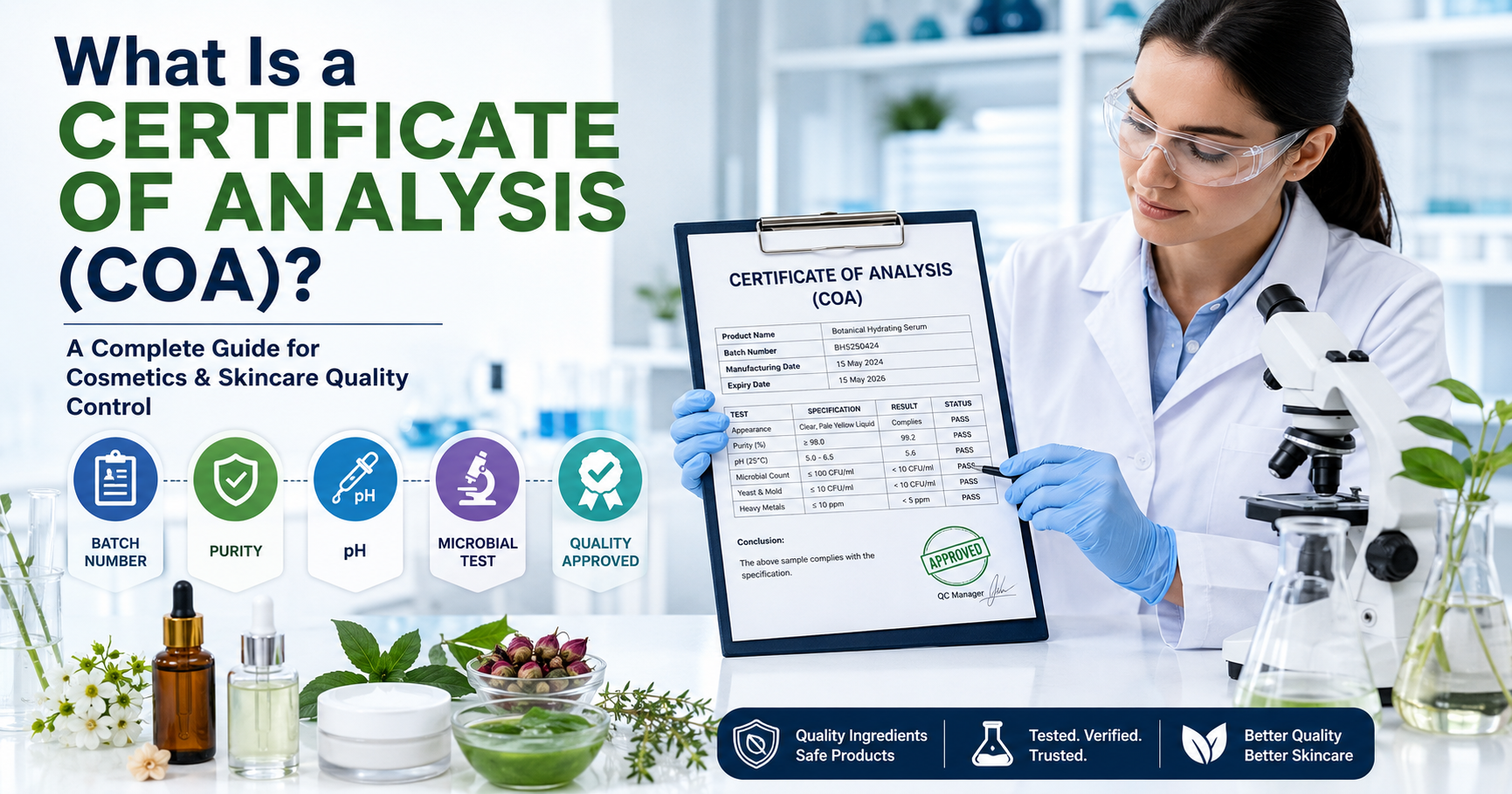
A bottle of face serum may look attractive on the outside, but how do you know the ingredients inside are safe, pure, and meet quality standards? The answer often lies in an important quality document called the Certificate of Analysis (COA).
Whether you are a skincare enthusiast, cosmetic brand owner, manufacturer, or simply someone who wants to understand how quality products are made, learning about a COA is extremely valuable. It provides evidence that a product or raw material has been tested and meets specific quality requirements before it is used or sold.
In the cosmetics industry, every ingredient matters. A small variation in purity, pH, microbial count, or active ingredient concentration can affect the safety and performance of the final product. This is why cosmetic manufacturers rely on Certificates of Analysis to verify that every batch meets the required specifications.
What Is a Certificate of Analysis (COA)?
A Certificate of Analysis (COA) is an official quality document issued after laboratory testing. It confirms that a specific batch of a raw material, ingredient, or finished product meets predetermined quality standards and specifications.
Think of it as a quality report card for a product.
Just as students receive report cards showing their performance in different subjects, a COA shows how a cosmetic ingredient or product performed in various laboratory tests.
For example, before a cosmetic manufacturer uses Vitamin C powder to make a facial serum, the supplier provides a Certificate of Analysis showing details such as:
Read More: Why Is PH Important In Skincare Products? Everything You Need To Know
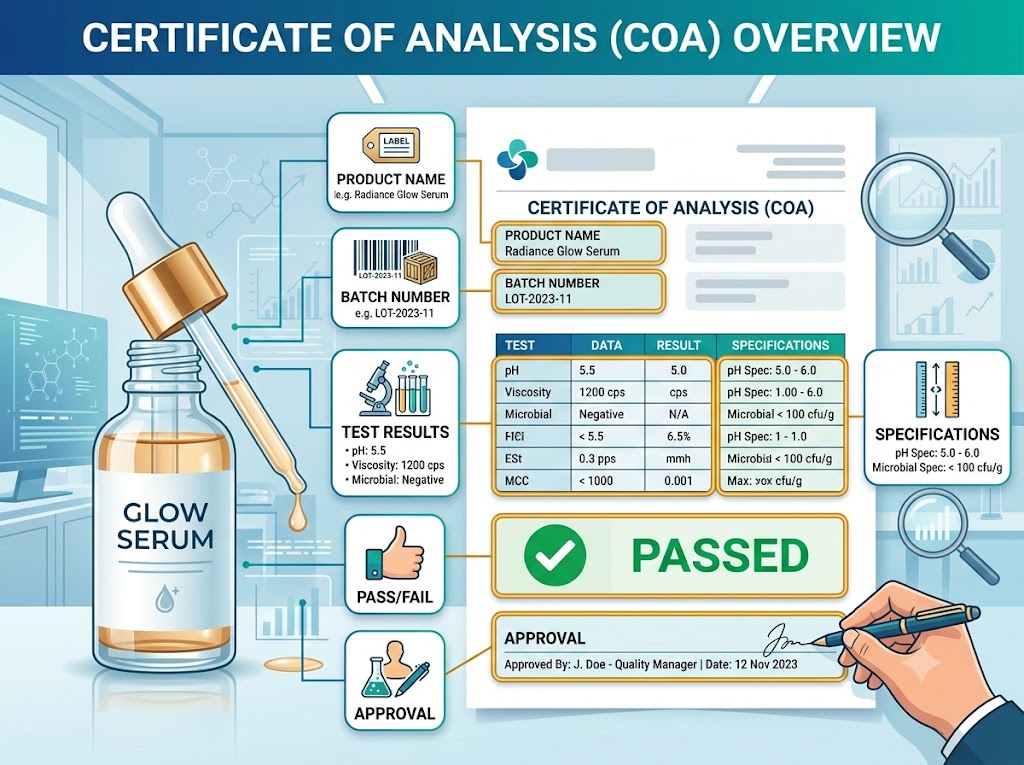
- Identity of the ingredient
- Purity level
- Appearance
- pH (if applicable)
- Moisture content
- Microbiological test results
- Manufacturing batch number
- Test methods used
- Pass or Fail status
If all values meet the required specifications, the ingredient can be approved for production.
Why Is a Certificate of Analysis Important?
A COA is much more than just paperwork. It plays a critical role in maintaining product quality throughout the manufacturing process.
Here are some of the biggest reasons why Certificates of Analysis are important.
1. Confirms Product Quality
The primary purpose of a COA is to verify that a material meets quality specifications before it is used.
Imagine purchasing Hyaluronic Acid from two different suppliers.
Supplier A provides a detailed COA showing:
- 99.8% purity
- Low moisture content
- No harmful microbes
Supplier B provides no quality documentation.
Which supplier would you trust more?
Most manufacturers would choose Supplier A because the COA provides confidence in the material’s quality.
2. Improves Consumer Safety
Cosmetic products are applied directly to the skin, lips, scalp, or around the eyes. Poor-quality ingredients may lead to irritation, contamination, or reduced product performance.
Laboratory testing helps identify problems before products reach consumers.
For example, if a batch of Aloe Vera Extract contains excessive microbial contamination, it can be rejected immediately instead of being used in thousands of skincare products.
This simple step helps protect consumers from unsafe products.
Read More: What Is the Best Brand of Hyaluronic Acid Serum?
3. Supports Regulatory Compliance
Many countries require cosmetic manufacturers to maintain proper quality records.
A Certificate of Analysis demonstrates that products or ingredients have been tested according to established quality standards.
During inspections or audits, companies can present COAs as evidence that quality control procedures were followed.
4. Reduces Manufacturing Risks
Imagine producing 20,000 bottles of moisturizer using a raw material that later turns out to be contaminated.
The company may have to:
- Recall products
- Destroy inventory
- Refund customers
- Face legal issues
- Lose customer trust
Reviewing the COA before production helps reduce these risks.
5. Builds Trust Between Suppliers and Manufacturers
A reliable supplier consistently provides accurate Certificates of Analysis for every batch.
This transparency helps manufacturers feel confident about the ingredients they purchase.
Over time, strong documentation builds long-term business relationships.
Who Uses a Certificate of Analysis?
Many people in the cosmetic supply chain depend on COAs every day.
Cosmetic Manufacturers
Manufacturers verify ingredient quality before production begins.
For example, before making a sunscreen, they check the COAs of UV filters, emulsifiers, preservatives, fragrances, and other raw materials.
Quality Control (QC) Teams
Quality Control professionals compare laboratory results with approved specifications.
If every parameter falls within the acceptable range, the batch is approved.
If not, the batch may be rejected or investigated further.
Quality Assurance (QA) Teams
Quality Assurance ensures that testing procedures are followed correctly and that all quality documents are complete and properly maintained.
COAs become part of the official manufacturing records.
Raw Material Suppliers
Suppliers generate Certificates of Analysis after testing each production batch.
They send the COA to customers along with the shipment so buyers can verify product quality before use.
Cosmetic Brand Owners
Many skincare brands outsource manufacturing.
Even if they don’t produce products themselves, they review COAs to ensure their manufacturing partners are using quality-tested ingredients.
Regulatory Authorities and Auditors
During inspections, auditors may request Certificates of Analysis to confirm that companies follow proper quality control practices.
Maintaining accurate COAs demonstrates good manufacturing practices and proper documentation.
Read More: What Is the Best Brand of Hyaluronic Acid Serum
Real-Life Example of a COA in Skincare
Imagine a company is producing a Niacinamide Face Serum.
Before manufacturing begins, they receive several raw materials from different suppliers.
These include:
- Niacinamide
- Glycerin
- Hyaluronic Acid
- Preservative
- Distilled Water
Each ingredient arrives with its own Certificate of Analysis.
The Quality Control team reviews every COA carefully.
For example:
- Niacinamide purity meets the required specification.
- Glycerin passes identity and moisture testing.
- Hyaluronic Acid meets viscosity requirements.
- The preservative passes microbial testing.
- Distilled water meets purity standards.
Since all ingredients meet the required specifications, the manufacturing process can begin with greater confidence that the final serum will be safe, stable, and effective.
Components of a Certificate of Analysis (COA)
Although the layout of a Certificate of Analysis may vary from one company to another, most COAs contain similar information. Every section helps manufacturers confirm that the product or ingredient meets the required quality standards before it is approved for use.
Let’s look at the most common parts of a COA and understand why each one is important.
1. Product Name
The product name clearly identifies the raw material or finished cosmetic product that has been tested.
For example:
- Niacinamide Powder
- Hyaluronic Acid Solution
- Aloe Vera Extract
- Vitamin E Oil
- Face Wash
- Moisturizing Cream
The product name helps avoid confusion, especially when a manufacturer receives many different ingredients from the same supplier.
Example
A skincare company receives two white powders:
- Niacinamide
- Allantoin
They may look almost identical, but the product name on the COA ensures that the correct ingredient is used in production.
2. Product Code or Item Number
Many manufacturers assign a unique code to every ingredient or product.
Instead of relying only on the product name, companies can quickly identify the exact material using this code.
For example:
- NIA-001
- HA-250
- GLY-100
This coding system makes inventory management easier and reduces the chance of using the wrong ingredient.
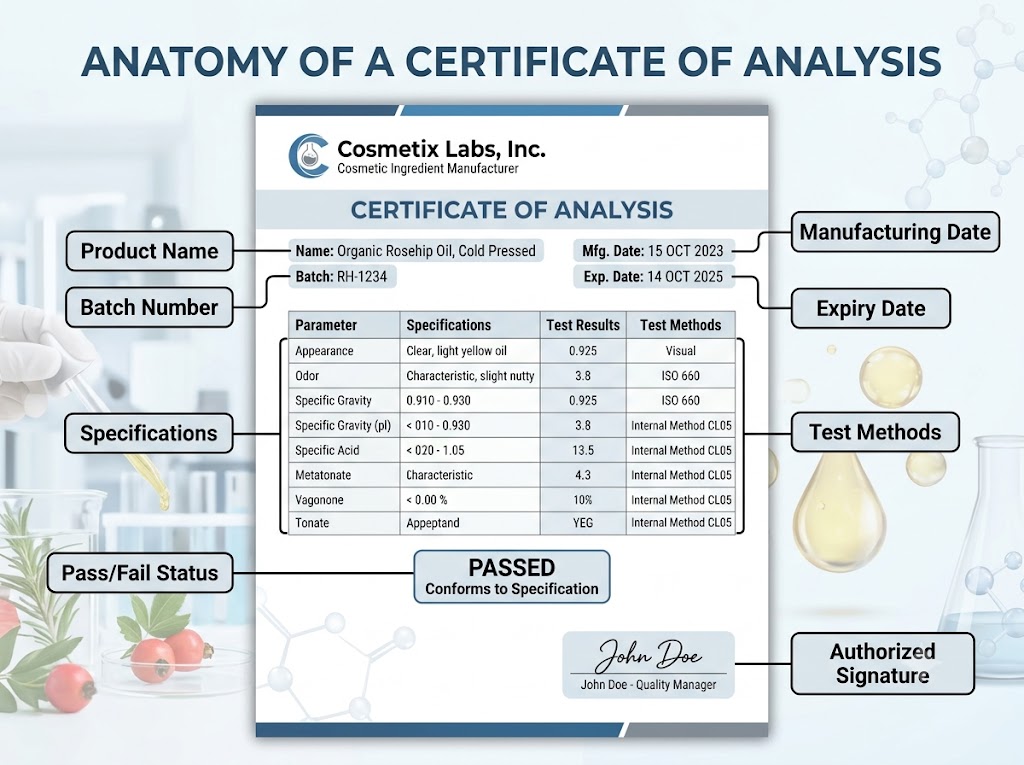
3. Batch Number (Lot Number)
One of the most important details on a COA is the Batch Number, also called the Lot Number.
A batch number identifies a specific production batch.
Every batch is tested separately because slight variations can occur during manufacturing.
Why is the batch number important?
Suppose a supplier manufactures Vitamin C powder every week.
Instead of producing one huge batch for the entire year, they manufacture multiple smaller batches.
Example:
- Batch VC24001
- Batch VC24002
- Batch VC24003
Each batch receives its own laboratory testing and its own Certificate of Analysis.
This system allows manufacturers to trace exactly where an ingredient came from if any quality issue arises later.
4. Manufacturing Date
The Manufacturing Date tells when the product or raw material was produced.
This helps companies:
- Track product age
- Manage inventory
- Follow First In, First Out (FIFO) inventory practices
- Ensure fresh materials are used in production
Using older ingredients without proper evaluation can affect product quality and stability.
5. Expiry Date or Retest Date
Many cosmetic ingredients remain stable for several years if stored correctly.
Depending on the ingredient, the COA may include either:
- Expiry Date – the last recommended date for use.
- Retest Date – the date after which the material should be tested again before use.
Example
A batch of Hyaluronic Acid manufactured in January 2026 may have:
- Manufacturing Date: January 2026
- Retest Date: January 2028
If the ingredient is still in storage after two years, it should be retested to confirm that it still meets quality specifications.
6. Specifications
Specifications are the predefined quality limits that every batch must meet.
Think of specifications as the “acceptable range” for each test.
For example:
| Test | Acceptable Specification |
|---|---|
| Appearance | White powder |
| Purity | ≥ 99% |
| Moisture | ≤ 1% |
| pH | 5.5–7.0 |
| Odor | Characteristic |
| Microbial Count | Within acceptable limits |
If the laboratory results fall within these limits, the material passes.
If not, it may be rejected.
7. Test Results
This section shows the actual laboratory values obtained during testing.
For example:
| Test | Specification | Result |
|---|---|---|
| Appearance | White Powder | White Powder |
| Purity | ≥99% | 99.6% |
| Moisture | ≤1% | 0.4% |
| pH | 5.5–7.0 | 6.2 |
| Odor | Characteristic | Characteristic |
The Quality Control team compares these results with the specifications before approving the batch.
8. Test Methods
Every laboratory test follows a defined scientific procedure.
The COA often mentions the method used.
Examples include:
- Internal laboratory methods
- Standard Operating Procedures (SOPs)
- Pharmacopoeia methods
- International standard methods
This information helps demonstrate that the testing was performed consistently and according to established procedures.
9. Pass or Fail Status
At the end of testing, the laboratory determines whether the batch meets all required specifications.
The result is usually shown as:
- Pass
- Complies
- Meets Specification
or
- Fail
- Does Not Comply
- Out of Specification (OOS)
Only materials that meet the required specifications should move forward for manufacturing.
10. Authorized Signature or Approval
Most Certificates of Analysis include approval from an authorized person, such as:
- Quality Control Manager
- Laboratory Manager
- Quality Assurance Representative
This signature confirms that the laboratory results have been reviewed and officially approved.
Many companies now use secure electronic signatures instead of handwritten ones.
Common Laboratory Tests Found in a COA
The exact tests depend on the ingredient or finished product, but some quality checks appear on most Certificates of Analysis.
Appearance Test
This verifies that the material looks as expected.
The laboratory checks characteristics such as:
- Color
- Texture
- Physical form
- Clarity
Example
Vitamin C powder should appear as a white to slightly off-white crystalline powder.
If it appears brown or has visible contamination, the batch may require further investigation.
Odor Test
Many cosmetic ingredients have a characteristic smell.
An unusual odor may indicate contamination, degradation, or improper storage.
Example
Lavender essential oil should have a fresh floral aroma.
If it smells burnt or rancid, it may no longer be suitable for use.
pH Test
The pH value measures how acidic or alkaline a product is.
This test is especially important for:
- Face wash
- Shampoo
- Toners
- Moisturizers
- Serums
- Cleansers
Maintaining the correct pH helps improve product stability and supports skin compatibility.
Purity Test
Purity testing determines how much of the desired ingredient is actually present.
Example
A supplier claims that Niacinamide has a purity of at least 99%.
Laboratory testing confirms whether the batch meets this claim.
Higher purity generally means greater consistency and fewer unwanted impurities.
Moisture Content
Some powdered cosmetic ingredients absorb moisture from the environment.
Excess moisture can reduce shelf life and affect product stability.
Testing moisture content helps ensure that ingredients remain suitable for manufacturing.
Microbiological Testing
One of the most critical sections of a COA is microbiological testing.
The laboratory checks for harmful microorganisms such as:
- Bacteria
- Yeast
- Mold
Microbial contamination can spoil cosmetic products and increase the risk of skin irritation or infection.
Only batches that meet acceptable microbiological limits should be approved for use.
Practical Example: Reading a COA
Imagine you receive a COA for Aloe Vera Extract.
You review the following details:
- Appearance: Clear pale yellow liquid ✔
- Odor: Characteristic ✔
- pH: 5.8 ✔
- Microbial Count: Within acceptable limits ✔
- Batch Number: AV26015 ✔
- Expiry Date: March 2028 ✔
- Status: Pass ✔
Since every result matches the required specifications, the Quality Control team approves the ingredient for production.
If even one critical parameter—such as microbial count—fails, the batch may be quarantined until further investigation is completed.
How Is a Certificate of Analysis (COA) Used in Cosmetic Manufacturing?
A Certificate of Analysis is not just a document that gets filed away after receiving a shipment. It is used throughout the manufacturing process to ensure that only quality-approved materials are used.
From the moment raw materials arrive at the factory until the finished product reaches customers, the COA plays an important role in quality control.
Let’s follow the journey of a cosmetic ingredient to understand how this works.
Step 1: Receiving Raw Materials
Every cosmetic product starts with raw materials such as:
- Niacinamide
- Hyaluronic Acid
- Aloe Vera Extract
- Shea Butter
- Glycerin
- Emulsifiers
- Preservatives
- Fragrances
When these ingredients arrive at the manufacturing facility, they are not immediately used in production.
Instead, the Quality Control (QC) team first checks the shipment and reviews the Certificate of Analysis provided by the supplier.
They verify details such as:
- Product name
- Batch number
- Manufacturing date
- Expiry or retest date
- Laboratory test results
- Approval status
If any information is missing or does not match the purchase order, the material may be placed on hold until the issue is resolved.
Step 2: Verifying Laboratory Results
Receiving a COA does not always mean the material is automatically accepted.
Many cosmetic manufacturers compare the supplier’s results with their own quality standards.
For example, a supplier’s COA may state:
| Test | Supplier Result |
|---|---|
| Purity | 99.5% |
| Moisture | 0.5% |
| pH | 6.1 |
The manufacturer checks whether these values fall within its approved specifications.
If everything meets the required limits, the ingredient can move to the next stage.
Step 3: In-House Confirmation Testing
Some companies perform additional laboratory testing before approving the material.
This process is known as incoming quality inspection or confirmation testing.
For high-value or high-risk ingredients, the in-house laboratory may verify:
- Identity
- Appearance
- pH
- Purity
- Microbial quality
This extra step reduces the risk of using incorrect or contaminated ingredients.
Example
A company receives Vitamin E Oil from a new supplier.
Although the supplier provides a COA, the QC laboratory also checks:
- Color
- Odor
- Identity
- Purity
Once the internal results match the supplier’s COA, the batch is approved for production.
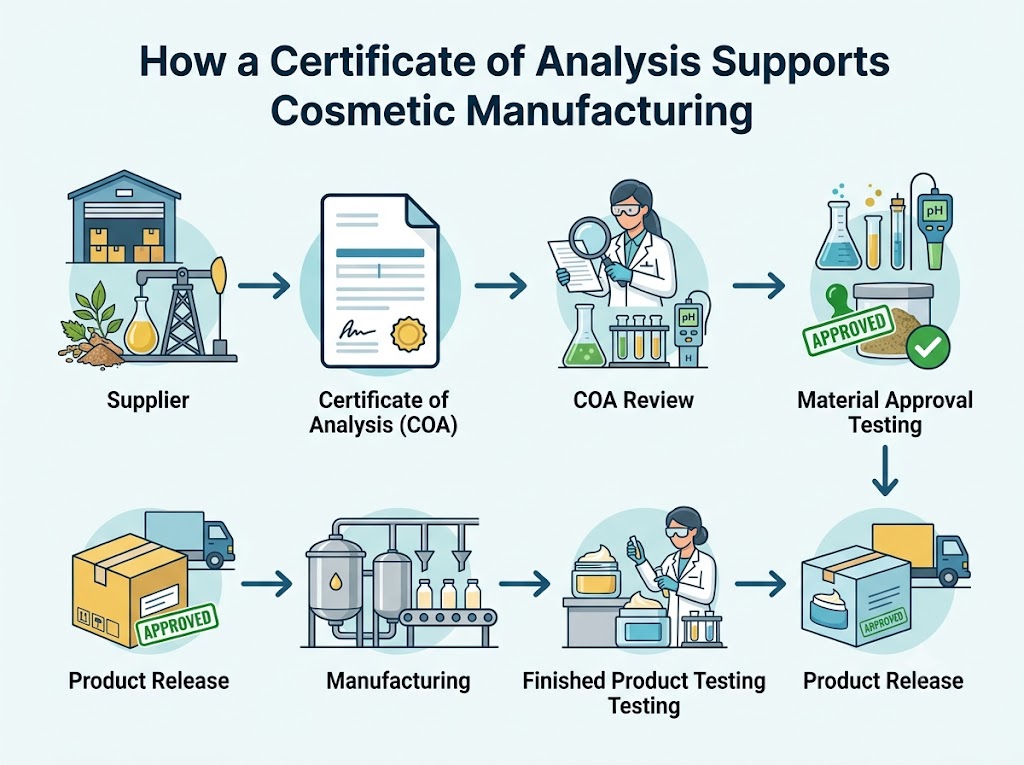
Step 4: Approval Before Production
Only approved materials are released to the production department.
If a batch fails testing, it is usually:
- Quarantined
- Rejected
- Returned to the supplier
- Investigated further
This prevents poor-quality ingredients from entering the manufacturing process.
Step 5: Manufacturing the Cosmetic Product
After all raw materials are approved, production begins.
Whether the company is making:
- Face wash
- Moisturizer
- Sunscreen
- Shampoo
- Face serum
- Body lotion
every ingredient used should have supporting quality documentation.
This helps maintain consistency from one production batch to the next.
Step 6: Testing the Finished Product
Quality checks do not stop after manufacturing.
The finished cosmetic product is also tested.
Common tests include:
- Appearance
- Color
- Odor
- pH
- Viscosity
- Stability
- Microbiological quality
After testing is complete, the manufacturer may issue a Certificate of Analysis for the finished product before it is released for sale.
COA vs. SDS (MSDS) vs. Product Specification Sheet
Many beginners confuse these documents because they are often supplied together. However, each serves a different purpose.
| Document | Main Purpose | Typical Contents |
|---|---|---|
| Certificate of Analysis (COA) | Confirms the quality of a specific batch after testing | Batch number, test results, specifications, Pass/Fail status |
| Safety Data Sheet (SDS/MSDS) | Explains safe handling, storage, transport, and emergency measures | Hazards, first aid, storage instructions, PPE, disposal guidance |
| Product Specification Sheet | Defines the expected quality requirements for a product | Target limits for appearance, pH, purity, odor, viscosity, and other quality parameters |
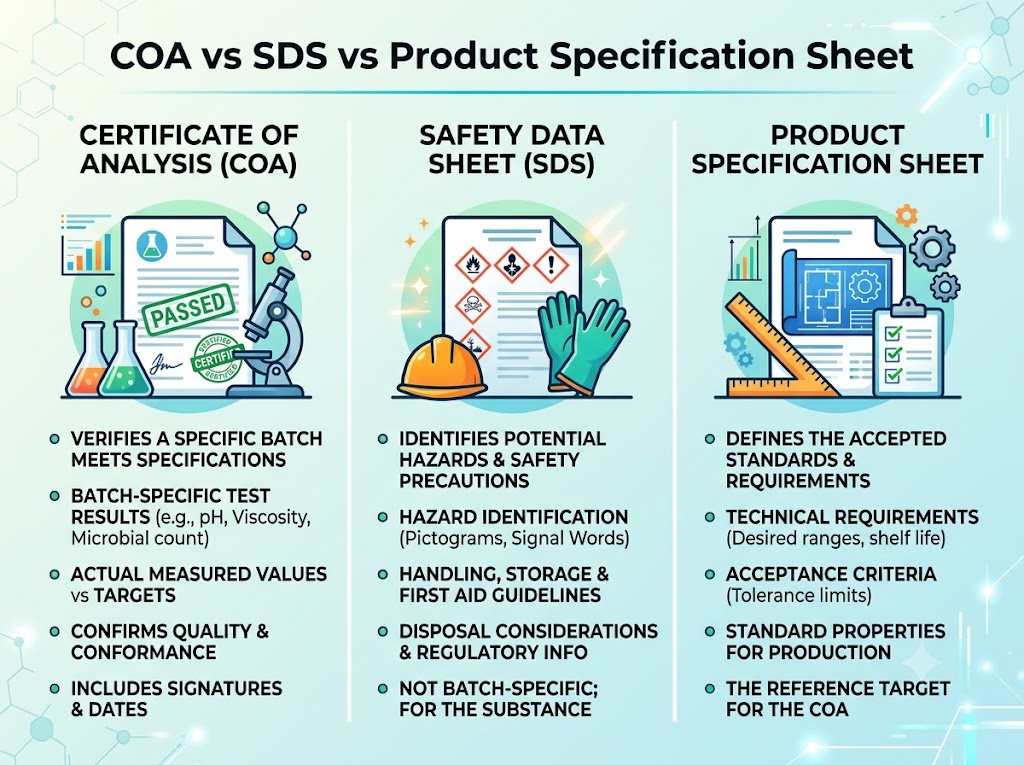
Simple Way to Remember
- COA = “This batch was tested and passed.”
- SDS = “Here is how to handle this material safely.”
- Specification Sheet = “These are the quality standards every batch must meet.”
Each document has a unique role, and together they help ensure safe and consistent cosmetic manufacturing.
Common Mistakes When Reading a COA
A COA is only useful if it is reviewed carefully. Even experienced professionals follow a checklist to avoid missing important details.
Here are some common mistakes beginners should avoid.
Ignoring the Batch Number
A COA applies only to the specific batch listed on the document.
Always confirm that the batch number on the container matches the batch number on the COA.
Using the wrong COA could result in approving an untested material.
Not Checking the Expiry or Retest Date
An ingredient may have passed laboratory testing when it was manufactured, but quality can change over time.
Always make sure the material is still within its expiry or retest period before use.
Looking Only at the “Pass” Status
It is tempting to focus only on the final approval, but it is also important to review the actual test results.
For example, if your company requires a purity of at least 99.5% and the COA shows 99.1%, the material may not meet your internal specification, even if the supplier has marked it as “Pass.”
Overlooking Missing Information
A complete COA should include essential details such as:
- Product name
- Batch number
- Test results
- Specifications
- Test methods (where applicable)
- Approval or signature
If key information is missing, request clarification from the supplier before using the material.
Assuming All Suppliers Use the Same Format
There is no single universal COA format.
Different suppliers may arrange information differently, but the core quality data should still be present.
Learning to identify these key sections makes it easier to review COAs from different manufacturers.
Benefits of a Certificate of Analysis for Cosmetic Brands
Using Certificates of Analysis offers several advantages for cosmetic companies.
Consistent Product Quality
Testing every batch helps ensure that products perform consistently, regardless of when they are manufactured.
Better Supplier Management
COAs make it easier to compare suppliers and identify those who consistently deliver high-quality materials.
Easier Traceability
If a quality issue is reported, the batch number on the COA helps trace the affected material quickly.
Improved Regulatory Readiness
Maintaining organized COAs demonstrates good documentation practices during inspections and audits.
Reduced Product Recalls
Identifying quality issues before production helps prevent costly recalls and protects the brand’s reputation.
Why Should Consumers Care About COAs?
Most consumers never see a Certificate of Analysis, but they still benefit from it.
When cosmetic brands use quality-tested ingredients and follow good manufacturing practices, consumers are more likely to receive products that are:
- Safe to use
- Consistent from batch to batch
- Free from unacceptable contamination
- Manufactured under controlled quality standards
While a COA alone does not guarantee that a product will suit every individual’s skin, it does provide evidence that the batch met the manufacturer’s defined quality specifications.
Practical Skincare Tip
If you have sensitive skin, try to buy skincare products from reputable brands that emphasize quality testing and Good Manufacturing Practices (GMP). Although consumers don’t usually receive a COA with retail products, brands that invest in strong quality control are generally more likely to produce consistent and reliable formulations.
Best Practices for Managing Certificates of Analysis (COAs)
Whether you are a cosmetic manufacturer, private label brand, raw material supplier, or quality professional, following good COA management practices helps maintain product quality and regulatory compliance.
Here are some recommended practices:
Keep COAs Organized
Store Certificates of Analysis in a well-organized digital or physical filing system.
Organize them by:
- Product name
- Supplier
- Batch number
- Manufacturing date
- Expiry or retest date
This makes it easier to retrieve documents during internal reviews, customer inquiries, or regulatory inspections.
Verify Every New Batch
Never assume that two batches of the same ingredient have identical quality.
Each production batch should have its own COA because test results can vary slightly.
For example, one batch of glycerin may have a moisture content of 0.2%, while another batch may show 0.5%. Both values may meet specifications, but they should still be documented separately.
Review COAs Before Production
Always review the Certificate of Analysis before releasing raw materials to the production floor.
Checking the document early helps identify potential issues before they affect manufacturing, saving both time and cost.
Work with Reliable Suppliers
Choose suppliers that consistently provide:
- Accurate COAs
- Complete laboratory reports
- Clear batch traceability
- Timely documentation
Reliable documentation is often a sign of a mature quality management system.
Train Employees
Quality Control, Quality Assurance, warehouse, and production teams should understand how to read and verify a COA.
Regular training helps reduce documentation errors and ensures that only approved materials are used in manufacturing.
Common Industries That Use Certificates of Analysis
Although COAs are widely used in the cosmetics industry, they are equally important in many other sectors where quality and consistency matter.
These include:
- Cosmetics and personal care
- Skincare manufacturing
- Pharmaceutical manufacturing
- Food and beverage industry
- Nutraceuticals and dietary supplements
- Essential oils and herbal extracts
- Chemical manufacturing
- Laboratory reagents
- Medical devices (for certain materials)
In all of these industries, a COA helps verify that products meet predefined quality standards before they are released or used.
Key Takeaways
Before we wrap up, let’s quickly summarize the most important points.
- A Certificate of Analysis (COA) is an official laboratory document that confirms a specific batch has been tested against predefined quality specifications.
- It helps verify the identity, purity, safety, and consistency of raw materials and finished cosmetic products.
- Common sections include the product name, batch number, manufacturing date, expiry or retest date, specifications, laboratory test results, and approval status.
- Cosmetic manufacturers use COAs to approve incoming ingredients, support quality control, improve traceability, and reduce manufacturing risks.
- A COA is different from a Safety Data Sheet (SDS) and a Product Specification Sheet because it reports the actual test results for a specific batch.
- Careful review of every COA helps maintain product quality, regulatory readiness, and consumer confidence.
Conclusion
A Certificate of Analysis (COA) is one of the most important quality documents in cosmetic manufacturing. While it may seem like a simple laboratory report, it plays a vital role in ensuring that every ingredient and finished product meets established quality standards before reaching the market.
From verifying purity and pH to checking microbial quality and confirming batch traceability, a COA supports safer manufacturing and more consistent skincare products. It also strengthens communication between suppliers, manufacturers, quality teams, and regulatory authorities by providing reliable evidence that each batch has been tested.
Frequently Asked Questions (FAQs)
1. What is a Certificate of Analysis (COA)?
A Certificate of Analysis (COA) is a laboratory-issued document that confirms a specific batch of a raw material or finished product has been tested and meets predefined quality specifications.
2. Why is a COA important in the cosmetics industry?
A COA helps ensure that cosmetic ingredients and finished products meet quality standards before they are used or sold. It supports product consistency, consumer safety, traceability, and regulatory compliance.
3. Who issues a Certificate of Analysis?
A COA is typically issued by the manufacturer, supplier, or an accredited testing laboratory after completing quality tests on a specific production batch.
4. What information is included in a COA?
A typical COA includes:
- Product name
- Batch or lot number
- Manufacturing date
- Expiry or retest date
- Product specifications
- Laboratory test results
- Test methods (where applicable)
- Pass/Fail or compliance status
- Authorized approval or signature
5. Is a COA the same as a Safety Data Sheet (SDS)?
No. A COA confirms the quality test results of a specific batch, while an SDS explains how to safely handle, store, transport, and dispose of a material.
6. Can consumers request a COA for skincare products?
Some cosmetic brands may provide a COA upon request, especially for professional, bulk, or business-to-business products. Retail brands do not always share COAs publicly, but many maintain them as part of their internal quality documentation.
7. Does a COA guarantee that a product will work for everyone?
No. A COA confirms that a batch meets quality specifications, but individual skin types, sensitivities, allergies, and product usage can still affect personal results. Performing a patch test before using a new skincare product is always recommended.