
Surfactants are one of the most important ingredients in modern skincare and cosmetic products. Whether you use a face wash, shampoo, body wash, cleanser, micellar water, or toothpaste, chances are that a surfactant is doing most of the work. Yet, many people have never heard the term “surfactant” or understand why it matters.
If you’ve ever wondered why your face wash creates foam, how oil and dirt wash away with water, or why some cleansers feel gentle while others leave your skin dry, the answer often comes down to the type of surfactant used.
Choosing products without understanding surfactants can lead to problems like dryness, irritation, or ineffective cleansing. On the other hand, selecting products with the right surfactants can help maintain a healthy skin barrier while keeping your skin clean and fresh.
In this beginner-friendly guide, you’ll learn what surfactants are, how they work, why they are essential in skincare, and the top 10 surfactants commonly used in cosmetic products. Everything is explained in simple English with practical examples so that anyone can understand.
What Is a Surfactant?
A surfactant, short for surface-active agent, is an ingredient that helps water mix with oil, dirt, makeup, sunscreen, and other impurities. Since water and oil naturally do not mix, surfactants act as a bridge between them.
Think of washing greasy dishes. If you rinse an oily plate with plain water, the grease stays on the surface. Add a little dishwashing liquid, and the grease quickly disappears. This happens because the surfactants surround the oil and allow water to wash it away.
Read More: What Is Allantoin in Skincare? A Beginner’s Complete Guide(2026)
The same science works in skincare products. Facial cleansers remove excess sebum, makeup, sunscreen, sweat, pollution, and dead skin cells with the help of surfactants.
Without surfactants, most cleansing products simply wouldn’t work effectively.
How Do Surfactants Work?
Every surfactant molecule has two different ends.
- One end is attracted to water (hydrophilic).
- The other end is attracted to oil and dirt (lipophilic).
When you massage a cleanser onto your skin, the oil-loving end attaches to sebum, makeup, and dirt. The water-loving end stays connected to water. Once you rinse your face, the surfactant carries away the trapped impurities, leaving your skin clean.
This simple mechanism is why surfactants are found in almost every cleansing cosmetic product.
Why Are Surfactants Important in Skincare?
Surfactants do much more than create foam. Their main job is to clean the skin without damaging it.
Here are some of their biggest benefits:
They Remove Dirt and Excess Oil
Throughout the day, your skin collects dust, sweat, sunscreen, makeup, and natural oils. Surfactants help lift these impurities away without requiring harsh scrubbing.
They Improve Product Performance
Many skincare products contain both water-based and oil-based ingredients. Surfactants help blend these ingredients evenly, making creams, lotions, and cleansers more stable and effective.
They Help Remove Makeup
Water-resistant makeup can be difficult to wash off with water alone. Surfactants break down makeup pigments and oils, making cleansing easier.
They Create Foam
Although foam isn’t necessary for cleaning, many people enjoy the rich lather produced by certain surfactants. Foam can also help spread the cleanser more evenly across the skin.
They Improve Skin Feel
Well-formulated surfactants cleanse while maintaining the skin’s natural moisture balance, leaving skin feeling soft instead of tight.
Read More: What Is Hyaluronic Acid? A Complete Beginner’s Guide (2026)
Types of Surfactants Used in Cosmetics
Not all surfactants are the same. Cosmetic chemists select different surfactants depending on the product and the intended skin type.
1. Anionic Surfactants
These are powerful cleansers that produce rich foam.
They are commonly used in:
- Face washes
- Shampoos
- Body washes
- Toothpaste
They are excellent at removing oil but may be drying for people with very sensitive skin if used in high concentrations.
Examples include Sodium Lauryl Sulfate (SLS) and Sodium Laureth Sulfate (SLES).
2. Nonionic Surfactants
These are much milder than anionic surfactants.
They are often found in:
- Cream cleansers
- Micellar water
- Makeup removers
- Baby products
They cleanse gently while reducing the risk of irritation.
3. Amphoteric Surfactants
These are considered some of the gentlest surfactants available.
They are widely used in:
- Baby shampoo
- Sensitive skin cleansers
- Mild facial cleansers
They also help reduce the irritation caused by stronger surfactants.
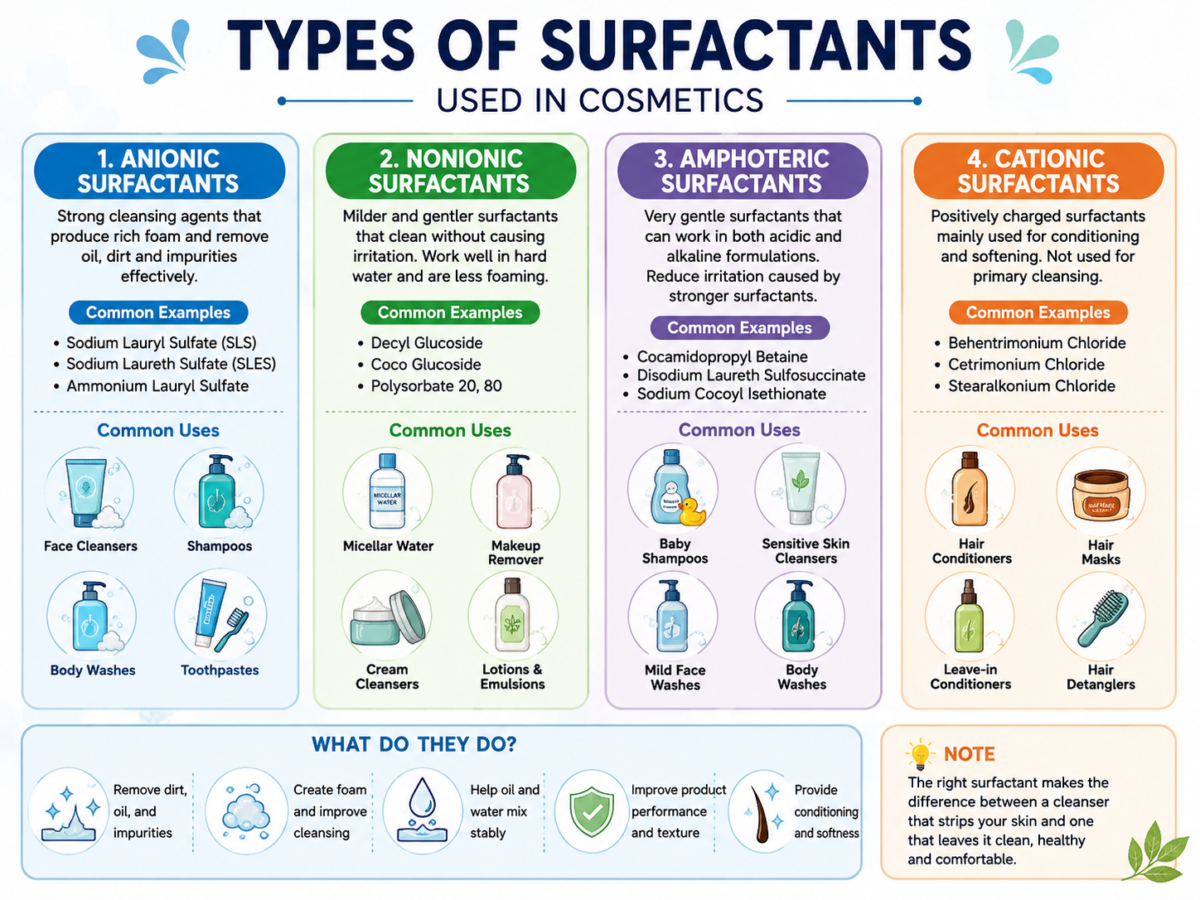
4. Cationic Surfactants
Unlike cleansing surfactants, these are mainly used as conditioning agents.
You’ll usually find them in:
- Hair conditioners
- Hair masks
- Leave-in conditioners
They help smooth hair, reduce static, and improve softness.
Read More:What Is the Cosmetic Industry? A Beginner’s Complete Guide (2026)
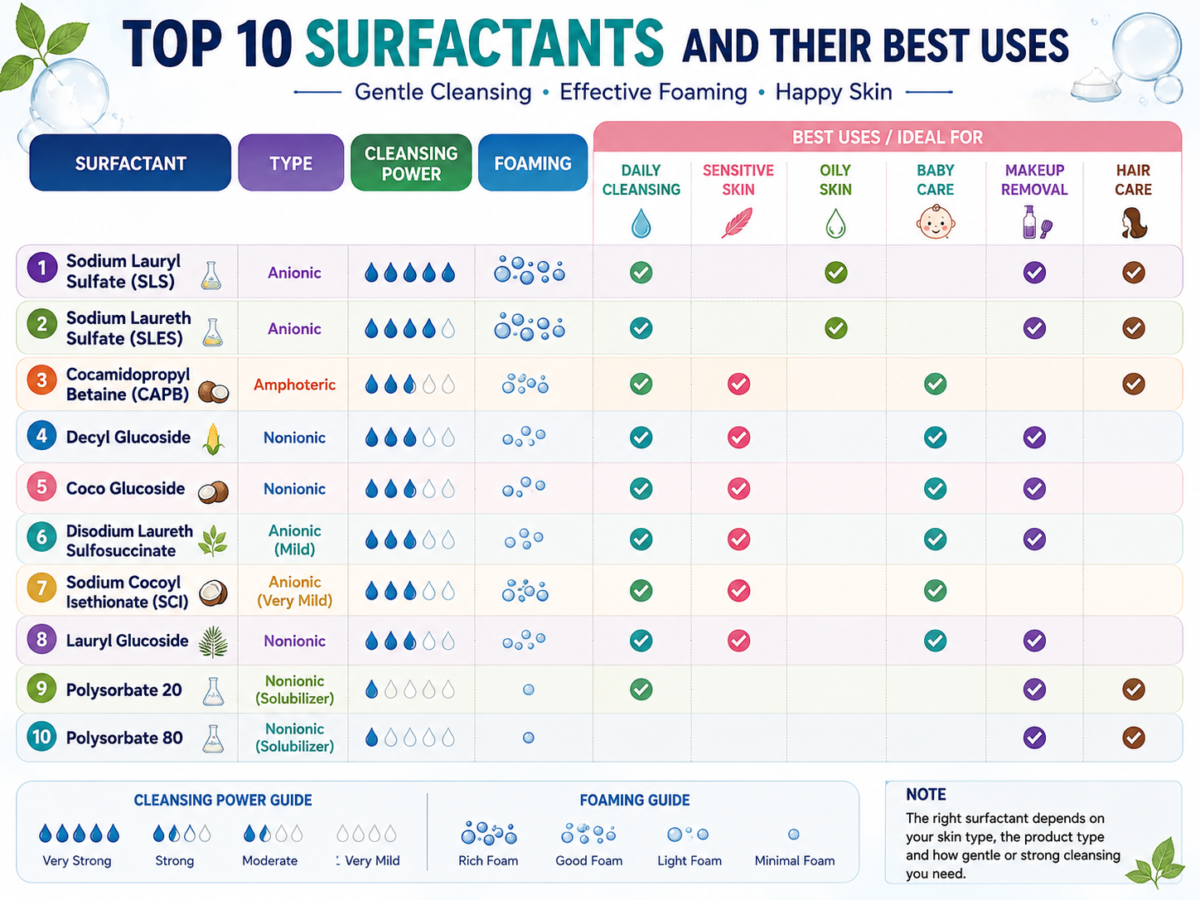
1. Sodium Lauryl Sulfate (SLS)
Sodium Lauryl Sulfate, commonly known as SLS, is one of the most well-known surfactants in the cosmetic industry. It is a strong anionic surfactant that provides excellent cleansing and creates a rich, creamy foam. Because of its high cleaning power, SLS is widely used in products that need to remove heavy oil, dirt, and product buildup.
You can commonly find SLS in:
- Face cleansers
- Body washes
- Shampoos
- Toothpaste
- Hand soaps
Benefits of SLS
One of the biggest advantages of SLS is its ability to clean thoroughly. It removes excess oil, sweat, pollution, sunscreen, and styling products very effectively. This makes it a popular choice for people with oily skin or oily hair.
SLS also creates a luxurious lather that many consumers associate with cleanliness.
Drawbacks
Although SLS is an excellent cleanser, it may remove too much of the skin’s natural oil if used frequently. This can leave dry or sensitive skin feeling tight, rough, or irritated.
People with eczema, rosacea, or a weakened skin barrier often prefer products made with gentler surfactants.
Best For
- Oily skin
- Oily scalp
- Deep-cleansing products
- Clarifying shampoos
Practical Tip
If your skin feels dry immediately after washing, your cleanser may contain strong surfactants like SLS. Consider switching to a gentler cleanser if dryness becomes a regular problem.
2. Sodium Laureth Sulfate (SLES)
Sodium Laureth Sulfate, or SLES, is closely related to SLS but is considered milder because it undergoes an additional manufacturing process called ethoxylation. This process reduces its potential to irritate the skin while maintaining excellent cleansing performance.
Today, SLES is one of the most commonly used surfactants in skincare and personal care products.
You’ll often find it in:
- Facial cleansers
- Body washes
- Liquid soaps
- Bubble baths
- Shampoos
Benefits of SLES
SLES effectively removes dirt, oil, makeup, and impurities while producing a pleasant foam. Compared to SLS, it is generally gentler on the skin and scalp.
Many cosmetic manufacturers choose SLES because it offers a good balance between cleansing power and skin comfort.
Drawbacks
Although milder than SLS, SLES can still be drying for people with very sensitive or extremely dry skin if used too often.
Best For
- Normal skin
- Combination skin
- Oily skin
- Daily cleansing products
Practical Tip
If you enjoy foaming cleansers but have sensitive skin, look for formulas where SLES is combined with moisturizing ingredients like glycerin, aloe vera, panthenol, or ceramides.
3. Cocamidopropyl Betaine (CAPB)
Cocamidopropyl Betaine is one of the most popular amphoteric surfactants used in modern skincare. It is derived from coconut oil and is known for being extremely gentle while helping create a soft, creamy foam.
Many brands combine CAPB with stronger surfactants to reduce irritation and improve the overall feel of the cleanser.
You’ll commonly see it in:
- Baby shampoos
- Sensitive skin cleansers
- Face washes
- Body washes
- Hand washes
Benefits of Cocamidopropyl Betaine
This surfactant cleanses the skin without stripping away too much natural moisture. It also improves foam quality and makes cleansers feel smoother during use.
Another advantage is that it helps reduce the harshness of stronger cleansing agents like SLS and SLES.
Drawbacks
Although rare, some people may develop an allergic reaction to impurities left behind during the manufacturing process rather than the ingredient itself.
High-quality cosmetic formulations generally minimize this risk.
Best For
- Sensitive skin
- Dry skin
- Children’s products
- Everyday facial cleansers
Practical Tip
If your cleanser says “soap-free” or “gentle cleanser,” there’s a good chance it contains Cocamidopropyl Betaine.
4. Decyl Glucoside
Decyl Glucoside is a naturally derived nonionic surfactant made from plant-based ingredients such as corn glucose and coconut oil. It has become increasingly popular because it is biodegradable, environmentally friendly, and extremely mild.
Many clean beauty and natural skincare brands prefer Decyl Glucoside because of its gentle cleansing action.
You’ll often find it in:
- Natural face cleansers
- Organic skincare
- Baby products
- Sensitive skin cleansers
- Micellar cleansers
Benefits of Decyl Glucoside
Decyl Glucoside cleanses effectively while helping maintain the skin’s natural protective barrier. It creates a light foam without causing excessive dryness.
Its gentle nature makes it suitable for daily use on both the face and body.
Drawbacks
It does not produce the thick, rich foam that many people expect from traditional cleansers. However, this does not mean it cleans less effectively.
Best For
- Sensitive skin
- Dry skin
- Baby skincare
- Eco-friendly skincare products
Practical Tip
Don’t judge a cleanser by how much it foams. Many gentle cleansers with Decyl Glucoside create less lather but clean the skin very well without causing irritation.
5. Coco Glucoside
Coco Glucoside is another plant-derived nonionic surfactant made from coconut oil and natural sugars. It is widely appreciated for its mild cleansing ability and excellent skin compatibility.
Because it is biodegradable and renewable, it is commonly used in sustainable cosmetic formulations.
You’ll commonly find Coco Glucoside in:
- Facial cleansers
- Natural shampoos
- Baby washes
- Organic body washes
- Foaming hand soaps
Benefits of Coco Glucoside
Coco Glucoside gently removes dirt, sweat, and excess oil without disturbing the skin’s moisture barrier. It also improves the texture of cleansing products and helps create a soft, pleasant foam.
Many natural skincare brands combine it with botanical extracts to create gentle formulas suitable for everyday use.
Drawbacks
Since Coco Glucoside is a mild cleanser, it may not remove heavy waterproof makeup in a single wash. In such cases, double cleansing is often recommended.
Best For
- Sensitive skin
- Dry skin
- Normal skin
- Natural skincare routines
6. Disodium Laureth Sulfosuccinate
Despite its long and complex name, Disodium Laureth Sulfosuccinate is known as one of the gentlest cleansing surfactants used in skincare. Although its name sounds similar to sulfates, it is chemically different from Sodium Lauryl Sulfate (SLS) and is much milder on the skin.
Many dermatologists recommend products containing this surfactant for people who need effective cleansing without excessive dryness.
You can commonly find it in:
- Sensitive skin face washes
- Baby cleansers
- Gentle shampoos
- Sulfate-free cleansing products
- Mild body washes
Benefits of Disodium Laureth Sulfosuccinate
This surfactant removes dirt, oil, and light makeup while helping preserve the skin’s natural moisture barrier. It produces a soft, creamy foam and is less likely to cause irritation than stronger surfactants.
Many premium skincare brands use it to create gentle cleansers suitable for everyday use.
Drawbacks
Its cleansing power is slightly lower than stronger surfactants, so it may require double cleansing if you wear heavy waterproof makeup or thick sunscreen.
Best For
- Sensitive skin
- Dry skin
- Mature skin
- Daily facial cleansing
Practical Tip
If your skin feels healthy after washing instead of tight or squeaky clean, your cleanser is likely using mild surfactants like Disodium Laureth Sulfosuccinate.
7. Sodium Cocoyl Isethionate (SCI)
Sodium Cocoyl Isethionate, often called SCI, is one of the most loved gentle surfactants in the skincare industry. It is derived from coconut fatty acids and is famous for producing a rich, luxurious foam without stripping the skin.
Because of its mild nature, SCI is commonly used in premium facial cleansers and sulfate-free cleansing bars.
You’ll often find it in:
- Syndet (soap-free) bars
- Facial cleansers
- Sensitive skin products
- Cleansing bars
- Luxury body washes
Benefits of Sodium Cocoyl Isethionate
SCI provides excellent cleansing while maintaining skin hydration. It leaves the skin feeling soft and smooth instead of dry.
It also creates a creamy lather that many people enjoy, making it a popular alternative to traditional sulfates.
Drawbacks
SCI is more expensive than many common surfactants, which is why products containing it may cost slightly more.
Best For
- Dry skin
- Sensitive skin
- Combination skin
- Everyday facial cleansing
Practical Tip
If you’re looking for a soap-free cleansing bar, check the ingredient list for Sodium Cocoyl Isethionate. It’s often a sign of a gentle, skin-friendly formula.
8. Lauryl Glucoside
Lauryl Glucoside is another plant-based, nonionic surfactant made from natural sugars and coconut or palm oils. It has gained popularity because it is gentle, biodegradable, and suitable for many skin types.
It is commonly used in:
- Organic face cleansers
- Natural shampoos
- Baby care products
- Facial cleansing gels
- Body washes
Benefits of Lauryl Glucoside
Lauryl Glucoside effectively removes dirt and excess oil while maintaining the skin’s natural balance. It works well with other mild surfactants, creating cleansers that are effective yet comfortable to use every day.
Its environmentally friendly profile also makes it a favorite among brands focused on sustainable beauty.
Drawbacks
Like many mild surfactants, it may not remove heavy makeup on its own. Using a cleansing balm or oil before washing can improve results.
Best For
- Sensitive skin
- Dry skin
- Natural skincare
- Eco-conscious consumers
Practical Tip
If your skincare routine focuses on minimal ingredients and gentle cleansing, Lauryl Glucoside is an excellent ingredient to look for.
9. Polysorbate 20
Polysorbate 20 is slightly different from traditional cleansing surfactants. It mainly works as a solubilizer, helping oil-based ingredients mix evenly with water.
Without ingredients like Polysorbate 20, many cosmetic products would separate into layers during storage.
You’ll commonly find it in:
- Micellar water
- Facial mists
- Toners
- Makeup removers
- Essential oil-based skincare
Benefits of Polysorbate 20
It helps dissolve fragrance oils, essential oils, and lightweight oils into water-based products, making them easier to apply and more stable.
It also contributes to gentle cleansing in products like micellar water.
Drawbacks
Polysorbate 20 is not designed for deep cleansing, so it is usually combined with other surfactants in cleansing products.
Best For
- Micellar water
- Toners
- Facial sprays
- Lightweight cleansing products
Practical Tip
If you use DIY skincare with essential oils, avoid mixing oils directly with water. Cosmetic formulators use ingredients like Polysorbate 20 to ensure proper blending and safer application.
10. Polysorbate 80
Polysorbate 80 is another commonly used solubilizing surfactant. Compared to Polysorbate 20, it is better at dispersing heavier oils and thicker ingredients.
It plays an important role in improving product stability and texture.
You’ll often find it in:
- Cleansing oils
- Makeup removers
- Cream cleansers
- Moisturizers
- Hair care products
Benefits of Polysorbate 80
It helps blend oils and water into a smooth, stable formula, ensuring that products remain consistent throughout their shelf life.
It also helps cleansing oils rinse away easily without leaving an overly greasy residue.
Drawbacks
Polysorbate 80 is not a primary cleanser, so it is usually paired with other surfactants in cleansing formulations.
Best For
- Oil cleansers
- Makeup removers
- Cream-based skincare
- Cosmetic emulsions
How to Choose the Right Surfactant for Your Skin Type
Not every surfactant is suitable for every skin type. Choosing a cleanser with the right ingredients can improve your skincare routine and help protect your skin barrier.
For Oily Skin
People with oily skin often benefit from surfactants that provide deeper cleansing without over-drying.
Good options include:
- Sodium Laureth Sulfate (SLES)
- Sodium Lauryl Sulfate (SLS) in occasional clarifying products
- Cocamidopropyl Betaine (combined with other mild surfactants)
For Dry Skin
Dry skin needs gentle cleansing that removes impurities while preserving natural moisture.
Look for ingredients such as:
- Sodium Cocoyl Isethionate
- Decyl Glucoside
- Coco Glucoside
- Disodium Laureth Sulfosuccinate
In the final part, we’ll discuss common myths about surfactants, expert skincare tips, mistakes to avoid, frequently asked questions, and a practical conclusion to help beginners choose the best cleanser with confidence.
For Sensitive Skin
Sensitive skin requires mild surfactants that cleanse effectively without weakening the skin’s natural protective barrier.
Look for cleansers containing:
- Cocamidopropyl Betaine
- Sodium Cocoyl Isethionate
- Decyl Glucoside
- Lauryl Glucoside
- Disodium Laureth Sulfosuccinate
Avoid products with strong fragrances or alcohol if your skin is easily irritated.
For Combination Skin
Combination skin has both oily and dry areas, so a balanced cleanser works best.
Good choices include:
- Sodium Laureth Sulfate (SLES) in gentle formulations
- Cocamidopropyl Betaine
- Coco Glucoside
- Sodium Cocoyl Isethionate
These ingredients help cleanse oily areas while keeping dry areas comfortable.
Common Myths About Surfactants
Many people misunderstand surfactants because of information shared online. Let’s clear up some common myths.
Myth 1: All Surfactants Are Harmful
This is false.
Surfactants are simply ingredients that help clean the skin or mix oil and water. Some are strong, while others are extremely gentle. The safety of a product depends on its complete formulation, not just one ingredient.
Myth 2: More Foam Means Better Cleansing
Foam does not determine how well a cleanser works.
Many gentle cleansers produce very little foam but still remove dirt, oil, and sunscreen effectively.
Myth 3: Sulfate-Free Means Better
Not always.
Sulfate-free cleansers can be excellent, but some sulfate-free formulas may still irritate sensitive skin if they contain other harsh ingredients. Likewise, many sulfate-based cleansers are carefully formulated with moisturizing ingredients to minimize dryness.
Myth 4: Natural Surfactants Are Always Safer
Plant-derived surfactants are often gentle, but “natural” does not automatically mean better or safer. Every ingredient should be evaluated based on scientific evidence, formulation quality, and your skin’s needs.
Expert Tips for Choosing the Right Cleanser
Buying a cleanser isn’t just about the brand. Understanding the ingredient list can help you choose a product that suits your skin.
Here are a few practical tips:
- Choose gentle surfactants if you have dry or sensitive skin.
- Don’t wash your face more than twice a day unless advised by a dermatologist.
- Avoid using very hot water, as it can dry out the skin.
- Follow cleansing with a moisturizer to help lock in hydration.
- Patch-test new products before applying them to your entire face.
- If you wear heavy makeup or waterproof sunscreen, consider double cleansing.
- Read the ingredient list instead of relying only on marketing claims.
Common Mistakes to Avoid
Even a good cleanser may not give the best results if it is used incorrectly.
Some common mistakes include:
- Using a cleanser that is too harsh for your skin type.
- Washing your face too frequently.
- Skipping moisturizer after cleansing.
- Scrubbing your skin aggressively.
- Choosing products based only on fragrance or foam.
- Ignoring signs of irritation such as redness, burning, or excessive dryness.
Frequently Asked Questions (FAQs)
1. What is the main purpose of a surfactant in skincare?
A surfactant helps remove oil, dirt, makeup, sunscreen, and impurities by allowing water to mix with oils, making cleansing effective.
2. Are all surfactants safe for the skin?
Most surfactants used in cosmetics are considered safe when used in properly formulated products. The best choice depends on your skin type and individual sensitivity.
3. Which surfactants are best for sensitive skin?
Gentle options include Cocamidopropyl Betaine, Sodium Cocoyl Isethionate, Decyl Glucoside, Lauryl Glucoside, and Disodium Laureth Sulfosuccinate.
4. Is Sodium Lauryl Sulfate (SLS) bad for the skin?
Not necessarily. SLS is an effective cleanser, but it can be drying for some people, especially those with dry or sensitive skin. Many people with oily skin use SLS-based products without any issues.
5. What is the difference between SLS and SLES?
Both are cleansing surfactants, but SLES is generally milder than SLS while still providing good cleansing and foaming.
6. Do sulfate-free cleansers clean the skin properly?
Yes. Sulfate-free cleansers can effectively remove dirt and oil when formulated with suitable alternative surfactants.
7. Why do some cleansers produce less foam?
Gentle surfactants often create less foam, but this does not mean they clean less effectively.
8. Can surfactants damage the skin barrier?
Overusing harsh cleansers or choosing products that are too strong for your skin type may weaken the skin barrier over time. Using a suitable cleanser and moisturizer helps maintain healthy skin.
Final Thoughts
Surfactants are the foundation of almost every cleansing product in the cosmetic industry. They make it possible to remove dirt, oil, makeup, sunscreen, and everyday impurities while helping skincare products perform effectively.
However, not all surfactants work the same way. Some provide powerful deep cleansing, while others are specifically designed to protect delicate or sensitive skin. Understanding the differences allows you to make informed choices instead of selecting products based only on advertising or packaging.
For most people, the best cleanser is one that leaves the skin feeling clean, comfortable, and balanced—not tight or overly dry. If your skin feels healthy after washing and remains hydrated throughout the day, you’ve likely found a surfactant system that suits your needs.
As the skincare industry continues to develop gentler and more sustainable formulations, knowing how surfactants work will help you choose products with greater confidence. By matching the cleanser to your skin type and following a consistent skincare routine, you can support a healthy skin barrier and achieve cleaner, fresher-looking skin every day.