
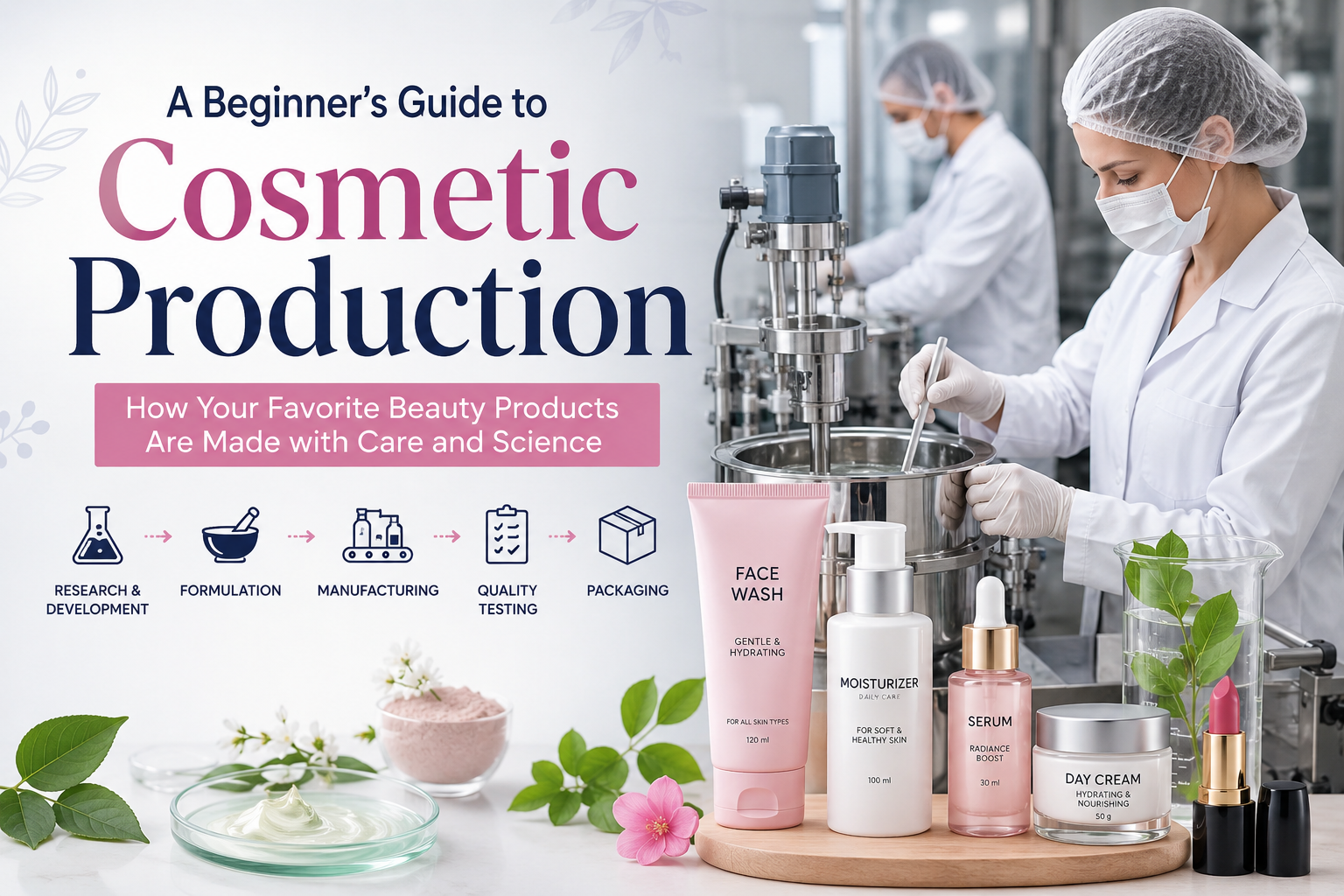
Have you ever wondered how your favorite face wash, sunscreen, moisturizer, or lipstick is made before it reaches the store? Every cosmetic product goes through a carefully planned manufacturing process known as cosmetic production. It is much more than simply mixing ingredients together. Every product must be researched, tested, manufactured, packed, and checked for quality before customers can safely use it.
Whether it is a gentle cleanser for sensitive skin or a bright lipstick for special occasions, cosmetic production ensures that every product meets safety standards, performs well, and provides a good user experience.
Understanding cosmetic production is helpful for skincare beginners, beauty enthusiasts, students, and anyone planning to start a cosmetic business. It also helps consumers appreciate why quality products are often worth the investment.
In this beginner-friendly guide, you will learn the meaning of cosmetic production, the departments involved, the production stages, examples, and the responsibilities of the people working behind every skincare and beauty product.
Cosmetic Production Definition
Cosmetic production is the complete process of manufacturing beauty and personal care products by using approved cosmetic ingredients under controlled conditions. The process includes planning, research, formulation, ingredient testing, manufacturing, quality inspection, packaging, labeling, and final distribution.
The goal of cosmetic production is not only to create attractive products but also to make sure they are:
- Safe for human use
- Effective for their intended purpose
- Stable during storage
- Free from contamination
- Consistent in quality from batch to batch
In simple words, cosmetic production is the journey that transforms raw ingredients into finished skincare, haircare, makeup, and personal care products.
Read More: How to Make Perfume Last Longer-Expert Tips
Why Cosmetic Production is Important
Cosmetic products come into direct contact with our skin, lips, scalp, or eyes. Poor manufacturing practices can cause irritation, allergies, infections, or product failure. That is why cosmetic production follows strict quality procedures.
Some major reasons why cosmetic production is important include:
1. Ensures Product Safety
Every ingredient is carefully measured and tested before production begins. Manufacturers follow hygiene standards to reduce contamination risks.
2. Maintains Product Quality
Customers expect the same texture, fragrance, color, and performance every time they purchase a product. Cosmetic production helps maintain this consistency.
3. Protects Consumer Health
Products are tested for stability, microbial safety, and compatibility before being sold.
4. Builds Brand Trust
When customers receive high-quality products consistently, they become loyal to the brand.
5. Supports Innovation
Modern cosmetic production allows companies to introduce better ingredients, eco-friendly packaging, and improved skincare technologies.
Examples of Cosmetic Products Made Through Cosmetic Production
Almost every beauty and personal care product goes through cosmetic production.
Some common examples include:
- Face wash
- Moisturizer
- Sunscreen
- Face serum
- Toner
- Lip balm
- Lipstick
- Foundation
- Compact powder
- Shampoo
- Conditioner
- Hair oil
- Hair serum
- Body lotion
- Body wash
- Hand cream
- Deodorant
- Perfume
- Face mask
- Scrubs
Although these products look very different, they all follow a systematic production process before reaching consumers.
Read More: Which Hair Mask is The Best for Frizzy and Dry
Simple Example of Cosmetic Production
Imagine a company wants to launch a new Vitamin C face serum.
The production journey may look like this:
- The research team selects a stable form of Vitamin C.
- The formulation expert develops the recipe.
- Raw materials are purchased from approved suppliers.
- Ingredients are mixed using industrial equipment.
- The product is tested for safety and stability.
- Quality inspectors approve the batch.
- The serum is filled into bottles.
- Labels are applied.
- Products are packed into cartons.
- The finished goods are shipped to distributors and retailers.
This entire journey is called cosmetic production.
Major Stages of Cosmetic Production (Step-by-Step Guide)
Cosmetic production follows a systematic process to ensure every product is safe, effective, and consistent. Whether a company manufactures a moisturizer, shampoo, sunscreen, or lipstick, the basic production stages are almost the same.
Let’s understand each stage in simple English.
1. Product Research and Market Analysis
Every cosmetic product starts with an idea.
Before manufacturing begins, companies study the market to understand what customers need. They research current beauty trends, consumer concerns, and popular ingredients.
For example:
- People want fragrance-free skincare for sensitive skin.
- Demand for mineral sunscreen is increasing.
- More customers prefer vegan and cruelty-free cosmetics.
- Lightweight moisturizers are becoming popular in hot climates.
The research team also studies competitor products to understand what improvements can be made.
Main Responsibilities
- Identify customer needs
- Study market trends
- Analyze competitors
- Decide the product category
- Estimate product demand
Example: A skincare company notices that many people struggle with oily skin during summer. They decide to develop a lightweight gel moisturizer specially designed for oily skin.
2. Cosmetic Formulation and Product Development
Once the product idea is approved, cosmetic chemists begin creating the formula.
This is one of the most important stages because the product’s quality depends on its formulation.
The chemist carefully selects:
- Active ingredients
- Base ingredients
- Emulsifiers
- Preservatives
- Fragrance (if needed)
- Colorants (if required)
- Stabilizers
- Moisturizing agents
Different samples are prepared until the desired texture, fragrance, appearance, and performance are achieved.
Main Responsibilities
- Develop the product formula
- Choose safe ingredients
- Ensure ingredient compatibility
- Improve product texture
- Achieve desired performance
Example: A Vitamin C serum may require several trial formulations before the chemist finds the perfect combination that remains stable for months.
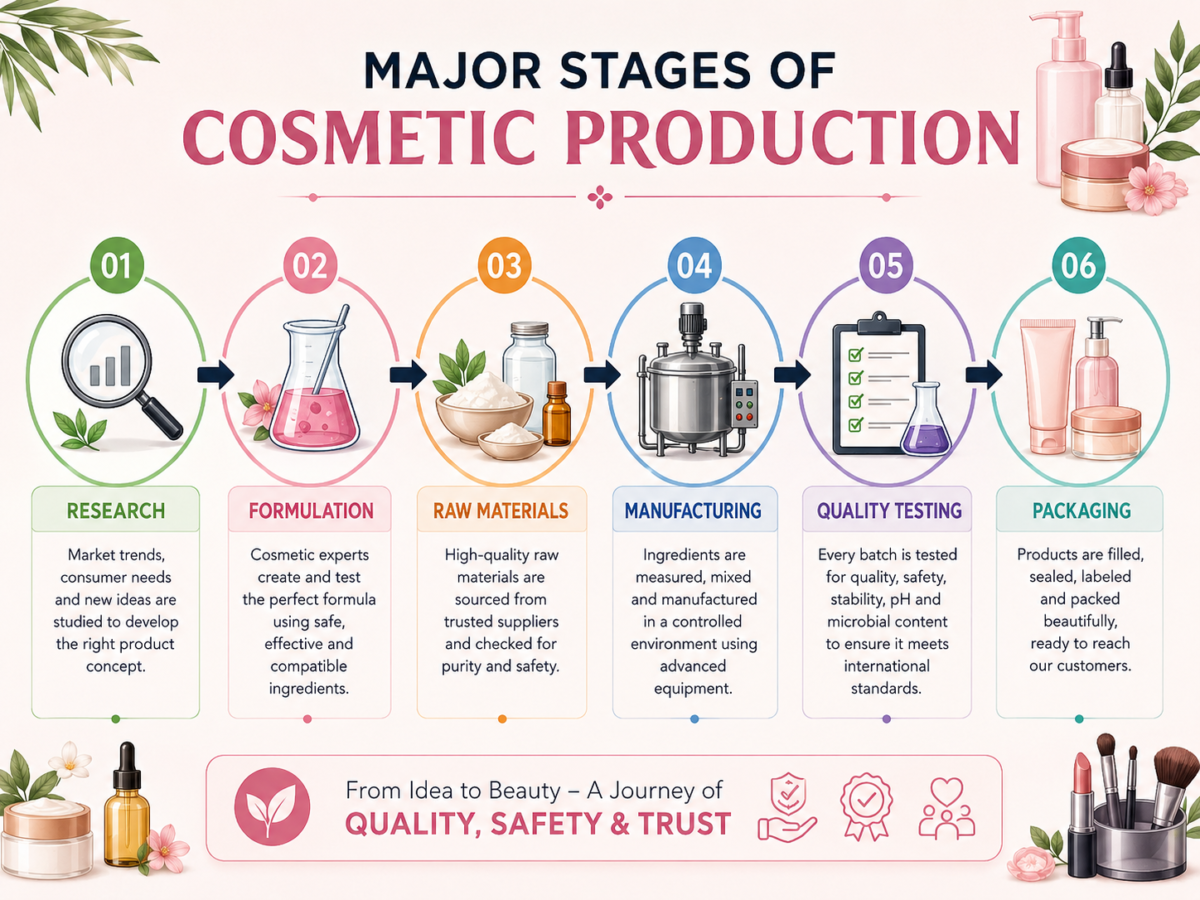
3. Raw Material Procurement
After the formula is finalized, the purchasing department orders raw materials from approved suppliers.
Only high-quality ingredients should be used because poor-quality materials can reduce product effectiveness or cause safety issues.
Common raw materials include:
- Plant extracts
- Oils
- Butters
- Vitamins
- Humectants
- Emollients
- Preservatives
- Essential oils
- Packaging materials
Every raw material is inspected before entering production.
Main Responsibilities
- Purchase approved ingredients
- Verify supplier quality
- Check certificates
- Store ingredients correctly
- Maintain inventory
Example: If a supplier delivers aloe vera extract with incorrect specifications, it will be rejected before production begins.
4. Manufacturing and Mixing
This is where the cosmetic product is actually made.
Ingredients are measured accurately and mixed in large stainless steel manufacturing tanks.
Depending on the product type, different equipment may be used.
Examples include:
- Mixing tanks
- Heating vessels
- Cooling systems
- Homogenizers
- Filling machines
Temperature, mixing speed, and production time are carefully controlled.
Main Responsibilities
- Measure ingredients accurately
- Follow manufacturing procedures
- Monitor temperature
- Maintain hygiene
- Record batch information
Example: A moisturizer requires oil and water phases to be heated separately before being combined into a smooth cream.
5. Quality Control Testing
No cosmetic product should be sold without quality testing.
The quality control (QC) team checks whether the product meets company standards.
Common tests include:
- Appearance
- Color consistency
- Fragrance
- pH level
- Viscosity
- Stability
- Microbial testing
- Packaging inspection
Only approved batches move to the next stage.
Main Responsibilities
- Test product safety
- Verify product consistency
- Approve or reject batches
- Document inspection results
Example: If a face wash has the wrong pH level, it may irritate the skin. The QC team identifies this issue before the product reaches customers.
Departments Involved in Cosmetic Production
A cosmetic product is not made by one person or one machine. It is the result of teamwork between different departments. Each department has its own responsibilities, and together they ensure that every product is safe, effective, and ready for customers.
Let’s look at the main departments involved in cosmetic production.
Read More : 10 Amazing Ayurvedic Skin Care Products for Naturally
1. Research and Development (R&D) Department
The Research and Development (R&D) department is where new cosmetic products are created. This team studies market trends, explores new ingredients, and develops innovative formulations that meet customer needs.
R&D experts also improve existing products by making them more effective, gentler on the skin, or better suited to different skin types.
Main Responsibilities
- Develop new cosmetic formulas
- Improve existing products
- Test ingredient compatibility
- Study new skincare technologies
- Conduct product trials
Example: If customers want a sunscreen that feels lighter on oily skin, the R&D team works on creating a non-greasy formula without reducing sun protection.
2. Purchasing and Procurement Department
The purchasing department ensures that all raw materials and packaging materials are available before production begins.
This department works closely with approved suppliers to source high-quality ingredients at the right price.
Main Responsibilities
- Purchase raw materials
- Select reliable suppliers
- Verify ingredient quality certificates
- Manage inventory
- Ensure timely deliveries
A delay in raw material supply can slow down the entire production process, making this department very important.
3. Production Department
The production department is responsible for manufacturing cosmetic products according to approved formulas and standard operating procedures.
Operators carefully measure ingredients, monitor machines, and maintain cleanliness throughout the manufacturing process.
Main Responsibilities
- Mix ingredients accurately
- Operate manufacturing equipment
- Follow production instructions
- Maintain hygiene
- Record batch information
Example: While producing a facial cleanser, the production team carefully controls the mixing speed and temperature to achieve the correct texture.
4. Quality Control (QC) Department
The Quality Control department checks products at different stages of manufacturing to make sure they meet quality standards.
This team inspects raw materials, monitors production, and tests finished products before they are released.
Main Responsibilities
- Test raw materials
- Check product appearance
- Measure pH and viscosity
- Conduct microbial testing
- Approve or reject batches
Without quality control, unsafe or defective products could reach customers.
5. Quality Assurance (QA) Department
Many beginners confuse Quality Assurance with Quality Control, but their roles are different.
- Quality Control (QC) checks the product.
- Quality Assurance (QA) checks the entire production process.
QA ensures that every department follows approved procedures and maintains proper documentation.
Main Responsibilities
- Monitor manufacturing processes
- Conduct internal audits
- Verify documentation
- Ensure compliance with quality standards
- Improve production systems
6. Packaging Department
Once the product passes quality inspection, it moves to the packaging department.
Packaging is not just about making products look attractive. It also protects the product from contamination, sunlight, moisture, and damage during transportation.
Main Responsibilities
- Fill products into containers
- Seal bottles and tubes
- Apply labels
- Print batch numbers
- Pack products into cartons
Good packaging also helps customers understand how to use the product safely.
7. Warehouse and Inventory Department
After packaging, finished products are stored in warehouses until they are shipped.
Proper storage conditions help maintain product quality and shelf life.
Main Responsibilities
- Store finished goods safely
- Monitor stock levels
- Manage inventory
- Prepare shipments
- Maintain storage conditions
8. Sales and Marketing Department
Even the best cosmetic product cannot succeed if people do not know about it.
The sales and marketing department promotes products through advertising, social media, websites, retail stores, and educational campaigns.
Main Responsibilities
- Launch new products
- Promote brand awareness
- Conduct marketing campaigns
- Gather customer feedback
- Increase product sales
Customer feedback collected by this department often helps the R&D team improve future products.
How These Departments Work Together
Think of cosmetic production like preparing a healthy meal.
- R&D creates the recipe.
- Purchasing buys fresh ingredients.
- Production cooks the meal.
- Quality Control checks the taste and safety.
- Packaging prepares it for customers.
- Warehouse stores it properly.
- Sales introduces it to the market.
If one department does not perform its job properly, the final product may not meet customer expectations.
Responsibilities in Cosmetic Production
Cosmetic production is not just about making beauty products. Every team member has a responsibility to ensure that products are safe, effective, and meet customer expectations. Below are the key responsibilities involved in the cosmetic production process.
1. Ensuring Product Safety
Safety is the top priority. Manufacturers must use approved cosmetic ingredients and follow strict hygiene practices. Every batch should be tested before it reaches the market.
2. Maintaining Consistent Quality
Customers expect the same texture, fragrance, color, and performance every time they buy a product. Maintaining consistency is one of the biggest responsibilities in cosmetic production.
3. Following Standard Operating Procedures (SOPs)
Every manufacturing step must follow written procedures. This helps reduce errors and ensures every batch is produced correctly.
4. Keeping Accurate Records
Production details, batch numbers, ingredient quantities, and quality test results should be properly documented. Good record-keeping helps trace products if any issue arises later.
5. Maintaining Clean Manufacturing Facilities
Machines, equipment, and production areas should be cleaned regularly to prevent contamination and protect product quality.
6. Improving Products Continuously
Consumer needs and skincare trends change over time. Cosmetic companies should regularly improve formulations, packaging, and production methods to offer better products.
Common Challenges in Cosmetic Production
Although cosmetic manufacturing is highly organized, companies still face several challenges.
Raw Material Availability
Natural ingredients may become difficult to source due to seasonal changes or supply chain disruptions.
Maintaining Product Stability
Some active ingredients are sensitive to heat, light, or air. Manufacturers must ensure products remain stable throughout their shelf life.
Quality Consistency
Producing thousands of identical products requires strict monitoring and quality checks.
Packaging Compatibility
A good formula can still fail if the packaging reacts with the ingredients or does not protect the product properly.
Meeting Customer Expectations
Consumers today expect products that are effective, affordable, environmentally friendly, and suitable for different skin types.
Practical Tips for Choosing Quality Cosmetic Products
Understanding cosmetic production can help you make smarter skincare choices. Here are a few practical tips:
- Buy products from trusted and reputable brands.
- Read the ingredient list before purchasing.
- Choose products suitable for your skin type.
- Check the manufacturing and expiry dates.
- Avoid products with damaged or broken packaging.
- Always perform a patch test before trying a new skincare product.
- Store cosmetics in a cool, dry place away from direct sunlight.
- Follow the usage instructions provided on the label.
Remember, even a well-made product may not suit everyone. Your skin type, lifestyle, and personal sensitivities all play a role in how a product performs.
Conclusion
Cosmetic production is a carefully managed process that transforms raw ingredients into safe, effective, and high-quality beauty products. From product research and formulation to manufacturing, quality control, packaging, and distribution, every stage plays an important role in delivering products that consumers can trust.
Behind every moisturizer, sunscreen, shampoo, or lipstick is a team of professionals working together to ensure safety, consistency, and performance. Understanding this process not only helps you appreciate the effort involved in creating cosmetics but also enables you to make better purchasing decisions.
Whether you are a skincare beginner, a beauty enthusiast, or someone planning to enter the cosmetic industry, learning about cosmetic production provides a strong foundation for understanding how modern beauty products are developed and manufactured.
Frequently Asked Questions (FAQs)
1. What is cosmetic production?
Cosmetic production is the complete process of manufacturing beauty and personal care products, including research, formulation, production, quality testing, packaging, and distribution.
2. Why is cosmetic production important?
It ensures cosmetic products are safe, effective, hygienic, and consistent in quality before reaching consumers.
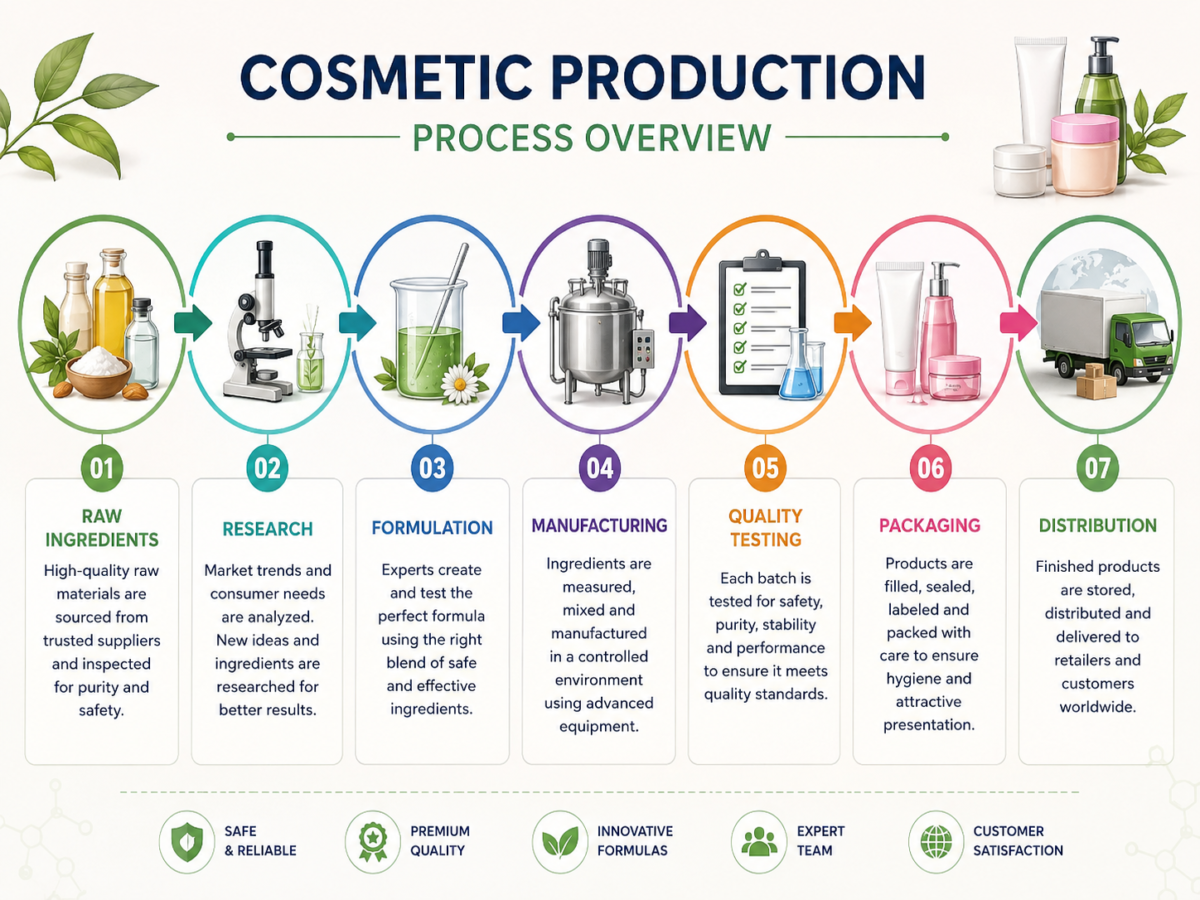
3. What are the main stages of cosmetic production?
The main stages include product research, formulation, raw material procurement, manufacturing, quality control, packaging, and distribution.
4. Which department develops new cosmetic products?
The Research and Development (R&D) department is responsible for creating and improving cosmetic formulations.
5. What is the role of Quality Control in cosmetic production?
Quality Control tests raw materials and finished products to ensure they meet safety and quality standards.
6. What is the difference between Quality Assurance and Quality Control?
Quality Assurance focuses on improving the manufacturing process, while Quality Control tests the products themselves.
7. What products are made through cosmetic production?
Face washes, moisturizers, sunscreens, serums, shampoos, conditioners, lipsticks, perfumes, body lotions, and many other beauty products.
8. Why are raw materials important in cosmetic production?
High-quality raw materials help produce safe, effective, and reliable cosmetic products with consistent performance.
9. How can consumers identify quality cosmetic products?
Look for trusted brands, proper labeling, manufacturing and expiry dates, ingredient lists, and undamaged packaging.
10. Can cosmetic production affect product performance?
Yes. Even with excellent ingredients, poor manufacturing practices can reduce a product’s effectiveness, stability, and safety.