cosmeticgyaan

What Is Emulsion in the Cosmetic Industry? A Complete A–Z Guide

An emulsion is a mixture of two immiscible liquids, typically oil and water, where one liquid is dispersed into the other in the form of tiny droplets with the help of an emulsifying agent (emulsifier).

In cosmetics:

  • Oil phase: Oils, butters, waxes, oil-soluble actives
  • Water phase: Water, hydrosols, water-soluble actives
  • Emulsifier: A substance that binds oil and water together

Without an emulsifier, oil and water will naturally separate.

Basic formula:

Oil Phase + Water Phase + Emulsifier = Stable Emulsion

Introduction

In the cosmetic industry, emulsion is the foundation of most personal care products. From face creams and body lotions to sunscreens and conditioners, emulsions play a critical role in determining product stability, texture, performance, appearance, and shelf life.

Despite its importance, emulsion science is often misunderstood. Many batch failures, product recalls, and customer complaints are directly linked to poor emulsification or emulsion breakage.

This article provides a complete A–Z explanation of emulsions in cosmetics, covering:

  • What an emulsion is
  • Types of emulsions
  • Why emulsification is essential
  • What happens if emulsion fails
  • Effects on color, fragrance, and batch quality
  • What to do if emulsion breaks

This guide is written for manufacturers, formulators, cosmetic chemists, and brand owners.

What Is an Emulsion?

In cosmetics:

An emulsion is a mixture of two immiscible liquids, typically oil and water, where one liquid is dispersed into the other in the form of tiny droplets with the help of an emulsifying agent (emulsifier).

  • Oil phase: Oils, butters, waxes, oil-soluble actives
  • Water phase: Water, hydrosols, water-soluble actives
  • Emulsifier: A substance that binds oil and water together

Without an emulsifier, oil and water will naturally separate.

Basic formula:

Oil Phase + Water Phase + Emulsifier = Stable Emulsion

Why Oil and Water Do Not Mix Naturally

Oil molecules are hydrophobic, while water molecules are hydrophilic. Due to this difference in molecular polarity, oil and water repel each other.

An emulsifier has:

  • A hydrophilic (water-loving) part
  • A lipophilic (oil-loving) part

This dual nature allows it to stay at the oil-water interface and keep the system stable.

Why Emulsification Is Essential in Cosmetics

Emulsification is not optional — it is mandatory for most cosmetic products.

Key Reasons Emulsion Is Required

  • To create a uniform and smooth texture
  • To prevent oil and water separation
  • To ensure even distribution of actives
  • To improve absorption and skin feel
  • To enhance product appearance
  • To increase shelf life and stability

Without proper emulsification, a cosmetic product becomes unstable, unsafe, and unmarketable.

Types of Emulsions in the Cosmetic Industry

1. Oil in Water (O/W) Emulsion

In this system:

  • Oil droplets are dispersed in water
  • Water is the continuous phase

Common Products:

  • Face creams
  • Body lotions
  • Sunscreens
  • Moisturizers
  • Serums

Characteristics:

  • Lightweight
  • Non-greasy
  • Fast absorbing
  • Easy to wash off
  • Preferred for day and summer products

This is the most widely used emulsion type in cosmetics.


2. Water in Oil (W/O) Emulsion

In this system:

  • Water droplets are dispersed in oil
  • Oil is the continuous phase

Common Products:

  • Cold creams
  • Night creams
  • Heavy moisturizers
  • Barrier repair creams

Characteristics:

  • Rich and greasy
  • Highly moisturizing
  • Excellent water resistance
  • Ideal for dry or damaged skin

3. Multiple Emulsions (W/O/W or O/W/O)

These are advanced emulsions where droplets exist inside droplets.

Applications:

  • Controlled release products
  • Sensitive skin formulations
  • Pharmaceutical-grade cosmetics
  • Luxury skincare

These emulsions require precise formulation and advanced processing.

Role of Emulsifiers in Cosmetic Formulations

Emulsifiers are the backbone of any emulsion system.

Functions of Emulsifiers

  • Reduce surface tension
  • Stabilize oil and water phases
  • Control droplet size
  • Improve texture and viscosity
  • Enhance product stability

Common Cosmetic Emulsifiers

EmulsifierApplication
Glyceryl StearateCreams, lotions
PEG-100 StearateO/W emulsions
Polysorbate 60 / 80Solubilization
Cetearyl AlcoholCo-emulsifier
Sorbitan EstersW/O systems

Choosing the correct emulsifier and HLB value is critical for success.

Why Emulsion Is Critical in Creams and Lotions

Creams and lotions contain:

  • Water
  • Oils
  • Actives
  • Colorants
  • Fragrance

Without emulsion:

  • Oil floats to the top
  • Water settles at the bottom
  • Actives become uneven
  • Product looks defective

A stable emulsion ensures:

  • Uniform appearance
  • Smooth application
  • Consistent dosing
  • Consumer trust

What Is Emulsion Breakage?

Emulsion breakage occurs when oil and water separate after emulsification.

Visible Signs of Emulsion Failure

  • Oil layer on top
  • Water leakage from cream
  • Grainy or curdled texture
  • Color separation
  • Unpleasant odor
  • Sudden viscosity loss

Once an emulsion breaks, the product is considered unstable.

Causes of Emulsion Breakage

1. Incorrect Emulsifier Selection

  • Wrong HLB value
  • Insufficient emulsifier quantity

2. Temperature Errors

  • Oil and water phases not heated equally
  • Overheating above 75°C
  • Rapid cooling

3. Improper Mixing or Homogenization

  • Low shear force
  • Incorrect RPM
  • Short mixing time

4. pH Imbalance

  • pH-sensitive emulsifiers
  • Acidic or alkaline actives added later

5. Electrolytes and Actives

  • Herbal extracts
  • Salts
  • Acids (AHA, BHA)
  • High active load

Effect of Emulsion Breakage on Color

  • Uneven color distribution
  • Patchy appearance
  • Pigment settling
  • Dull or faded shade
  • Whitening or streaking

This directly affects visual appeal and market acceptance.

Effect of Emulsion Breakage on Fragrance

  • Fragrance evaporation
  • Loss of top notes
  • Odor imbalance
  • Chemical or rancid smell

Fragrance instability often leads to consumer rejection.

Impact on Batch Quality and Business

  • Batch rejection
  • Increased production cost
  • Customer complaints
  • Product recalls
  • Brand reputation damage
  • Regulatory risk

Even a small emulsion failure can cause major financial loss.

What To Do If an Emulsion Breaks

Step-by-Step Corrective Actions

1. Reheating and Re-homogenization

  • Heat both phases to 65–70°C
  • Apply high-shear mixing
  • Cool gradually with stirring

2. Add Additional Emulsifier

  • Increase by 0.2–0.5%
  • Maintain HLB balance

3. Add Stabilizing Thickeners

  • Xanthan Gum
  • Carbomer
  • Sepiplus
  • Aristoflex

4. Adjust pH

  • Target pH: 5.0 – 6.5
  • Use citric acid or sodium hydroxide

When a Batch Should Be Rejected

  • Permanent color change
  • Strong off-odor
  • Microbial growth
  • Repeated separation
  • Texture degradation

In such cases, reprocessing is unsafe and uneconomical.

Stability Testing for Emulsions

To prevent future failures:

  • Hot-cold cycle test
  • Centrifuge test
  • Accelerated stability test
  • Long-term storage test

Stability testing is non-negotiable for commercial products.

Conclusion

Emulsion is the backbone of cosmetic formulation. A well-designed emulsion ensures product stability, performance, safety, and customer satisfaction.

Poor emulsification leads to:

  • Product failure
  • Financial loss
  • Brand damage

Mastering emulsion science is essential for anyone involved in cosmetic manufacturing or formulation.

A strong emulsion is not just chemistry — it is product success.

Department of Cosmetic Industry – Full Guide (A to Z)

Cosmetic industry guide image with skincare tube, dropper bottle and makeup brush on beige background”

Department of Cosmetic Industry – Full Guide (A to Z)

Cosmetic Industry आज के समय की सबसे तेजी से बढ़ती हुई industries में से एक है। Shampoo, face wash, cream, lotion, serum, lip balm, hair gel, face pack, makeup products—इन सभी के पीछे एक पूरी cosmetic manufacturing system काम करती है।

एक cosmetic factory चलाने के लिए कई departments की जरूरत होती है और हर department की अपनी responsibilities, qualifications और salary ranges होती हैं।
इस ब्लॉग में हम A से Z तक cosmetic industry के सभी departments को समझेंगे और जानेंगे कि कौन क्या काम करता है, उसके लिए क्या qualification चाहिए और salary package कितना होता है।

Cosmetic Industry क्या होती है?

Cosmetic Industry उन products को बनाती है जो skin, hair और body की cleaning, beautification, protection या maintenance में इस्तेमाल होते हैं।

इन products की safety, quality और effectiveness maintain करने के लिए एक पूरी professional team काम करती है।


🏭 Cosmetic Industry में A to Z Departments

नीचे पूरे A से Z तक वो departments दिए गए हैं जो लगभग हर cosmetic manufacturing company में पाए जाते हैं:

✔ 1. QA – Quality Assurance

✔ 2. QC – Quality Control

✔ 3. R&D – Research & Development

✔ 4. Production / Manufacturing

✔ 5. Packaging Department

✔ 6. Warehouse (RM/PM Store)

✔ 7. Purchase / Procurement

✔ 8. Sales & Marketing

✔ 9. HR & Admin

✔ 10. Maintenance Department

✔ 11. Regulatory Affairs

✔ 12. Microbiology Lab

✔ 13. Dispatch & Logistics

✔ 14. Safety & EHS

✔ 15. Accounts & Finance

अब एक-एक department को detail में समझते हैं।

1. QA – Quality Assurance Department

Quality Assurance cosmetic manufacturing की backbone होता है।

Work / Responsibilities

  • SOP बनाना
  • GMP compliance maintain करना
  • BMR/BPR verify करना
  • In-process quality checks
  • Change control & deviation handle करना
  • Final product release approval

Common Job Positions

  • QA Assistant
  • QA Officer
  • QA Executive
  • QA Manager
  • QA Head

Qualification

  • B.Sc Chemistry
  • B.Tech/B.E Chemical
  • M.Sc Cosmetics/Chemistry
  • Diploma in Cosmetics

Salary Range

  • Fresher: ₹12,000 – ₹18,000
  • 2–5 years: ₹20,000 – ₹35,000
  • Manager: ₹40,000 – ₹80,000
  • QA Head: ₹1 lakh – ₹2 lakh/month

2. QC – Quality Control Department

QC product को टेस्ट करता है ताकि product safe और effective रहे।

Quality control

Work

  • Raw material testing
  • Finished product testing
  • pH, viscosity, stability test
  • Microbial testing (MB Lab के साथ)
  • COA prepare करना

Positions

  • QC Chemist
  • QC Officer
  • QC Executive
  • QC Manager

Qualification

  • B.Sc / M.Sc Chemistry
  • Diploma in Chemical Technology

Salary

  • Fresher: ₹12k – ₹18k
  • 2–5 Years: ₹18k – ₹30k
  • QC Manager: ₹50k – ₹1 lakh

3. R&D – Research & Development

ये department new formulas बनाता है।

R&D department

Work

  • New product formulation
  • Ingredients selection
  • Lab batch trials
  • Stability check
  • Product improvement

Positions

  • R&D Chemist
  • Formulation Scientist
  • R&D Executive
  • R&D Manager

Qualification

  • M.Sc Cosmetics
  • B.Tech / M.Tech Chemical
  • Diploma in Cosmetic Technology

Salary

  • Fresher: ₹15k – ₹25k
  • 3–5 years: ₹30k – ₹60k
  • R&D Manager: ₹80k – ₹2 lakh

4. Production / Manufacturing Department

Production टीम actual product बनाती है।

Production Department

Work

  • Mixing operations
  • Batch preparation
  • Filling & sealing
  • In-process quality checks
  • Machine handling

Positions

  • Production Operator
  • Production Supervisor
  • Shift Incharge
  • Production Manager

Qualification

  • ITI / Diploma
  • B.Tech Chemical
  • Experience based hiring भी होती है

Salary

  • Operator: ₹10k – ₹15k
  • Supervisor: ₹15k – ₹25k
  • Shift Incharge: ₹25k – ₹40k
  • Manager: ₹40k – ₹1 lakh

5. Packaging Department

Product को bottle, jar या tube में भरकर ready-to-sale बनाता है।

Work

  • Packaging line monitoring
  • Labeling
  • Capping
  • Batch coding
  • Quality check

Positions

  • Packer
  • Packaging Supervisor
  • Line Incharge
  • Packaging Manager

Salary

  • Worker: ₹8k – ₹12k
  • Supervisor: ₹12k – ₹20k
  • Manager: ₹30k – ₹80k

6. Warehouse / Store Department

Raw materials और packaging materials को store करता है।

Work

  • RM/PM receiving
  • Stock maintenance
  • Material issue for production
  • FIFO/FEFO follow करना

Positions

  • Store Keeper
  • Store Executive
  • Store Manager

Salary

  • Fresher: ₹10k – ₹15k
  • Experienced: ₹18k – ₹40k

7. Purchase / Procurement Department

Work

  • Raw material purchase करना
  • Vendor selection
  • Cost control
  • Bills verification

Positions

  • Purchase Executive
  • Purchase Manager

Salary

₹15k – ₹50k

8. Sales & Marketing Department

Work

  • Product promotion
  • Distributor handling
  • Branding
  • Market research

Salary

₹15k – ₹1 lakh (performance-based)

9. HR & Admin Department

Work

HR & Admin

Work

  • Hiring
  • Training
  • Attendance
  • Employee safety

Salary

₹12k – ₹90k

10. Maintenance Department

Machines की देखभाल करता है।

Salary

₹15k – ₹90k

11. Regulatory Affairs

Work

  • Legal compliance
  • FDA approvals
  • Label claims check

Salary

₹25k – ₹1.5 lakh

12. Microbiology Lab

Work

  • Microbial limit test
  • Preservative challenge test

Salary

₹15k – ₹80k

13. Dispatch & Logistics

Work

  • Finished goods shipment
  • Transportation management

14. EHS (Environment, Health & Safety)

Work

  • Safety training
  • Chemical handling SOP
  • Emergency control

15. Accounts & Finance

Work

  • Billing
  • Salary
  • Budget planning

Conclusion

Cosmetic industry एक बहुत बड़ा career option है जहाँ A to Z तक हर department में job opportunities मिलती हैं।
Fresher से लेकर experienced candidates तक हर कोई cosmetic manufacturing में अच्छा काम कर सकता है।


Quality Assurance in Cosmetic Industry

Quality Assurance in Cosmetic Industry – Full Hindi Guide

Cosmetic industry में Quality Assurance (QA) एक बहुत महत्वपूर्ण हिस्सा है। किसी भी cosmetic product—जैसे shampoo, face wash, skin cream, lotion, serum—की safety, quality, purity और effectiveness ensure करना QA की जिम्मेदारी होती है।

अगर किसी company का QA system मजबूत नहीं है तो product market में fail हो जाता है और consumer का trust भी टूट जाता है। इस ब्लॉग में हम simple language में समझेंगे कि QA क्या होता है, क्यों जरूरी है और cosmetic industry में QA कैसे काम करता है।

⭐ Quality Assurance (QA) क्या होता है?

Quality Assurance एक ऐसी प्रक्रिया है जो यह सुनिश्चित करती है कि cosmetic product सही तरीके से, सही ingredients से, और सही conditions में बनाया गया है।

QA का main goal है:
👉 Product safe हो
👉 Skin-friendly हो
👉 Shelf life अच्छी हो
👉 हर batch में quality same रहे

⭐ Cosmetic Industry में QA क्यों जरूरी है?

1️⃣ Product Safety सुनिश्चित करने के लिए

Cosmetics skin पर directly apply होते हैं, इसलिए harmful ingredients या contamination product को unsafe बना सकते हैं।

2️⃣ Regulatory compliance के लिए

Companies को ISO, GMP, FDA जैसी guidelines को follow करना होता है।

3️⃣ Customer trust build करने के लिए

Quality वाला product market में जल्दी accept होता है और brand का नाम बनता है।

4️⃣ Defects और Complaints कम करने के लिए

QA process गलतियों को पहले ही पकड़ लेता है, जिससे rejection और loss कम होता है।

⭐ QA vs QC में क्या फर्क है?

QA (Quality Assurance)QC (Quality Control)
Process-based systemProduct testing-based
Mistake को prevent करता हैFinished product में गलती ढूंढता है
पूरे manufacturing process को monitor करता हैLab testing पर focused
SOP बनाता हैRaw material & finished goods test करता है

⭐ Cosmetic Industry में QA की Responsibilities

✔ 1. SOP (Standard Operating Procedures) बनाना

हर काम कैसे होगा, कौन करेगा, किस step पर क्या-check होगा — ये सब SOP में लिखा जाता है।

✔ 2. Raw Material Approval

Raw materials की quality, certificate of analysis (COA), और specifications check करना।

✔ 3. Packaging Material Approval

Bottles, jars, tubes, caps, labels की quality check।

✔ 4. Batch Manufacturing Records (BMR) verify करना

हर batch की proper documentation maintain करना।

✔ 5. In-process Quality Checks

Manufacturing के दौरान:

  • pH

  • Viscosity

  • Weight

  • Filling accuracy

  • Mixing time

  • Temperature

सब check किया जाता है।

✔ 6. Finished Product Testing Approval

QC के test reports देखने के बाद QA final release देता है।

✔ 7. Change Control & Deviation Handling

अगर किसी process में बदलाव करना हो, या manufacturing में कोई deviation हो जाए, तो QA इसे manage करता है।

✔ 8. Stability Studies Monitoring

Product कितने समय तक stable रहता है — ये test QA ensure करता है।

⭐ QA Documentation in Cosmetics

Cosmetic factory में सबसे ज्यादा focus documents पर होता है:

  • SOPs

  • BMR (Batch Manufacturing Record)

  • BPR (Batch Packaging Record)

  • COA (Certificate of Analysis)

  • Cleaning & Sanitization records

  • Equipment logbook

  • Calibration records

Good documentation = Good Quality

⭐ GMP in Cosmetic QA

Cosmetic companies को Good Manufacturing Practices (GMP) follow करनी होती हैं:

  • Clean premises

  • Trained manpower

  • Controlled environment

  • Calibrated equipment

  • Proper documentation

  • Material handling SOPs

अगर GMP follow नहीं होगी तो product safe नहीं रहेगा।

⭐ Cosmetic QA में Common Tests

✔ pH Testing

Product skin-friendly pH पर होना चाहिए।

✔ Viscosity Testing

Shampoo, lotion आदि की thickness check।

✔ Microbial Testing

Bacteria या fungus contamination check।

✔ Stability Testing

Temperature, humidity, light exposure में product का behavior check।

✔ Patch Test

Skin irritation chances check करने के लिए।

⭐ Conclusion (Final Summary)

Quality Assurance cosmetic industry की backbone है।
एक अच्छा QA system:

✔ Product को safe बनाता है
✔ Brand value बढ़ाता है
✔ Customer trust build करता है
✔ Market complaints कम करता है
✔ Manufacturing को smooth बनाता है

Cosmetic industry में career बनाना चाहते हैं तो QA एक बहुत बड़ा और promising field है।

Cleaning and Sanitization in the Cosmetics Industry

Cleaning and Sanitization in the Cosmetics Industry

Maintaining cleanliness in a cosmetic manufacturing unit is not just about looking clean — it’s about making sure every product we make is safe, pure, and high quality.
Cleaning and sanitization are both essential parts of Good Manufacturing Practices (GMP) in the cosmetics industry.

Let’s understand what they are, why they are important, and how we do them step by step.

🧴 1. What is Cleaning?

Cleaning means removing dirt, dust, oil, leftover product, or any visible or invisible residue from surfaces, equipment, or areas.
It helps remove all unwanted materials before sanitization starts.

Why Cleaning is Important

It keeps equipment and work areas free from contamination.

It avoids product mix-ups and cross-contamination.

It helps maintain product quality and consistency.

It’s a key requirement under GMP.


🧽 2. Types of Cleaning in Cosmetics Industry

Cleaning is mainly divided into two types: A-type cleaning and B-type cleaning.

A-Type Cleaning (Product Changeover Cleaning)

Done when you change from one product to another (for example, from shampoo to lotion).

A type cleaning

It’s a deep cleaning process that removes all traces of the old product.

It includes cleaning all contact surfaces — tanks, mixers, transfer lines, and filling machines.

Usually done after every batch or product change.

✅ B-Type Cleaning (Routine or Daily Cleaning)

Done daily or at the end of each shift.

Keeps the production area and equipment clean while making the same product.

Includes cleaning of tables, external parts of machines, floors, and walls.

Helps in preventing dust or microbial build-up.

🧼 3. Cleaning Process Step-by-Step

Let’s look at the typical cleaning process used in cosmetic manufacturing:

Step 1: Pre-Cleaning

Remove leftover or bulk product manually using brushes, cloths, or scrapers.

Makes the next cleaning steps easier and faster.

Step 2: Rinse with Water

Wash all parts with warm or purified water to remove loose particles or product residues.

Step 3: Apply Cleaning Agent or Detergent

Use an approved cleaning solution (alkaline or surfactant-based).

Apply using brushes, sponges, or circulation systems (for tanks and pipes).

Allow enough time for the solution to work on the dirt or oil.

Step 4: Rinsing

Rinse properly with purified or deionized water to remove all detergent traces.

This step is very important — leftover detergent can affect the next product batch.

Step 5: Drying

Dry all cleaned surfaces completely using hot air, lint-free cloths, or natural air drying.

Moisture can cause microbial growth, so drying is a must.

Step 6: Inspection

Visually check the equipment and area.

If clean, sign and record in the cleaning logbook.

⚙️ 4. Equipment Cleaning Under GMP

In the cosmetics industry, equipment like mixers, tanks, filling machines, filters, and hoses must be cleaned as per written SOPs (Standard Operating Procedures).

Main Points to Remember

1. Validation:
Cleaning methods must be tested to show that they effectively remove residues.

2. Dedicated vs. Multi-Use Equipment:

Dedicated equipment (used for one product only) needs less frequent cleaning.

Multi-use equipment must be cleaned deeply every time a product changes.

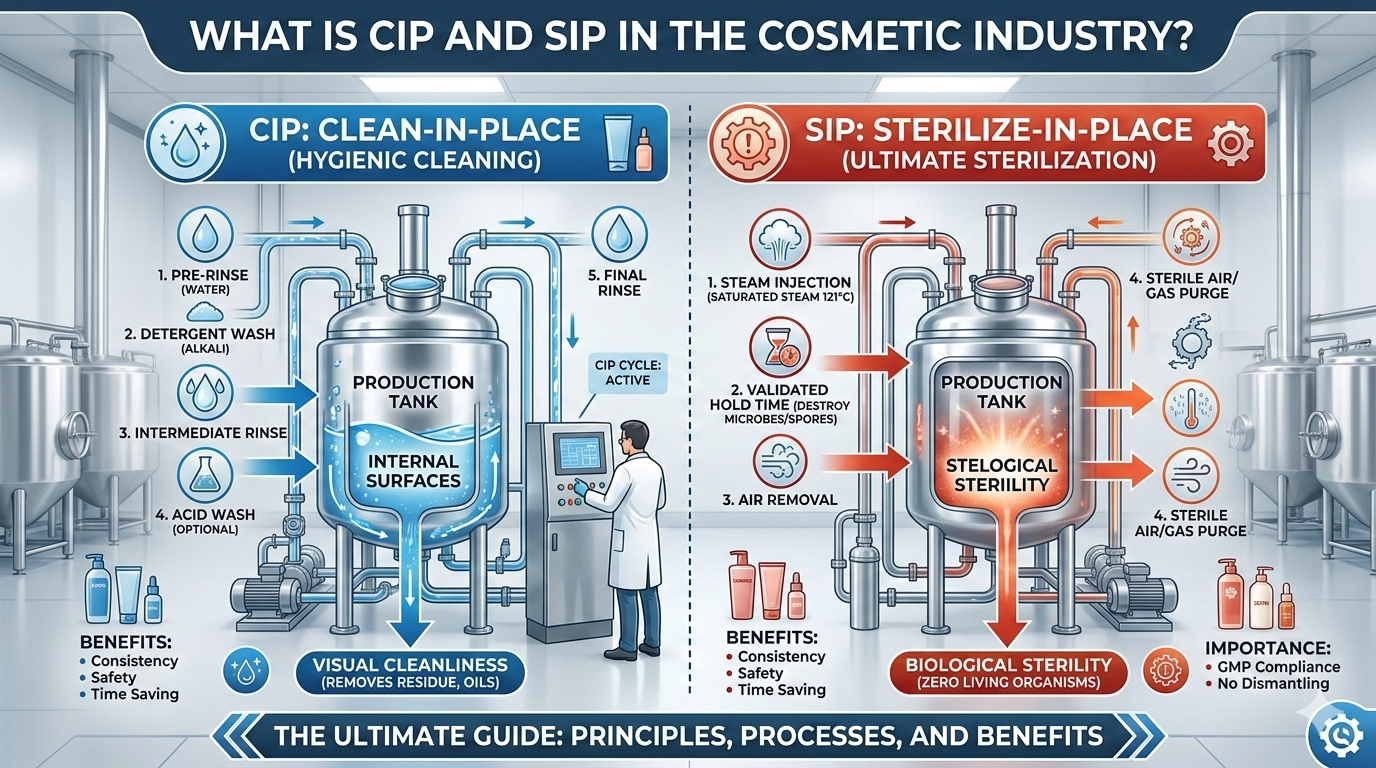
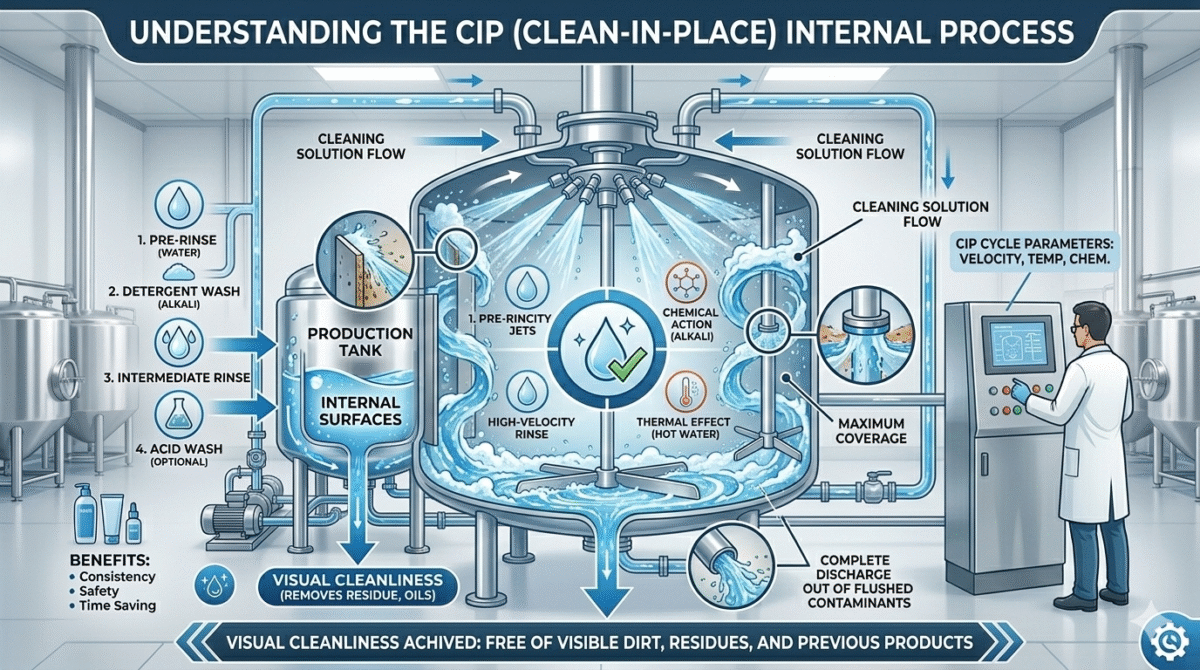
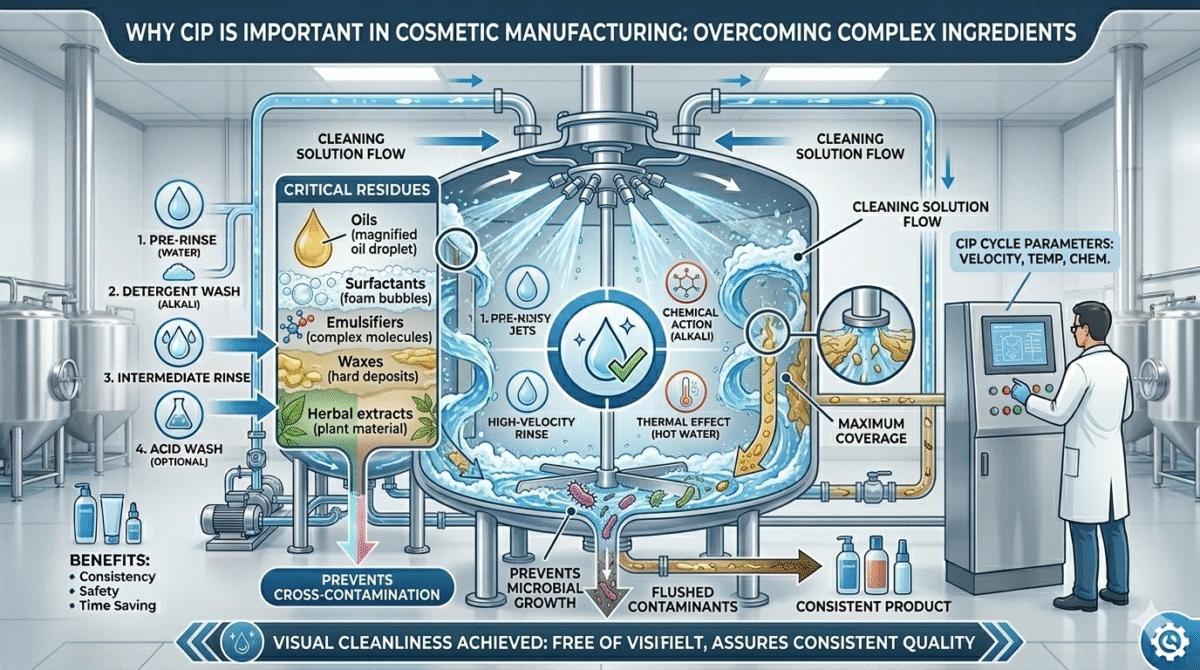
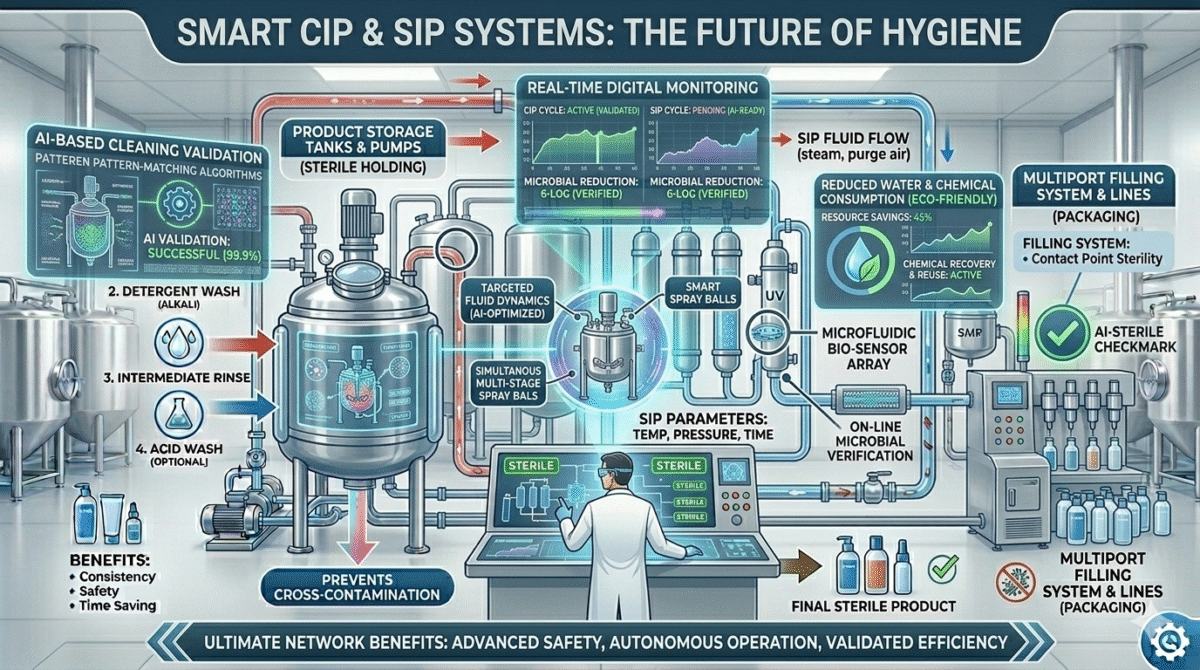
3. CIP (Clean-In-Place):

Cip

For large tanks and pipelines.

Cleaning happens automatically by circulating cleaning and rinsing liquids inside without dismantling.

4. Manual Cleaning:

Used for small parts or tools.

Operators follow proper SOPs and use approved brushes and cleaning agents.

💧 5. What is Rinse Sampling?

Rinse sampling is a test done after cleaning to confirm that equipment is clean.

How It Works

Collect the final rinse water from the cleaned equipment.

The sample is tested for:

pH

Conductivity

Microbial count

Residual detergent traces


If all values are within acceptable limits, the equipment is marked as CLEAN and READY TO USE.

🧫 6. What is Swab Sampling?

Sometimes, instead of rinse water, we test the surface directly using a swab.

Swab Sampling Process

1. Take a sterile swab (cotton or polyester).


2. Moisten it with purified water or solvent.


3. Wipe a fixed area (like 25 cm²) of the equipment surface.


4. Put the swab into a sterile tube and send it for testing.


Purpose

To find out if any residue, detergent, or microorganisms are still on the surface.

It gives direct proof that cleaning was effective.


🧰 7. Why Cleaning is Important in GMP

Under GMP (Good Manufacturing Practices), cleaning is a must because it:

Prevents contamination between different batches.

Protects product quality and safety.

Reduces risk of product recall or rejection.

Fulfills regulatory requirements (like ISO 22716, FDA, BIS).

Keeps the environment safe for workers.


Simply put — cleaning is the backbone of quality in cosmetics manufacturing.

🌿 8. What is Sanitization?

Sanitization is the process of killing or reducing microorganisms on equipment, surfaces, and rooms to safe levels.
It is done after cleaning — because cleaning removes dirt, but sanitization kills the germs that might still remain.

🧴 9. Sanitization Process Step-by-Step

Step 1: Choose Sanitizing Agent

Use only approved sanitizers, such as:

70% Isopropyl Alcohol (IPA)

Hydrogen Peroxide (3–6%)

Sodium Hypochlorite (bleach)

Quaternary Ammonium Compounds (QAC)

Peracetic Acid


Step 2: Prepare Solution

Prepare the sanitizer as per required concentration.

Label the container with date, strength, and expiry.


Step 3: Apply Sanitizer

Spray the solution on all surfaces, equipment, and areas.

You can also use mops, wipes, or fogging machines.


Step 4: Contact Time

Leave it for 10–15 minutes to allow full germ-kill effect.

Do not wipe it off immediately.


Step 5: Drying

Let the surface air dry.

Avoid touching it until dry.

📅 10. How Often to Sanitize?

Production Areas: Daily or after every shift

Filling Room: Before and after every batch

Storage Room: Weekly or as per SOP

Clean Room: As per schedule (daily or alternate day)

🌼 11. Benefits of Sanitization

Kills harmful microorganisms

Prevents contamination in products

Extends product shelf life

Helps meet GMP and ISO 22716 standards

Reduces batch rejection or recall chances

Keeps production environment hygienic and safe

📋 12. Cleaning & Sanitization Records

Every cleaning and sanitization activity must be properly documented.
Documentation helps in traceability and regulatory inspections.

Important Records

Cleaning Logbooks

Equipment Cleaning Records

Sanitization Schedule

Swab and Rinse Test Reports

Cleaning Validation Reports

Operator Training Records


Proper documentation = proof of compliance.

🧠 13. Summary

Process Purpose Frequency Validation

A-Type Cleaning Deep cleaning during product change After each product/batch Yes
B-Type Cleaning Daily maintenance cleaning Daily or shift-end Yes
Rinse Sampling Test of final rinse water After cleaning Yes
Swab Sampling Direct surface test After cleaning Yes
Sanitization Kill microorganisms Daily or weekly Yes

🌟 14. Conclusion

Cleaning and sanitization are not just regular tasks — they are the heart of quality control in the cosmetics industry.
Without proper cleaning, even the best ingredients can turn unsafe.
A disciplined cleaning and sanitization program ensures every product that reaches the customer is pure, safe, and trustworthy.

Kapiva Himalayan Shilajit – A Natural Power Booster for Mind & Body | Complete Guide

“Kapiva Himalayan Shilajit jar with shilajit resin and stones displayed on a beige background”


🪷 Introduction – What is Kapiva Himalayan Shilajit? | कपीवा हिमालयन शिलाजीत क्या है?

Nature has hidden many treasures in the lap of the Himalayas — one of the most powerful among them is Shilajit (शिलाजीत).
Kapiva Himalayan Shilajit is a pure Ayurvedic supplement extracted from the high Himalayan rocks, rich in Fulvic Acid, minerals, and antioxidants.

In simple words, it’s a natural resin that seeps out from mountain rocks during summers. Over thousands of years, plants and minerals decompose and form this potent blackish-brown substance — known for its rejuvenating power.

👉 Ayurveda kehta hai — “Shilajit is the destroyer of weakness” (शिलाजीत दुर्बलता का नाशक है).

Kapiva ensures purity and safety — it’s GMP-certified, FSSAI-approved, and free from heavy metals.

How to Use Kapiva Shilajit | इसे कैसे इस्तेमाल करें

Using Shilajit is very simple, but correct dosage matters.

✅ Dosage & Method

Take a pea-sized (मटर जितना) quantity of Shilajit resin or powder.

Mix it in warm milk or lukewarm water.

Stir well until it dissolves completely.

Drink it once daily, preferably in the morning on an empty stomach or before bedtime.

⚠️ Precautions

Don’t consume in large quantities.

Avoid during fever, severe cold, or if you are under medical treatment.

Always store it in a cool, dry place.

🌿 Why Use Kapiva Himalayan Shilajit | क्यों लें कपीवा शिलाजीत?

In today’s busy lifestyle, most people feel fatigue, low energy, stress, and poor focus. Shilajit works as a complete tonic for your body, mind, and stamina.

It balances the three Ayurvedic doshas — Vata, Pitta, and Kapha, and restores the body’s natural energy levels.

Here’s why Kapiva Shilajit is better than ordinary brands:

  1. 100% Pure Himalayan Source – Extracted from high altitudes for maximum mineral content.
  2. Heavy Metal Tested & Purified – Completely safe for long-term use.
  3. Rich in Fulvic Acid – Boosts cell function and nutrient absorption.
  4. Trusted Ayurvedic Brand – Kapiva follows ancient formulations backed by modern lab testing.

Top 7 Benefits of Kapiva Himalayan Shilajit | कपीवा शिलाजीत के मुख्य 7 फायदे

Let’s explore the powerful benefits that make Kapiva Himalayan Shilajit a super supplement.


🧠 1. Boosts Brain Power & Memory | दिमाग को तेज़ बनाए

Shilajit contains antioxidants that enhance brain function and improve focus and memory.
It promotes better oxygen supply to brain cells and helps in reducing mental fatigue.
Perfect for students, professionals, or anyone needing sharper concentration.


💥 2. Enhances Stamina and Strength | ताकत और स्टैमिना बढ़ाए

This is one of the most popular benefits — it naturally enhances male vigor and stamina.
Shilajit improves testosterone levels, boosts endurance, and reduces tiredness — perfect for those who feel drained or low on energy.

(Note: Always use under recommended dose.)


😌 3. Reduces Stress and Anxiety | तनाव और चिंता कम करे

Life is hectic — but Shilajit helps your body adapt to stress.
Its magnesium and potassium content relaxes muscles and nerves, while dopamine secretion improves your mood.
Regular use can make you feel calm and focused.


🔋 4. Acts as a Natural Energizer | एनर्जी बूस्टर

Feeling tired even after rest?
Shilajit works at the cellular level, providing energy to mitochondria — the powerhouses of your cells.
This helps in reducing fatigue and improving overall vitality.

Daily consumption = more energy, better focus, and higher productivity.


🧴 5. Anti-Aging & Skin Benefits | झुर्रियां घटाए और त्वचा निखारे

Fulvic acid in Shilajit is a powerful antioxidant that helps repair cell damage and delay aging signs.
It promotes skin elasticity, reduces wrinkles, and gives a youthful glow.
It’s an internal skincare tonic you don’t want to miss.


❤️ 6. Improves Heart and Immunity | दिल और इम्युनिटी के लिए लाभकारी

Shilajit strengthens your heart and boosts your immune response.
It helps regulate cholesterol and blood pressure levels, supporting long-term heart health.

Its anti-inflammatory and detoxifying nature keeps your immune system active and ready to fight infections.


🌈 7. Promotes Holistic Wellness | सम्पूर्ण स्वास्थ्य के लिए अमृत समान

Shilajit is more than just an energy supplement — it’s a complete Ayurvedic rejuvenator.
It supports:

Better sleep

Hormonal balance

Faster muscle recovery

Enhanced focus

Stronger bones and joints

In short, it helps your mind, body, and spirit stay in harmony.

⚗️ Key Ingredients in Kapiva Himalayan Shilajit | मुख्य घटक

  1. Pure Himalayan Shilajit Extract (Fulvic Acid rich) – Restores energy & detoxifies body.
  2. Mineral Complex (Iron, Zinc, Copper, Magnesium) – Strengthens muscles and bones.
  3. Antioxidants & Trace Elements – Protect cells from oxidative stress.

Each batch is triple purified, lab-tested, and prepared under GMP-certified facilities.


⭐ Customer Reviews | उपयोगकर्ता की राय

💬 “After using Kapiva Shilajit for 3 weeks, I feel more energetic and focused at work. My stress levels have gone down too!” – Ramesh S., Delhi


> 💬 “Excellent purity and packaging. Dissolves easily in warm milk. Highly recommend!” – Akshay P., Mumbai


> 💬 “This product really works! I feel a visible improvement in stamina and sleep quality.” – Rahul V., Jaipur


Average Rating: ⭐⭐⭐⭐⭐ (4.8/5)
Thousands of users trust Kapiva for natural vitality and long-term wellness.

❓ Frequently Asked Questions (FAQs)

Q1. Can women use Kapiva Shilajit?
👉 Yes, absolutely. It’s safe for both men and women. It helps boost energy, skin health, and hormonal balance.

Q2. How long should I use it?
👉 You can take it regularly for 2–3 months for noticeable results. Ayurveda takes time to heal from within.

Q3. Can I take it with other supplements?
👉 Yes, but keep a 1-hour gap between Shilajit and any other medicine or supplement.

Q4. Is Kapiva Shilajit safe for daily use?
👉 100% safe when taken in the recommended dose. It’s purified and heavy metal-free.

Q5. How can I test its purity at home?
👉 Pure Shilajit dissolves completely in warm water, leaving no residue, and turns water brownish-gold. It doesn’t dissolve in alcohol.

🧘‍♂️ Conclusion | निष्कर्ष

Kapiva Himalayan Shilajit is not just a supplement — it’s an Ayurvedic powerhouse for inner strength, stamina, and peace of mind.

By adding it to your daily routine, you can:

Boost energy naturally

Improve focus and confidence

Slow down aging

Enhance your overall vitality


🌿 Ayurveda takes time — but results are permanent.
Start your wellness journey today with Kapiva Himalayan Shilajit, and feel the transformation from within.

How to Use pH Meter

♦Cosmetic ya chemical formulation banate waqt pH ki accuracy bahut matter karti hai. pH meter ek aisa device hai jo kisi bhi liquid formulation ka acidity ya alkalinity measure karta hai. Cosmetic industry mein face wash, shampoo, lotion, toner, serum – sabka ideal pH maintain karna zaroori hota hai, warna product skin-friendly nahi banega.

Iss blog mein hum step-by-step jaanenge pH meter kaise use karte hain, kaunse precautions lene chahiye aur iske maintenance tips kya hain. Chaliye start karte hain! 💡

pH Meter Kya Hota Hai?

pH meter ek electronic device hai jo kisi bhi solution ka hydrogen ion concentration measure karta hai. Iska result 0 se 14 ke scale par dikhayi deta hai:

0-6.9: Acidic

7: Neutral

7.1-14: Alkaline

Iska use cosmetic manufacturing, laboratory testing, agriculture, water testing, aur pharmaceutical industries mein hota hai.

https://cosmeticgyaan.com/quality-assurance-in-pharmaceutical-industry/

pH Meter ke Main Parts:

1. Digital Display – jahan reading dikhti hai

2. Electrode (Glass Electrode) – jo solution ke contact mein aata hai

3. Temperature Sensor (optional) – kuch models mein hota hai

4. Calibration Knobs/Auto Button – calibration ke liye

5. Buffer Solution Bottles – 4.01, 7.00, 10.01 (standard values)


🔧 pH Meter Use Karne Ka Step-by-Step Process:

✅ Step 1: Device ka Inspection

Sabse pehle pH meter ke probe ko check karo – cracks, dust ya dry electrode to nahi hai.

Agar electrode dry hai to usse electrode storage solution mein 10-15 mins ke liye dip karo.

Step 2: pH Meter Calibration

Accurate result ke liye har use se pehle calibration karna zaroori hai.

🧼 Best face wash for oily skin in 2025

Calibration ke steps:

1. 3 alag-alag buffer solution (4.01, 7.00, 10.01) ready karo.

2. Electrode ko pehle pH 7.00 buffer mein dip karo, reading stable hone do, phir “Cal” button dabao.

3. Uske baad same process repeat karo with pH 4.01 and then pH 10.01.


Tip: 2-point ya 3-point calibration se jyada accurate result milta hai.

Step 3: Sample Preparation

Jis solution ka pH check karna hai, usse ek clean beaker mein lo.

Agar cosmetic product viscous hai (jaise cream ya lotion), use thoda distilled water se dilute karo.

Step 4: Electrode Ko Solution Mein Dip Karna

Electrode ko sample mein lightly swirl karo. Zyada force use mat karo.

Air bubbles na bane is baat ka dhyan rakho.

Step 5: Reading Ko Note Karna

Display par jab reading stable ho jaaye, tab value note karo.

Reading automatically ya manually lock ho sakti hai depending on model.

⚠️ Precautions While Using pH Meter:

1. Electrode ko kabhi bhi dry mat hone do.

2. Har measurement ke baad use distilled water se rinse karo.

3. Buffer solutions ko reuse mat karo.

4. Calibration har din ya har test ke pehle karo.

5. pH meter ko hamesha clean aur dry place mein rakho.

Cleaning & Maintenance Tips:

Weekly basis par electrode ko cleaning solution mein soak karo.

Agar probe par deposit ho gaya ho to soft brush se gently clean karo.

Long-term use ke liye storage solution mein hi rakho, kabhi dry na hone do.

🏭 Cosmetic Industry mein pH Meter ka Use:

Product Type Ideal pH Range

Face Wash 4.5 – 6.5
Shampoo 4.0 – 6.0
Toner 3.5 – 5.5
Moisturizer 5.0 – 7.0
Serum 4.0 – 6.0

Agar product ka pH ideal se bahar ho, to:

Citric acid se pH low karo

TEA (Triethanolamine) ya Sodium Hydroxide se pH high karo.

🧠 Final Thoughts – Expert Advice

pH meter ka proper use na sirf accurate formulation banane mein help karta hai, balki product safety ko bhi ensure karta hai. Agar aap cosmetic ya chemical manufacturing se jude ho, to pH meter ki calibration aur handling seekhna must hai.


Why pH Balance Matters in Cosmetic Products

In the cosmetic industry, product effectiveness and consumer safety are paramount. One critical factor that influences both is the pH balance of the cosmetic formulation. Whether it’s a face wash, shampoo, lotion, or serum, maintaining an ideal pH ensures product performance while safeguarding skin and hair health.

pH balance

What is pH Balance?

pH (Potential of Hydrogen) is a scale that measures the acidity or alkalinity of a substance, ranging from 0 (highly acidic) to 14 (highly alkaline). A pH of 7 is considered neutral. Human skin typically has a natural pH around 4.5 to 5.5, which is slightly acidic. This acidic environment forms a protective barrier called the acid mantle, guarding against bacteria, pollutants, and moisture loss.

How pH Affects Skin and Hair

Skin:

Products with a pH too high or too low can disrupt the skin’s acid mantle.

This can lead to dryness, irritation, acne, or increased sensitivity.

Hair:

Hair’s natural pH is similar to skin.

A balanced pH in shampoos and conditioners ensures the hair cuticle remains sealed, reducing frizz and breakage.

Ideal pH Range for Common Cosmetic Products

Product Type Ideal pH Range

Face Wash 4.5 – 6.0
Shampoo 4.5 – 5.5
Conditioner 4.0 – 5.0
Moisturizer 5.0 – 7.0
Toner 4.0 – 5.5
Serum 4.0 – 6.0

pH of Face Wash, Shampoo, Creams, Serums

Face Wash: Should cleanse without stripping the skin’s natural oils. A pH close to 5.5 is ideal.

Shampoo: Maintains scalp health and prevents hair damage when formulated around 5.0.

Creams & Moisturizers: Designed to hydrate while respecting the skin’s natural pH.

Serums: Active ingredients perform better in slightly acidic environments.

https://cosmeticgyaan.com

How Manufacturers Control pH in Formulation

1. Buffer Systems: Ingredients like citric acid or sodium hydroxide are added to maintain stability.

2. pH Adjusters: Adjust pH during manufacturing to meet safety and efficacy standards.

3. Testing Protocols: Every batch undergoes pH testing before release.

Benefits of Maintaining Correct pH

Protects the skin barrier.

Prevents irritation and allergic reactions.

Enhances product efficacy.

Improves customer satisfaction and brand trust.

Complies with cosmetic regulatory standards.

Risks of Using Wrong pH Products

Skin dryness, sensitivity, and breakouts.

Scalp irritation and hair damage.

Loss of product effectiveness.

Possible long-term skin barrier damage.

Conclusion

For cosmetic manufacturers and formulators, understanding and controlling the pH balance of products is non-negotiable. It ensures that consumers enjoy the benefits of the product without compromising their skin or hair health. A well-balanced product not only performs better but also builds a loyal customer base, strengthening the brand’s market reputation.

🙋‍♂️ FAQs – pH Balance in Cosmetic Products

Q1. pH-balanced product kya hota hai?
Ans: pH-balanced product wo cosmetic product hota hai jiska pH human skin ke natural pH (4.5–5.5) ke kareeb ho. Yeh skin ke acid mantle ko disturb nahi karta.

Q2. Agar product ka pH high ho to kya problem ho sakti hai?
Ans: High pH wale products skin ko dry, irritated aur sensitive bana dete hain. Skin infections aur breakouts ka risk bhi badh jata hai.

Q3. Hair care products ka pH kyun important hai?
Ans: Hair products ka ideal pH 4.5–5.5 hona chahiye taaki cuticle sealed rahe, frizz kam ho aur hair damage na ho.

Q4. Cosmetic product ka pH kaise measure karte hain?
Ans: Lab me pH meter ya pH indicator strips ka use karke final formulation ka pH measure kiya jata hai.

Q5. kya natural ya herbal products ka bhi pH check karna jaruri hai?
Ans: Haan, natural ingredients ka bhi pH ho sakta hai acidic ya alkaline. Isliye har product, chahe herbal ho ya synthetic, uska pH check karna zaroori hai.

Q6. kya pH-balanced product sabhi skin types ke liye safe hote hain?
Ans: Haan, pH-balanced products mostly all skin types ke liye safe hote hain, especially sensitive or acne-prone skin ke liye.

Q7. kya low pH wala product skin ko harm kar sakta hai?
Ans: Haan, bahut low pH (acidic) wale products skin ko jala sakte hain, redness aur irritation create kar sakte hain.


Cosmetic Products Kya Hote Hai?

“Cosmetic Products kya hote hai? Inke types, uses aur importance janiye is blog me. Complete guide for skincare, haircare aur personal hygiene

Cosmetic Products Kya Hote Hai? Aur Kyu Zaruri Hai?

Introduction

Cosmetics ka matlab sirf makeup nahi hota. Aaj ke zamane me cosmetics ka scope bahut bada ho chuka hai. Har vyakti directly ya indirectly cosmetics ka use karta hai — chahe wo skincare ho, haircare ho ya personal hygiene products.

Is blog me hum detail me samjhenge:

Cosmetics kya hote hai

Types of cosmetic products

Inke uses aur benefits

Kyu use karne chahiye

Market me popular cosmetic products

Cosmetics Kya Hote Hai?

Cosmetics aise products hote hai jo human body ke external parts par apply kiye jate hai for cleaning, beautifying, enhancing appearance aur body odor improve karne ke liye.

Cosmetics Ki Official Definition (According to BIS):

“Cosmetics are products intended to be applied on human body for cleansing, beautifying, promoting attractiveness or altering appearance without affecting body’s structure or functions.”

Cosmetic Products Ke Types

1️⃣ Skincare Products

Skincare products ka use skin ki health aur appearance maintain karne ke liye hota hai.
Examples:

Face wash

Moisturizers

Face creams

Serums

Sunscreen

Face masks

Uses & Benefits:

Skin hydration

Acne prevention

Anti-aging benefits

Sun protection


2️⃣ Haircare Products (H3 Heading)

Baalo ki safai, conditioning aur styling ke liye haircare cosmetics ka use hota hai.
Examples:

Shampoo

Conditioner

Hair serum

Hair oil

Hair masks

Uses & Benefits:

Hair nourishment

Damage repair

Scalp care

Hair shine & softness


3️⃣ Makeup Products (H3 Heading)

Face ko beautify aur enhance karne ke liye makeup ka use hota hai.
Examples:

Foundation

Compact powder

Lipstick

Eyeliner

Kajal

Blush

Uses & Benefits:

Enhance facial features

Boost confidence

Artistic expression


4️⃣ Personal Hygiene Products (H3 Heading)

Yeh products daily routine me use hote hai personal cleanliness aur hygiene maintain karne ke liye.
Examples:

Deodorants

Soaps

Body wash

Hand sanitizers

Feminine hygiene products

Uses & Benefits:

Maintain body odor

Protect from infections

Keep body fresh & clean


5️⃣ Fragrance Products (H3 Heading)

Body aur environment me pleasant smell create karne ke liye fragrances ka use hota hai.
Examples:

Perfumes

Body mists

Room fresheners

Uses & Benefits:

Mood enhancement

Personality impact

Freshness.

Cosmetics Kyu Zaruri Hai?

✅ Skin & Hair Protection

Cosmetics help karte hai environmental damage se bachane me — jaise UV rays, pollution aur dirt.

✅ Personal Confidence Boost

Achhi appearance confidence ko badhawa deti hai, jo har field me important hai.

✅ Health & Hygiene Maintenance

Personal care aur hygiene products directly health aur well-being ko impact karte hai.

✅ Social & Professional Impact

Good grooming aur neat appearance aapki social aur professional life me positive impression dalte hai.

Market Me Popular Cosmetic Products 

Garnier Face Wash — Skin cleansing ke liye

L’Oréal Hair Serum — Hair smoothening ke liye

Maybelline Lipstick — Makeup enhancement ke liye

Nivea Deodorant — Personal hygiene ke liye

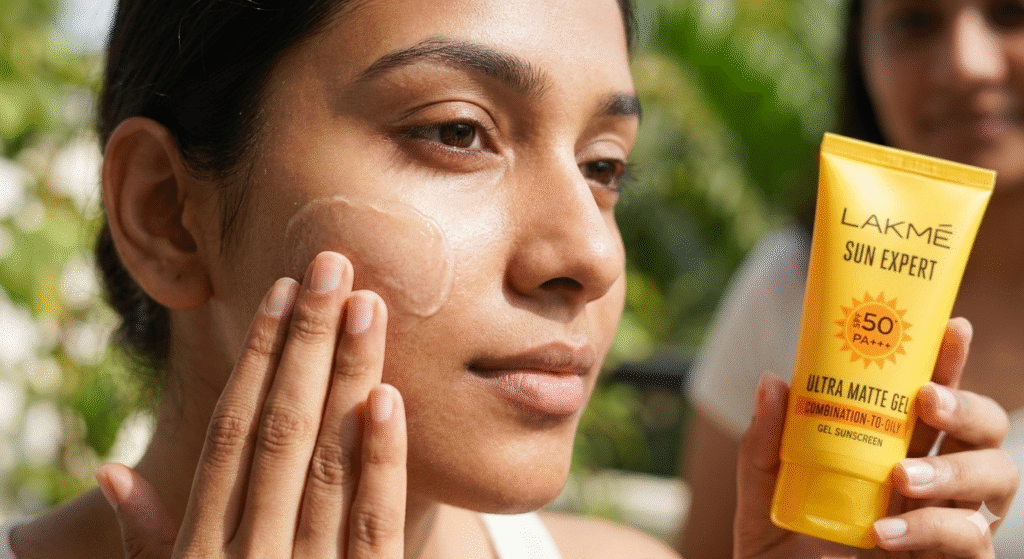
Lakme Sunscreen — UV protection ke liye


Final Words-

Cosmetics sirf beauty badhane ka medium nahi hai, balki ek daily necessity hai modern lifestyle ka. Cosmetics ka proper use aapke personal aur professional life ko positively impact karta hai.

Aap bhi apni skincare aur personal care routine me suitable cosmetics ka use karke apna confidence boost kare aur hygiene maintain kare.

FAQs

Q. Kya cosmetics harmful hote hai?

Agar certified aur skin type ke hisaab se use kare to nahi.

Q. Kya daily cosmetics ka use karna safe hai?

Haan, lekin product quality aur skin suitability ka dhyan rakhna chahiye.

Q. Kya men bhi cosmetics ka use kar sakte hai?

Bilkul, cosmetics gender-neutral products hote hai.


How to Read MSDS in Cosmetics

MSDS (Material Safety Data Sheet) ek essential document hai cosmetic manufacturing aur formulation industry ke liye. Ye document product ke raw materials ke safety, handling, aur usage guidelines ko define karta hai.

📌 What is MSDS?

Material Safety Data Sheet (MSDS) ek technical document hota hai jo kisi bhi chemical substance ya cosmetic raw material ke following details provide karta hai:

Chemical Composition

Hazard Identification

Safe Handling Instructions

First Aid Measures

Storage Guidelines

Disposal Methods

Regulatory Information.

https://cosmeticgyaan.com/quality-assurance-in-pharmaceutical-industry/

📌 Why MSDS is Important in Cosmetics Industry?

✅ Ensures Workplace Safety

✅ Complies with Legal Requirements (like OSHA, GHS)

✅ Helps in Proper Storage & Handling of Raw Materials

✅ Important for Emergency Response

✅ Essential for Quality Assurance & Documentation

📌 How to Read MSDS in Cosmetics — Step by Step Breakdown

Section What It Tells You Why It’s Important

1. Identification of the Substance Product Name, Manufacturer Details To know exactly which material you’re using
2. Hazards Identification Potential Risks To prevent accidents & health risks
3. Composition/Information on Ingredients Ingredients & Concentrations For formulation compliance
4. First-Aid Measures How to act in case of exposure For safety during mishandling
5. Fire-Fighting Measures How to extinguish fire caused by the chemical For risk management
6. Accidental Release Measures Spill handling instructions For factory safety
7. Handling & Storage Safe storage conditions To avoid spoilage & hazard
8. Exposure Controls/Personal Protection PPE required For worker safety
9. Physical & Chemical Properties Boiling point, pH, Appearance For formulation design
10. Stability & Reactivity Chemical stability & incompatibilities For safe production process
11. Toxicological Information Health effects For risk assessment
12-16. Ecological, Disposal, Transport, Regulatory Info Environmental impact & compliance For eco-friendly production & legal compliance.

https://cosmeticgyaan.com/cosmetic-products-types-uses-importance/

📌 Key Points to Focus on While Reading MSDS

Hazard Statements — Like Flammable, Irritant

PPE Requirements — Gloves, Masks, Eye Protection

Handling Instructions — Temperature, Ventilation

Storage Conditions — Humidity, Sunlight Exposure

Toxicological Info — Inhalation, Skin Contact, Eye Contact

📌 MSDS Example for Cosmetic Ingredient (Simplified)

Section Example

Product Name Glycerine USP
Hazard Non-hazardous under normal conditions
First Aid Wash with water if eye contact
Storage Cool, Dry Place
PPE Gloves recommended

📌 Common Mistakes to Avoid While Reading MSDS

❌ Ignoring the Hazard Identification Section
❌ Overlooking Storage Conditions
❌ Not Following PPE Guidelines

✅ Conclusion — MSDS Reading is a Must for Cosmetic Professionals

MSDS sirf ek paper nahi hai, ye ek safety guideline hai jo cosmetic manufacturers, formulators, aur QA teams ke liye daily practice ka part hona chahiye.

RO Water in Cosmetics and Pharma 2025

RO Water

“Why RO Water May Be Harming the Cosmetics and Pharma Sectors in 2025”

2025 Aaj ke competitive industrial environment mein, RO Water (Reverse Osmosis Water) ka role cosmetic aur pharmaceutical industry mein backbone ki tarah hai. Purity aur quality control ke strict norms ke wajah se RO water na sirf ek necessity hai balki ek industry standard ban chuka hai.

Introduction

2025 Aaj ke competitive industrial environment mein, RO Water (Reverse Osmosis Water) ka role cosmetic aur pharmaceutical industry mein backbone ki tarah hai. Purity aur quality control ke strict norms ke wajah se RO water na sirf ek necessity hai balki ek industry standard ban chuka hai.

Chaliye, step by step samajhte hain — RO water kya hota hai, kaise banta hai, kis kaam aata hai, aur uske kya kya benefits hain.

What is RO Water?

RO Water (Reverse Osmosis Water) ek ultra-purified water hai jo reverse osmosis process se banaya jata hai.
Is process mein water ko ek semi-permeable membrane se pass karaya jata hai jo impurities, dissolved salts, heavy metals, microorganisms aur pyrogens ko remove karta hai.

Cosmetic aur pharmaceutical applications mein, RO water ka matlab hota hai —
“Ultra-Pure Water which meets industry-grade specifications”

https://cosmeticgyaan.com/

RO Water

RO Water Kaise Banta Hai? — The Process of Reverse Osmosis

1️⃣ Pre-Filtration Stage

Sand Filter se large particles jaise dust, mud, aur debris hata diya jata hai.

Carbon Filter se chlorine aur organic impurities remove ki jati hai.

2️⃣ Softening

Water Softener se hardness remove hoti hai (Calcium aur Magnesium ions).

3️⃣ RO Membrane Process

High-pressure pump ke through water ko RO Membrane se pass kiya jata hai.

RO Membrane 95-99% salts, heavy metals, microorganisms aur bacteria hata deti hai.

4️⃣ Post Filtration (Optional)

UV Sterilization ya EDI (Electrodeionization) for pharmaceutical-grade water.

https://cosmeticgyaan.com/

Why is RO Water Used in Cosmetics Industry?

Cosmetic industry mein water base products jaise —

Lotions

Creams

Shampoos

Facewash

Hair Serum

Cleansers

In sab mein RO Water use hota hai because:
✅ Impurity Free Base — No risk of contamination
✅ Prevents Microbial Growth — Stability enhance hoti hai
✅ Better Product Consistency — Smooth texture aur uniformity maintain hoti hai
✅ Safe for Sensitive Skin — No allergic reactions

https://cosmeticgyaan.com/

Why is RO Water Used in Pharmaceutical Industry?

Pharma mein water ka role hota hai —

Drug Formulations

Injection Preparation

Syrup Manufacturing

Cleaning of Equipment

RO Water pharma ke liye essential hai because:
✅ Pyrogen Free Water
✅ Compliance with USP Standards
✅ No Heavy Metal Contamination
✅ Better Solubility of Drugs

Key Applications of RO Water in Cosmetics & Pharma

https://cosmeticgyaan.com/%f0%9f%8c%9f-top-10-hair-serums-in-india-2025/

Cosmetics Pharmaceuticals

Cream & Lotion Manufacturing Injectable Drug Preparation
Shampoo & Hair Care Products Tablet Coating & Formulation
Face Wash & Cleanser Cleaning of Equipment & Vessels
Makeup Products Syrups, Suspensions & Solutions
Skin Toners & Mist Hand Sanitizers & Topical Solutions

Benefits of Using RO Water in Industry

✅ Maintains Product Quality

High-quality purified water ensures better product stability and shelf life.

✅ Prevents Product Contamination

RO removes bacteria, viruses, fungi, ensuring microbiological safety.

✅ Meets Regulatory Compliance

Fulfills standards like GMP, USP, WHO Guidelines.

✅ Cost-Effective in the Long Run

Though setup cost is high, it reduces risk of recalls and product failures.

✅ Improves Consumer Safety

Using RO water prevents allergic reactions or skin irritations from impurities.

How RO Water Plant Setup Looks Like?

Pre-Filtration Unit

Softener Unit

High-Pressure Pump

RO Membrane Housing

UV Sterilizer or EDI Unit

Storage Tank with Recirculation System

👉 Production Capacity Range: 250 LPH – 10,000 LPH depending on plant size.

RO Water Testing Parameters in Cosmetic & Pharma Industries

Parameter Standard Limit

pH 6.0 – 7.5
Conductivity < 5 µS/cm
TDS (Total Dissolved Solids) < 10 ppm
Bacterial Count Nil
Endotoxin Level (Pharma) < 0.25 EU/ml

Regulatory Guidelines You Should Know

Cosmetics: As per BIS Standards (IS 4707)

Pharmaceutical: As per WHO-GMP, USP Standards

ISO 22716 (Cosmetic GMP) recommends RO Water for safe manufacturing.

Challenges & Maintenance of RO System

Regular Membrane Cleaning

Periodic Filter Replacement

Bacterial Control & Sanitization

Conductivity Monitoring

https://cosmeticgyaan.com/face-wash-for-acne/

Conclusion

RO Water isn’t just “filtered water” — it’s a strategic investment for cosmetic and pharmaceutical companies.
Purity, consistency, and regulatory compliance ke liye RO Water ka use mandatory hai.

Jo brands RO Water ka use karte hain, woh apne product quality aur customer trust dono mein edge banate hain.

Quick Summary for Industry Use

✅ RO Water = Impurity Free, Microbiologically Safe
✅ Essential for Cosmetics & Pharma Manufacturing
✅ Enhances Product Stability & Safety
✅ Critical for Compliance with Global Standards.

https://cosmeticgyaan.com/